Und dann auf "Zum Home-Bildschirm [+]".

Stöbern
genialokal zum Startbildschirm hinzufügen
Installieren Sie die genialokal App auf Ihrem Startbildschirm für einen schnellen Zugriff und eine komfortable Nutzung.
Installieren Sie die genialokal App auf Ihrem Startbildschirm für einen schnellen Zugriff und eine komfortable Nutzung.
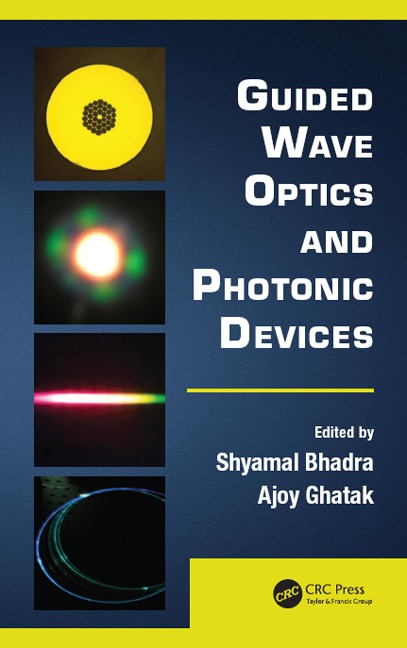
Guided Wave Optics and Photonic Devices introduces readers to a broad cross-section of topics in this area, from the basics of guided wave optics and nonlinear optics to biophotonics. The book is inspired by and expands on lectures delivered by distinguished speakers at a three-week school on guided wave optics and devices organized at the CSIR-Central Glass and Ceramic Research Institute in Kolkata in 2011. An Introduction to Guided Wave Optics and Photonic Devices: Principles, Applications, and Future Directions The book discusses the concept of modes in a guided medium from first principles, emphasizing the importance of dispersion properties in optical fibers. It describes fabrication and characterization techniques of rare-earth-doped optical fibers for amplifiers and lasers, with an eye to future applications. Avoiding complex mathematical formalism, it also presents the basic theory and operational principles of fiber amplifiers and lasers. The book examines techniques for writing fiber Bragg gratings, which are of particular interest for smart sensing applications. A chapter focuses on the fundamental principles of Fourier optics and its implementation in guided wave optics. In addition, the book explains the critical phenomena of soliton dynamics and supercontinuum generation in photonic crystal fiber, including its fabrication process and characteristics. It also looks at plasmonics in guided media and nonlinearity in stratified media-both key areas for future research. The last chapter explores the importance of lasers in biophotonic applications. Written by experts engaged in teaching, research, and development in optics and photonics, this reference brings together fundamentals and recent advances in one volume. It offers a valuable overview of the field for students and researchers alike and identifies directions for future research in guided wave and photonic device technology.
Shyamal Bhadra received his Ph.D. from Jadavpur University, Kolkata. After working at Carl Zeiss, Dr. Bhadra joined the CSIR-Central Glass and Ceramic Research Institute (CSIR-CGCRI), Kolkata, in 1984, where he is currently Chief Scientist. He leads a group working in advanced areas of fiber optics, photonics, and nonlinear optics. He has worked closely with industry to bring out products such as EDFA and super-continuum source generators. Dr. Bhadra has published more than sixty research papers and has five patents to his credit. Presently he is the honorary editor of the journal Transactions of the Indian Ceramic Society. He is the recipient of the Deokaran award in glass given by the Indian Ceramic Society. Dr Bhadra is also one of the recipients of the prestigious "Most Significant CSIR Technology of Five-Year Plan Period Award 2012" for commercialization of EDFA technology in India. Ajoy Ghatak obtained his Ph.D. from Cornell University. He recently retired from IIT Delhi as professor of physics. He received the 2008 SPIE Educator award in recognition of "his unparalleled global contributions to the field of fiber optics research, and his tireless dedication to optics education worldwide" and the 2003 OSA Esther Hoffman Beller award in recognition of his "outstanding contributions to optical science and engineering education." He is also a recipient of the CSIR SS Bhatnagar award, 16th Khwarizmi International award, the International Commission for Optics Galileo Galilei award, and the UGC Meghnad Saha Award for his contributions in fiber optics. He has authored several books, including Optics, Introduction to Fiber Optics and Optical Electronics, and Albert Einstein: A Glimpse of His Life, Philosophy and Science. He received a D.Sc. (Honoris Causa) from the University of Burdwan in 2007.
Concept of Modes in Optical Waveguides. Modes in Optical Fibres. Dispersion in Optical Fibres. Evolution of Specialty Optical Fibres. Materials and Fabrication Technology of Rare-Earth-Doped Optical Fibres. Optical Fibre Amplifiers. Erbium-Doped Fibre Lasers. Semiconductor Light Sources and Detectors. Silicon-Based Detectors and Sources for Optoelectronic Devices. Advances in Packet Optical Transport in Optical Networking and Broadband Transmission. Guided-Wave Fourier Optics. Fibre Bragg Gratings: Basic Theory. Photosensitivity, In-Fibre Grating Writing Techniques and Applications. Optical Solitons in Nonlinear Fibre Systems: Recent Development. Photonic Crystal Fibre: Basic Principles of Light Guidance, Fabrication Process and Applications. Nonlinear Optics and Physics of Supercontinuum Generation in Optical Fibre. Guided Wave Plasmonics. Stratified Media for Novel Optics, Perfect Transmission and Perfect Coherent Absorption. Nonlinear Optical Frequency Conversion Using Quasi-Phase Matching. Biophotonics: An Introduction. Index.
Dieses eBook wird im PDF-Format geliefert und ist mit einem Adobe Kopierschutz (DRM) versehen. Sie können dieses eBook mit allen Geräten lesen, die das PDF-Format und den Adobe Kopierschutz (DRM) unterstützen.
Zum Beispiel mit den folgenden Geräten:
• tolino Reader
Laden Sie das eBook direkt über den Reader-Shop auf dem tolino herunter oder übertragen Sie das eBook auf Ihren tolino mit einer kostenlosen Software wie beispielsweise Adobe Digital Editions.
• Sony Reader & andere eBook Reader
Laden Sie das eBook direkt über den Reader-Shop herunter oder übertragen Sie das eBook mit der kostenlosen Software Sony READER FOR PC/Mac oder Adobe Digital Editions auf ein Standard-Lesegeräte mit epub- und Adobe DRM-Unterstützung.
• Tablets & Smartphones
Möchten Sie dieses eBook auf Ihrem Smartphone oder Tablet lesen, finden Sie hier unsere kostenlose Lese-App für iPhone/iPad und Android Smartphone/Tablets.
• PC & Mac
Lesen Sie das eBook direkt nach dem Herunterladen mit einer kostenlosen Lesesoftware, beispielsweise Adobe Digital Editions, Sony READER FOR PC/Mac oder direkt über Ihre eBook-Bibliothek in Ihrem Konto unter „Meine eBooks“ - „online lesen“.
Schalten Sie das eBook mit Ihrer persönlichen Adobe ID auf bis zu sechs Geräten gleichzeitig frei.
Bitte beachten Sie, dass die Kindle-Geräte das Format nicht unterstützen und dieses eBook somit nicht auf Kindle-Geräten lesbar ist.