Und dann auf "Zum Home-Bildschirm [+]".

Stöbern
genialokal zum Startbildschirm hinzufügen
Installieren Sie die genialokal App auf Ihrem Startbildschirm für einen schnellen Zugriff und eine komfortable Nutzung.
Installieren Sie die genialokal App auf Ihrem Startbildschirm für einen schnellen Zugriff und eine komfortable Nutzung.
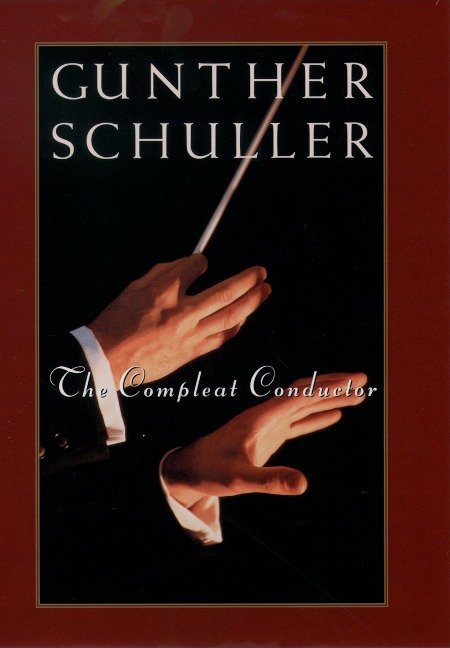
A world-renowned conductor and composer who has lead most of the major orchestras in North America and Europe, a talented musician who has played under the batons of such luminaries as Toscanini and Walter, and an esteemed arranger, scholar, author, and educator, Gunther Schuller is without doubt a major figure in the music world. Now, in The Compleat Conductor, Schuller has penned a highly provocative critique of modern conducting, one that is certain to stir controversy. Indeed, in these pages he castigates many of this century's most venerated conductors for using the podium to indulge their own interpretive idiosyncrasies rather than devote themselves to reproducing the composer's stated and often painstakingly detailed intentions. Contrary to the average concert-goer's notion (all too often shared by the musicians as well) that conducting is an easily learned skill, Schuller argues here that conducting is "the most demanding, musically all embracing, and complex" task in the field of music performance. Conducting demands profound musical sense, agonizing hours of study, and unbending integrity. Most important, a conductor's overriding concern must be to present a composer's work faithfully and accurately, scrupulously following the score including especially dynamics and tempo markings with utmost respect and care. Alas, Schuller finds, rare is the conductor who faithfully adheres to a composer's wishes. To document this, Schuller painstakingly compares hundreds of performances and recordings with the original scores of eight major compositions: Beethoven's fifth and seventh symphonies, Schumann's second (last movement only), Brahms's first and fourth, Tchaikovsky's sixth, Strauss's "Till Eulenspiegel" and Ravel's "Daphnis et Chloe, Second Suite." Illustrating his points with numerous musical examples, Schuller reveals exactly where conductors have done well and where they have mangled the composer's work. As he does so, he also illuminates the interpretive styles of many of our most celebrated conductors, offering pithy observations that range from blistering criticism of Leonard Bernstein ("one of the world's most histrionic and exhibitionist conductors") to effusive praise of Carlos Kleiber (who "is so unique, so remarkable, so outstanding that one can only describe him as a phenomenon"). Along the way, he debunks many of the music world's most enduring myths (such as the notion that most of Beethoven's metronome markings were "wrong" or "unplayable," or that Schumann was a poor orchestrator) and takes on the "cultish clan" of period instrument performers, observing that many of their claims are "totally spurious and chimeric." In his epilogue, Schuller sets forth clear guidelines for conductors that he believes will help steer them away from self indulgence towards the correct realization of great art. Courageous, eloquent, and brilliantly insightful, The Compleat Conductor throws down the gauntlet to conductors worldwide. It is a controversial book that the music world will be debating for many years to come.
About the Author: Gunther Schuller has written a wide range of orchestral and chamber music, as well as jazz compositions. As an educator, he was associated with the Berkshire Music Center at Tanglewood for twenty-two years, mostly as its artistic director, and he was president of the New England Conservatory of Music from 1967 to 1977. He is also the author of two landmark studies of the history of jazz, Early Jazz and The Swing Era. He was also a recipient of a MacArthur Foundation "genius" grant.
Dieses eBook wird im PDF-Format geliefert und ist mit einem Adobe Kopierschutz (DRM) versehen. Sie können dieses eBook mit allen Geräten lesen, die das PDF-Format und den Adobe Kopierschutz (DRM) unterstützen.
Zum Beispiel mit den folgenden Geräten:
• tolino Reader
Laden Sie das eBook direkt über den Reader-Shop auf dem tolino herunter oder übertragen Sie das eBook auf Ihren tolino mit einer kostenlosen Software wie beispielsweise Adobe Digital Editions.
• Sony Reader & andere eBook Reader
Laden Sie das eBook direkt über den Reader-Shop herunter oder übertragen Sie das eBook mit der kostenlosen Software Sony READER FOR PC/Mac oder Adobe Digital Editions auf ein Standard-Lesegeräte mit epub- und Adobe DRM-Unterstützung.
• Tablets & Smartphones
Möchten Sie dieses eBook auf Ihrem Smartphone oder Tablet lesen, finden Sie hier unsere kostenlose Lese-App für iPhone/iPad und Android Smartphone/Tablets.
• PC & Mac
Lesen Sie das eBook direkt nach dem Herunterladen mit einer kostenlosen Lesesoftware, beispielsweise Adobe Digital Editions, Sony READER FOR PC/Mac oder direkt über Ihre eBook-Bibliothek in Ihrem Konto unter „Meine eBooks“ - „online lesen“.
Schalten Sie das eBook mit Ihrer persönlichen Adobe ID auf bis zu sechs Geräten gleichzeitig frei.
Bitte beachten Sie, dass die Kindle-Geräte das Format nicht unterstützen und dieses eBook somit nicht auf Kindle-Geräten lesbar ist.