Und dann auf "Zum Home-Bildschirm [+]".

Stöbern
genialokal zum Startbildschirm hinzufügen
Installieren Sie die genialokal App auf Ihrem Startbildschirm für einen schnellen Zugriff und eine komfortable Nutzung.
Installieren Sie die genialokal App auf Ihrem Startbildschirm für einen schnellen Zugriff und eine komfortable Nutzung.
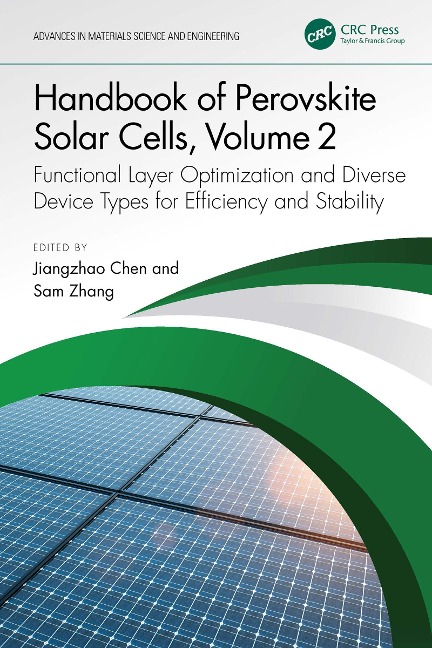
Perovskite solar cells (PSCs) have received significant attention in academia and industry due to their low cost and high-power conversion efficiency (PCE). Single- and multijunction PSCs have obtained promising certified PCEs, which suggests that PSCs are a very promising next-generation photovoltaic technology. In addition to the perovskite absorber layer, other functional layers, including electron transport layer (ETL), hole transport layer (HTL), and electrode layer (EL), have also made huge contributions to enhancing device performance. This book focuses on the development, advancement, and application of these functional layers in various PSCs. This volume: - Introduces ETL, HTL, and EL in efficient and stable PSCs. - Covers material properties. - Discusses a wide variety of PSCs including single-crystal PSCs, flexible PSCs, perovskite tandem solar cells, lead-free PSCs, inorganic PSCs, fully printable mesoscopic PSCs, electron/hole-transport-layer-free PSCs, semitransparent PSCs for building-integrated photovoltaics (BIPV), tandem solar cells, perovskite indoor photovoltaics, and inverted PSCs. - Details potential for commercial application. This book is aimed at researchers, advanced students, and industry professionals in materials, energy, and related areas of engineering who are interested in development and commercialization of photovoltaic technologies.
Jiangzhao Chen (---) is a professor in the Faculty of Materials Science and Engineering at Kunming University of Science and Technology. He received his B.S. and Ph.D. degrees in Applied Chemistry from Northeast Forestry University in July 2011 and in Optical Engineering from Huazhong University of Science and Technology in June 2016, respectively. From October 2016 to February 2019, he worked as a postdoctoral researcher at Sungkyunkwan University. From March 2019 to November 2019, he worked as a postdoctoral researcher at the University of Hong Kong. From December 2019 to December 2023, he worked as a professor in the School of Optoelectronic Engineering, Chongqing University. Professor Sam Zhang Shanyong (---), FRSC, FTFS, FIoMMM, academically known as Sam Zhang, was born and brought up in the famous "City of Mountains" Chongqing, China. He received his Bachelor of Engineering in Materials in 1982 from Northeastern University (Shenyang, China), Master of Engineering in Materials in 1984 from Iron & Steel Research Institute (Beijing, China) and Ph.D. degree in Ceramics in 1991 from The University of Wisconsin-Madison, USA. He was a tenured full professor (since 2006) at the School of Mechanical and Aerospace Engineering, Nanyang Technological University Singapore. Between 2018 and 2023, he was Professor at the School of Materials and Energy, Southwest University, China and and served as the founding director of the Centre for Advanced Thin Films and Devices. Since 2023, he is Professor at the School of Aeronautics, Harbin Institute of Technology, and is also affiliated with HIT Zhengzhou Research Institute.
1. The Electron Transport Layer in Perovskite Solar Cells, 2. Hole Transport Materials for Perovskite Solar Cells, 3. Electrode Materials for Perovskite Solar Cells, 4. Single-Crystal Perovskite Solar Cells, 5. Flexible Perovskite Solar Cells, 6. Perovskite Tandem Solar Cells, 7. Lead-Free Perovskites for Solar Cells and Beyond, 8. Inorganic Perovskite Solar Cells, 9. Fully Printable Mesoscopic Perovskite Solar Cells, 10. Electron/Hole Transport Layer Free Perovskite Solar Cells, 11. Semitransparent Perovskite Solar Cells for Building-Integrated Photovoltaics (BIPV) and Tandem Solar Cells, 12. Perovskite Indoor Photovoltaics, 13. Inverted Perovskite Solar Cells
Dieses eBook wird im PDF-Format geliefert und ist mit einem Adobe Kopierschutz (DRM) versehen. Sie können dieses eBook mit allen Geräten lesen, die das PDF-Format und den Adobe Kopierschutz (DRM) unterstützen.
Zum Beispiel mit den folgenden Geräten:
• tolino Reader
Laden Sie das eBook direkt über den Reader-Shop auf dem tolino herunter oder übertragen Sie das eBook auf Ihren tolino mit einer kostenlosen Software wie beispielsweise Adobe Digital Editions.
• Sony Reader & andere eBook Reader
Laden Sie das eBook direkt über den Reader-Shop herunter oder übertragen Sie das eBook mit der kostenlosen Software Sony READER FOR PC/Mac oder Adobe Digital Editions auf ein Standard-Lesegeräte mit epub- und Adobe DRM-Unterstützung.
• Tablets & Smartphones
Möchten Sie dieses eBook auf Ihrem Smartphone oder Tablet lesen, finden Sie hier unsere kostenlose Lese-App für iPhone/iPad und Android Smartphone/Tablets.
• PC & Mac
Lesen Sie das eBook direkt nach dem Herunterladen mit einer kostenlosen Lesesoftware, beispielsweise Adobe Digital Editions, Sony READER FOR PC/Mac oder direkt über Ihre eBook-Bibliothek in Ihrem Konto unter „Meine eBooks“ - „online lesen“.
Schalten Sie das eBook mit Ihrer persönlichen Adobe ID auf bis zu sechs Geräten gleichzeitig frei.
Bitte beachten Sie, dass die Kindle-Geräte das Format nicht unterstützen und dieses eBook somit nicht auf Kindle-Geräten lesbar ist.