Und dann auf "Zum Home-Bildschirm [+]".

Stöbern
genialokal zum Startbildschirm hinzufügen
Installieren Sie die genialokal App auf Ihrem Startbildschirm für einen schnellen Zugriff und eine komfortable Nutzung.
Installieren Sie die genialokal App auf Ihrem Startbildschirm für einen schnellen Zugriff und eine komfortable Nutzung.
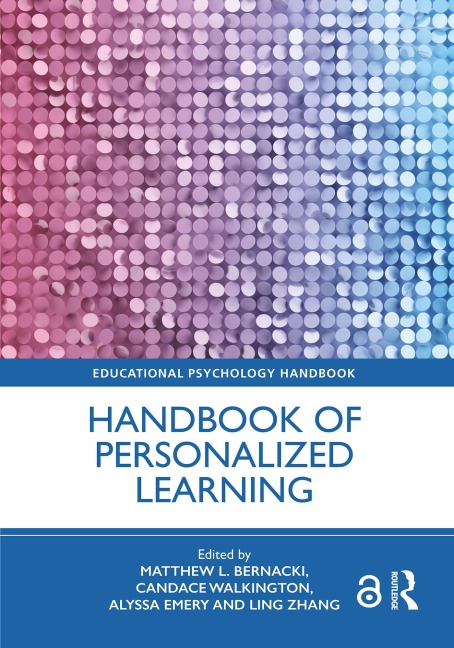
The Handbook of Personalized Learning offers a theoretically grounded conceptualization for the development and implementation of personalizing learning. This comprehensive volume addresses personalized learning's roots in educational, cognitive, and social psychological studies of learning as well as in practice. Positioned to shape the future of personalized learning, this handbook documents past innovations achieved in educational technology research and development; considers how advancements in learning analytics and machine learning have influenced policy and implementation; and showcases current and future applications of personalized learning in diverse K-12 classrooms, higher education, and informal educational settings. The book's varied, rigorous contributions are informed by an overarching model of personalized learning that centers the assets individuals bring to learning opportunities (including their prior knowledge, interests, self-beliefs, autonomy, and identity) and whose responsive designs build on those assets to improve learning and attainment. Researchers, developers, teaching faculty, and graduate students across educational psychology, educational technology, the learning sciences, learning analytics, human-computer interaction, and beyond will come away with substantive foundations and cutting-edge exemplars of the ways in which designs can be personalized to promote learners' experiences in educational settings. Chapter 13 and Chapter 25 of this book are freely available as a downloadable Open Access PDF at http://www.taylorfrancis.com under a Creative Commons Attribution-Non Commercial-No Derivatives (CC BY-NC-ND) 4.0 license.
Matthew L. Bernacki is Associate Professor of Learning Sciences and Psychological Studies and Kinnard White Endowed Scholar in the School of Education at the University of North Carolina at Chapel Hill, USA. Candace Walkington is Professor of Mathematics Education and the Annette and Harold Simmons Centennial Chair in the Department of Teaching and Learning at Southern Methodist University, USA. Alyssa Emery is Assistant Professor of Learning Sciences in the School of Education at Iowa State University, USA. Ling Zhang is Assistant Professor of Special Education in the College of Education at the University of Wyoming, USA.
Section 1. An Introduction to Personalized Learning 1. Trends in Personalized Learning 2. A History & Taxonomy of Personalized Learning 3. An Extensible Model of Personalized Learning Section 2. Exemplary Models of Personalized and Adaptive Learning 4. An Exemplar: Personalized Learning from the Perspective of Intelligent Tutoring Systems 5. An Exemplar: Personalized Learning in Educational Games Using Stealth Assessment Section 3. Psychological Theories of Learning that Can Inform Personalized Learning Design 6. Adapting to Prior and Developing Knowledge 7. Personalizing Learning to Promote Interest 8. Personalizing Learning to Promote Relevance 9. Personalizing with Choices to Promote Autonomy: A Self-Determination Perspective on Personalized Learning Design 10. Personalizing to Individual Differences: Promoting Inclusive and Equitable Opportunities for Learning Section 4. Instructional Designs for Personalized Learning 11. Culturally Responsive Personalized Learning 12. Leveraging Digital Curation for Personalized Learning 13. Project-Based Instruction as Personalized Learning 14. Personalized Learning in the Age of Generative Artificial Intelligence: Opportunities and Challenges Section 5. PL in Academic Subjects 15. Personalized Learning in Mathematics 16. Personalized Learning in English Language Arts: Reading Comprehension 17. Personalized Learning in Social Studies 18. Theoretical, Empirical, and Illustrative Considerations of Personalized Learning within Computer Science Education Section 6. Personalization For Learners, Teachers, and Communities 19. Personalized Learning for Early Learners 20. Applying Self-Determination Theory to the Effective Implementation of Personalized Learning in Online Higher Education 21. Holistic Individualized Coaching: A Personalized Learning Approach to Support Teacher Learning 22. Anishinaabe Indigenous & Extensible Models of (Inter-Species)-Personalized Learning: Towards a Holistic Revision Section 7. Implementing Personalization: Policy, Technology, and Contextual Considerations 23. Understanding Personalization and Individualization from Education Policy Perspectives: Towards an Integrated School-Wide Implementation System 24. Teacher Perspectives on Implementing Personalized Learning across Contexts 25. Design and Implementation Factors for Digital Personalized Learning in Low- and Middle-Income Countries 26. Asset-based Personalized Learning
Dieses eBook wird im PDF-Format geliefert und ist mit einem Adobe Kopierschutz (DRM) versehen. Sie können dieses eBook mit allen Geräten lesen, die das PDF-Format und den Adobe Kopierschutz (DRM) unterstützen.
Zum Beispiel mit den folgenden Geräten:
• tolino Reader
Laden Sie das eBook direkt über den Reader-Shop auf dem tolino herunter oder übertragen Sie das eBook auf Ihren tolino mit einer kostenlosen Software wie beispielsweise Adobe Digital Editions.
• Sony Reader & andere eBook Reader
Laden Sie das eBook direkt über den Reader-Shop herunter oder übertragen Sie das eBook mit der kostenlosen Software Sony READER FOR PC/Mac oder Adobe Digital Editions auf ein Standard-Lesegeräte mit epub- und Adobe DRM-Unterstützung.
• Tablets & Smartphones
Möchten Sie dieses eBook auf Ihrem Smartphone oder Tablet lesen, finden Sie hier unsere kostenlose Lese-App für iPhone/iPad und Android Smartphone/Tablets.
• PC & Mac
Lesen Sie das eBook direkt nach dem Herunterladen mit einer kostenlosen Lesesoftware, beispielsweise Adobe Digital Editions, Sony READER FOR PC/Mac oder direkt über Ihre eBook-Bibliothek in Ihrem Konto unter „Meine eBooks“ - „online lesen“.
Schalten Sie das eBook mit Ihrer persönlichen Adobe ID auf bis zu sechs Geräten gleichzeitig frei.
Bitte beachten Sie, dass die Kindle-Geräte das Format nicht unterstützen und dieses eBook somit nicht auf Kindle-Geräten lesbar ist.