Und dann auf "Zum Home-Bildschirm [+]".

Stöbern
genialokal zum Startbildschirm hinzufügen
Installieren Sie die genialokal App auf Ihrem Startbildschirm für einen schnellen Zugriff und eine komfortable Nutzung.
Installieren Sie die genialokal App auf Ihrem Startbildschirm für einen schnellen Zugriff und eine komfortable Nutzung.
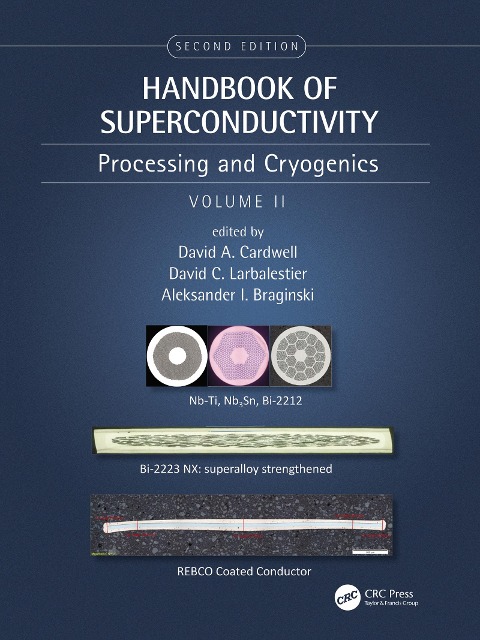
This is the second of three volumes of the extensively revised and updated second edition of the Handbook of Superconductivity. The past twenty years have seen rapid progress in superconducting materials, which exhibit one of the most remarkable physical states of matter ever to be discovered. Superconductivity brings quantum mechanics to the scale of the everyday world where a single, coherent quantum state may extend over a distance of metres, or even kilometres, depending on the size of a coil or length of superconducting wire. Viable applications of superconductors rely fundamentally on an understanding of this intriguing phenomena and the availability of a range of materials with bespoke properties to meet practical needs. While the first volume covers the fundamentals of superconductivity and the various classes of superconducting materials, Volume 2 covers processing of the desired superconducting materials into desired forms: bulks, films, wires and junction-based devices. The volume closes with articles on the refrigeration methods needed to put the materials into the superconducting state. Key Features: - Covers the depth and breadth of the field - Includes contributions from leading academics and industry professionals across the world - Provides hands-on guidance to the manufacturing and processing technologies A comprehensive reference, the handbook is suitable for both graduate students and practitioners in experimental physics, materials science, and multiple engineering disciplines, including electronic and electrical, chemical, mechanical, metallurgy and others.
David A. Cardwell, David C. Larbalestier, Aleksander Braginski
Foreword. Preface. Acknowledgements. Editors-in-Chief. Contributors. PART E Processing. E1 Introduction to Processing Methods. E2 Introduction to Section E2: Bulk Materials. E2.1 Introduction to Bulk Firing Techniques. E2.2 (RE)BCO Melt Processing Techniques: Fundamentals of the Melt Process. E2.3 Melt Processing Techniques: Melt Processing for BSCCO. E2.4 Growth of Superconducting Single Crystals. E2.5 Growth of A15 Type Single Crystals and Polycrystals and Their Physical Properties. E2.6 Irradiation. E2.7 Superconductors in Future Accelerators: Irradiation Problems. E3 Introduction to Section E3: Processing of Wires and Tapes. E3.1 Processing of High Tc Conductors: The Compound Bi-2212. E3.2 Processing of High Tc Conductors: The Compound Bi,Pb(2223). E3.3 Highlights on Tl(1223). E3.4 Processing of High Tc Conductors: The Compound YBCO. E3.5 Processing of High Tc Conductors: The Compound Hg(1223). E3.6 Overview of High Field LTS Materials (Without Nb3Sn). E3.7 Processing of Low Tc Conductors: The Alloy Nb-Ti. E3.8 Processing of Low Tc Conductors: The Compound Nb3Sn. E3.9 Processing of Low Tc Conductors: The Compound Nb3Al. E3.10 Processing of Low Tc Conductors: The Compounds PbMo6S8 and SnMo6S8. E3.11 Processing of Low Tc Conductors: The Compound MgB2. E3.12 Processing Pnictide Superconductors. E4 Introduction to Section E4: Thick and Thin Films. E4.1 Substrates and Functional Buffer Layers. E4.2 Physical Vapor Thin-Film Deposition Techniques. E4.3 Chemical Deposition Processes for REBa2Cu3O7 Coated Conductors. E4.4 High Temperature Superconductor Films: Processing Techniques. E4.5 Processing and Manufacture of Josephson Junctions: Low-Tc. E4.6 Processing and Manufacture of Josephson Junctions: High-Tc. E5 Introduction to Section E5: Superconductor Contacts. E5.1 Superconductor to Normal-Metal Contacts. E5.2 Resistive High Current Splices. E5.3 Persistent Mode Joints. PART F Refrigeration Methods. F1 Introduction to Part F: Refrigeration Methods. F1.1 Review of Refrigeration Methods. F1.2 Pulse Tube Cryocoolers. F1.3 Gifford-McMahon Cryocoolers. F1.4 Microcooling. F1.5 Cooling with Liquid Helium. Glossary. Index.
Dieses eBook wird im PDF-Format geliefert und ist mit einem Adobe Kopierschutz (DRM) versehen. Sie können dieses eBook mit allen Geräten lesen, die das PDF-Format und den Adobe Kopierschutz (DRM) unterstützen.
Zum Beispiel mit den folgenden Geräten:
• tolino Reader
Laden Sie das eBook direkt über den Reader-Shop auf dem tolino herunter oder übertragen Sie das eBook auf Ihren tolino mit einer kostenlosen Software wie beispielsweise Adobe Digital Editions.
• Sony Reader & andere eBook Reader
Laden Sie das eBook direkt über den Reader-Shop herunter oder übertragen Sie das eBook mit der kostenlosen Software Sony READER FOR PC/Mac oder Adobe Digital Editions auf ein Standard-Lesegeräte mit epub- und Adobe DRM-Unterstützung.
• Tablets & Smartphones
Möchten Sie dieses eBook auf Ihrem Smartphone oder Tablet lesen, finden Sie hier unsere kostenlose Lese-App für iPhone/iPad und Android Smartphone/Tablets.
• PC & Mac
Lesen Sie das eBook direkt nach dem Herunterladen mit einer kostenlosen Lesesoftware, beispielsweise Adobe Digital Editions, Sony READER FOR PC/Mac oder direkt über Ihre eBook-Bibliothek in Ihrem Konto unter „Meine eBooks“ - „online lesen“.
Schalten Sie das eBook mit Ihrer persönlichen Adobe ID auf bis zu sechs Geräten gleichzeitig frei.
Bitte beachten Sie, dass die Kindle-Geräte das Format nicht unterstützen und dieses eBook somit nicht auf Kindle-Geräten lesbar ist.