Und dann auf "Zum Home-Bildschirm [+]".

Stöbern
genialokal zum Startbildschirm hinzufügen
Installieren Sie die genialokal App auf Ihrem Startbildschirm für einen schnellen Zugriff und eine komfortable Nutzung.
Installieren Sie die genialokal App auf Ihrem Startbildschirm für einen schnellen Zugriff und eine komfortable Nutzung.
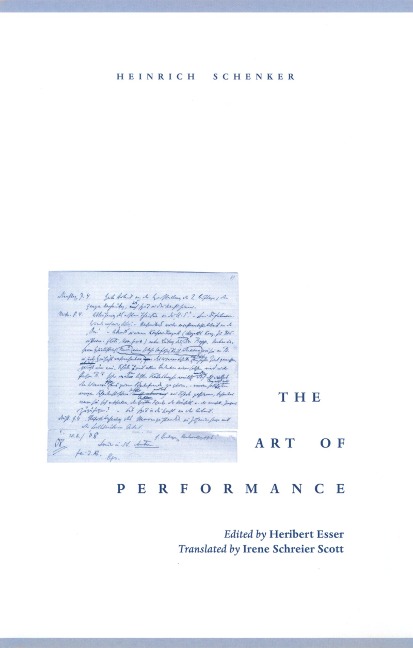
Heinrich Schenker's The Art of Performance shows this great music theorist in a new light. While his theoretical writings helped transform music theory in the twentieth century, this book draws on his experience as a musician and teacher to propose a sharp reevaluation of how musical compositions are realized in performance. Filled with concrete examples and numerous suggestions, the book will interest both music theorists and practicing performers. Schenker's approach is based on his argument that much of contemporary performance practice is rooted in the nineteenth-century cult of the virtuoso, which has resulted in an overemphasis on technical display. To counter this, he proposes specific ways to reconnect the composer's intentions and the musician's performance. Schenker begins by showing how performers can benefit from understanding the laws of composition. He demonstrates how a literal interpretation of the composer's indications can be self-defeating, and he provides a lively discussion of piano technique, including suggestions for pedal, sound color, orchestral effects, and balance. He devotes separate chapters to non-legato, legato, fingering, dynamics, tempo, and rests. In addition to the examples for pianists, Schenker covers a number of topics, such as bowing technique, that will prove invaluable for other instrumentalists and for conductors. The book concludes with an aphoristic and sometimes lyrical chapter on practicing. After Schenker's death, his student Oswald Jonas prepared the text for publication from Schenker's notes, eventually leaving the manuscript to his stepdaughter, Irene Schreier Scott, who entrusted the work of organizing and editing the disparate material to Jonas's friend and student Heribert Esser. She later translated it into English. This edition is the first publication in any language of this remarkable work.
Heribert Esser has had a long and distinguished career as a conductor. He was music director of the Braunschweig State Theater and has been a guest conductor on every continent, conducting a wide repertoire of symphonic music as well as opera. Irene Schreier is a pianist who has performed widely in Europe, Israel, and the Americas. She is Artist-Lecturer at Carnegie Mellon University's School of Music.
Dieses eBook wird im PDF-Format geliefert und ist mit einem Adobe Kopierschutz (DRM) versehen. Sie können dieses eBook mit allen Geräten lesen, die das PDF-Format und den Adobe Kopierschutz (DRM) unterstützen.
Zum Beispiel mit den folgenden Geräten:
• tolino Reader
Laden Sie das eBook direkt über den Reader-Shop auf dem tolino herunter oder übertragen Sie das eBook auf Ihren tolino mit einer kostenlosen Software wie beispielsweise Adobe Digital Editions.
• Sony Reader & andere eBook Reader
Laden Sie das eBook direkt über den Reader-Shop herunter oder übertragen Sie das eBook mit der kostenlosen Software Sony READER FOR PC/Mac oder Adobe Digital Editions auf ein Standard-Lesegeräte mit epub- und Adobe DRM-Unterstützung.
• Tablets & Smartphones
Möchten Sie dieses eBook auf Ihrem Smartphone oder Tablet lesen, finden Sie hier unsere kostenlose Lese-App für iPhone/iPad und Android Smartphone/Tablets.
• PC & Mac
Lesen Sie das eBook direkt nach dem Herunterladen mit einer kostenlosen Lesesoftware, beispielsweise Adobe Digital Editions, Sony READER FOR PC/Mac oder direkt über Ihre eBook-Bibliothek in Ihrem Konto unter „Meine eBooks“ - „online lesen“.
Schalten Sie das eBook mit Ihrer persönlichen Adobe ID auf bis zu sechs Geräten gleichzeitig frei.
Bitte beachten Sie, dass die Kindle-Geräte das Format nicht unterstützen und dieses eBook somit nicht auf Kindle-Geräten lesbar ist.