Und dann auf "Zum Home-Bildschirm [+]".

Stöbern
genialokal zum Startbildschirm hinzufügen
Installieren Sie die genialokal App auf Ihrem Startbildschirm für einen schnellen Zugriff und eine komfortable Nutzung.
Installieren Sie die genialokal App auf Ihrem Startbildschirm für einen schnellen Zugriff und eine komfortable Nutzung.
Ihr gewünschter Artikel ist in 0 Buchhandlungen vorrätig - wählen Sie hier eine Buchhandlung in Ihrer Nähe aus:

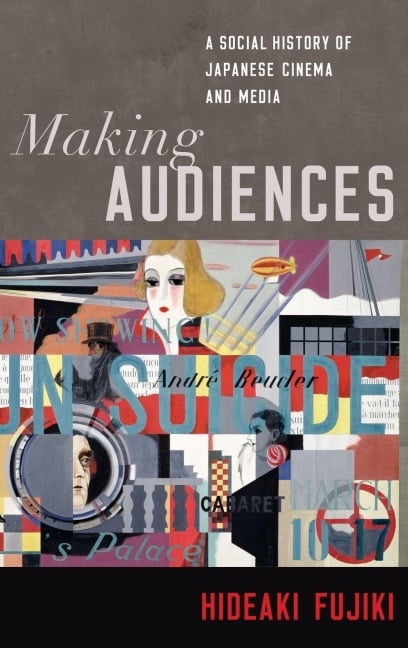
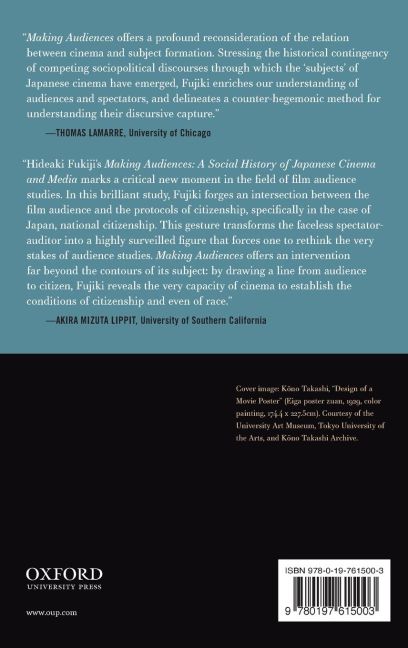
Film has always been a key technology for producing and disseminating attachments to 'the social.' Making Audiences explores the century-old relationships between Japanese media and social subjects, analyzing the connections between cinema audiences and five significant discursive terms: minshu (the people), kokumin (the national populace), toa minzoku (the East Asian race), taishu (the masses), and shimin (citizens). Fujiki narrates the history of Japan's transmedia ecology, illuminating cinema's enmeshment with other forms of media, from vaudeville to the internet, so that cinema audiences emerge as simultaneously shaped by and shaping social history. His extensive empirical research and commitment to interdisciplinarity bring new perspective to the history of Japanese society and culture in its global context from the early twentieth century up to the beginning of the twenty-first century, setting his insights within the context of total wars, imperialism, gender, ethnicity, mass society and communication, the ethics of care, citizenship, globalization, neoliberalism, social movements, digital media, and public and intimate spheres. By reorganizing the study of film and its audiences as central players of the history and politics of the 20th century, Fujiki writes the history of Japan and East Asia anew.
Hideaki Fujiki is Professor of Screen Studies at the Graduate School of Humanities, Nagoya University, Japan. His other publications include Making Personas: Transnational Film Stardom in Modern Japan (2013) and The Japanese Cinema Book, co-edited with Alastair Phillips (2020).
Introduction
PART I: THE PEOPLE
Chapter 1: The Emergence of the Social Subject: "The People" and the Cinema Audience through Popular Entertainment and Social Education
PART II: THE NATIONAL POPULACE
Chapter 2: Total War and Transmedia Consumer Culture: The Re-definition and Contradictions of "the National Populace"
Chapter 3: Mobilizing Individuals into "the National Populace": The Cinema Audience from Total War to Postwar
PART III: EAST ASIAN RACE
Chapter 4: Inventing "the East Asian Race:" The Fantasy of the Japanese Empire and Its Mobilization through Cinema
PART IV: THE MASSES
Chapter 5: The Politics of "the Masses" in the Televisual and Atomic Age: Theories of Mass Society, Mass Culture, and Mass Communication
Chapter 6: "The Masses" as Democratic Subjects: Cinema Audiences and the Reassembling of Transmedia Consumer Culture through Television
PART V: CITIZENS
Chapter 7: "Citizens" as Vulnerable Subjects: Individualizing and Networking in the Postwar Period and the Age of Risk
Chapter 8: The Porous Intimate-Public Sphere of "Citizens": Transmedia Social Movement through Independent Film Screening Events and Social Media
Conclusion
Bibliography