Und dann auf "Zum Home-Bildschirm [+]".

Stöbern
genialokal zum Startbildschirm hinzufügen
Installieren Sie die genialokal App auf Ihrem Startbildschirm für einen schnellen Zugriff und eine komfortable Nutzung.
Installieren Sie die genialokal App auf Ihrem Startbildschirm für einen schnellen Zugriff und eine komfortable Nutzung.
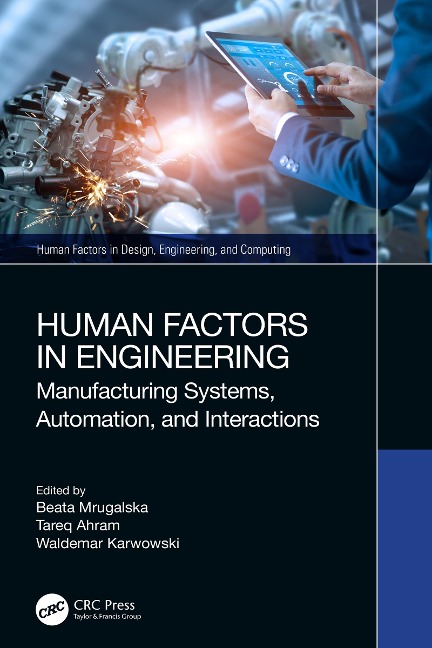
This book addresses aspects of human factors in engineering and provides a detailed discussion of novel approaches, systems engineering tools, artificial cognitive systems, and intelligent technologies and automation. It presents applications in diverse areas, including digital manufacturing, transportation, infrastructure development, and cybersecurity. This book: . Merges the engineering perspective with the human factors and social dimension of computing and artificial intelligence-based technologies. . Covers technological development of human factors engineering and the human dimension in applications across all areas of modern society. . Relates to human behavior in the context of technology and systems interactions. . Discusses the design and the appropriation of 3D printing techniques in the management of an innovative product system. . Presents systems engineering tools, user experience methodologies, artificial cognitive systems, intelligent technologies, and automation. The text is for students, professionals, and researchers in the fields of ergonomics, human factors, industrial engineering, and manufacturing engineering.
Beata Mrugalska, PhD, DSc, Eng. is Associate Professor and Head of Division of Applied Ergonomics in the Institute of Safety and Quality Engineering at the Faculty of Management Engineering at the Poznan University of Technology, Poznan, Poland. She received the M.Sc. Eng. in Management and Marketing (specialization: Corporate Management) in 2001 (including one semester under LPP Erasmus at Centria University of Applied Sciences in Ylivieska, Finland), the Ph.D. and D.Sc. (habilitation) degrees in Machines Building and Operations in 2008 and 2019, all of them from the Poznan University of Technology, Poland. In 2012 she completed postgraduate studies in Occupational Health and Safety at the Faculty of Management Engineering at the Poznan University of Technology. She is the author or co-author/editor or co-editor of 10 books and more than 100 journal articles, book chapters and conference papers. She serves as a member of journal editorial board of WORK: Journal of Prevention, Assessment & Rehabilitation, Human-Intelligent Systems Integration, International Journal of Occupational and Environmental Safety, International Journal of Ergonomics (IJEG) and member of advisory board of Journal of Turkish Operations Management. Tareq Ahram is presently working as an assistant research professor and lead scientist at the Institute for Advanced Systems Engineering at the University of Central Florida, USA. He received a Ph.D. degree in Industrial and Systems Engineering from the University of Central Florida, in 2008, with a specialization in human systems integration and large-scale information retrieval systems optimization. He has served as an invited speaker and a scientific member for several systems engineering, emerging technologies, neuro design, and human factors research, and an Invited Speaker and a Program Committee Member for the U.S. Department of Defence Human Systems Integration and the Human Factors Engineering Technical Advisory Group. He serves as the Applications Subject editor member of Frontiers in Neuroergonomics, and the executive editor of the Journal of Human-Intelligent Systems Integration. Waldemar Karwowski is currently working as a Pegasus Professor and Chairman, Department of Industrial Engineering and Management Systems and Executive Director, Institute for Advanced Systems Engineering, University of Central Florida, Orlando, USA. He holds a Ph.D. in Industrial Engineering from Texas Tech University. He is Past President of the International Ergonomics Association (2000-2003), and past President of the Human Factors and Ergonomics Society (2007). He has over 500 publications focused on human performance, safety, cognitive systems engineering, human-centered design, neuro-fuzzy systems, nonlinear dynamics, neurotechnology, and neuroergonomics. He serves as Co-Editor-in-Chief of Theoretical Issues in Ergonomics Science journal (Taylor & Francis, Ltd), Editor-in-Chief of Human-Intelligent Systems Integration (Springer), and Field Chief Editor of Frontiers in Neuroergonomics
1. Comparative Study of Quality, and Health and Safety Oriented Management Models for an Ergonomics Oriented Management Model for the evaluation of supply chains: A Literature Review. 2. Deviations in Operational Culture: A Barrier Analysis. 3. Pupillary Reaction as a Tool to Control the Psychophysical State of Workers. 4. Ergonomic Work from Home Recommendations using TRIZ: "Stop Robbing Peter to Pay Paul". 5. Impact of strategic orientation and supply chain integration on firm's innovation performance. A mediation analysis.. 6. The South African Automotive Industry's competitiveness and Supply Chain Integration Challenges. 7. Assembly Line Optimization Applying a Construction Algorithm. 8. The Competitive and Productivity Challenges in developing nations, a case study of South African Automotive Industry. 9. Digital Twin, Servitization, Circular Economy and Lean manufacturing: A step towards sustainability. 10. Reference low-code development platform architecture: Aurea BPM. 11. Monitoring and improvement of data quality in product catalogs using defined normalizers and validation patterns. 12. Simulation exercises for the state sanitary and epidemiological service related to the epidemic of food-borne diseases. 13. MIG welding quality improvement study for joined st37 material using building constructions. 14. Control of the Process of Plasma-arc Spraying by the Method of Control of Dynamic Parameters of Condensed Phase Particles.
Dieses eBook wird im PDF-Format geliefert und ist mit einem Adobe Kopierschutz (DRM) versehen. Sie können dieses eBook mit allen Geräten lesen, die das PDF-Format und den Adobe Kopierschutz (DRM) unterstützen.
Zum Beispiel mit den folgenden Geräten:
• tolino Reader
Laden Sie das eBook direkt über den Reader-Shop auf dem tolino herunter oder übertragen Sie das eBook auf Ihren tolino mit einer kostenlosen Software wie beispielsweise Adobe Digital Editions.
• Sony Reader & andere eBook Reader
Laden Sie das eBook direkt über den Reader-Shop herunter oder übertragen Sie das eBook mit der kostenlosen Software Sony READER FOR PC/Mac oder Adobe Digital Editions auf ein Standard-Lesegeräte mit epub- und Adobe DRM-Unterstützung.
• Tablets & Smartphones
Möchten Sie dieses eBook auf Ihrem Smartphone oder Tablet lesen, finden Sie hier unsere kostenlose Lese-App für iPhone/iPad und Android Smartphone/Tablets.
• PC & Mac
Lesen Sie das eBook direkt nach dem Herunterladen mit einer kostenlosen Lesesoftware, beispielsweise Adobe Digital Editions, Sony READER FOR PC/Mac oder direkt über Ihre eBook-Bibliothek in Ihrem Konto unter „Meine eBooks“ - „online lesen“.
Schalten Sie das eBook mit Ihrer persönlichen Adobe ID auf bis zu sechs Geräten gleichzeitig frei.
Bitte beachten Sie, dass die Kindle-Geräte das Format nicht unterstützen und dieses eBook somit nicht auf Kindle-Geräten lesbar ist.