Und dann auf "Zum Home-Bildschirm [+]".

Stöbern
genialokal zum Startbildschirm hinzufügen
Installieren Sie die genialokal App auf Ihrem Startbildschirm für einen schnellen Zugriff und eine komfortable Nutzung.
Installieren Sie die genialokal App auf Ihrem Startbildschirm für einen schnellen Zugriff und eine komfortable Nutzung.
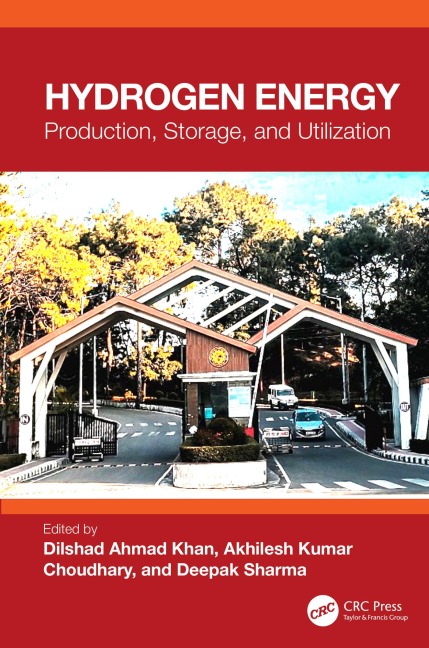
Since the low energy efficiency and rise in emissions by using fossil fuels, the hydrogen economy has been considered as a unique approach to resolve these problems, making hydrogen an attractive fuel. This book titled Hydrogen Energy: Production, Storage, and Utilization describes various technologies for hydrogen production from different sources and storage in liquid, gaseous, and compound forms, which have also been covered in detail. It also highlights the various modes of transportation of hydrogen and its utilization in a variety of engineering applications such as automotive engines, fuel cells, electric power generation, and aerospace. The book also explores the safety challenges, handling issues, and future scope. This book: - Covers the methods of hydrogen production including the bioconversion method. - Explains the hydrogen storage technologies with proper illustrations. - Includes engineering and non-engineering applications of hydrogen utilization covering the most advanced generation of fuel cells, power generation for hybrid vehicles, and space applications. - Presents state-of-the-art research carried out in the domains of hydrogen production, storage, transportation, and utilization along with safety aspects. - Discusses modes and methods of hydrogen transportation such as in gaseous form, liquid form, and solid form. The book has a wide scope of reaching out to diverse readers including but not limited to industrial engineers, process engineers, researchers, and academicians. The research fraternity will gain the benefit of being aware and selecting a similar recent research domain in the field of hydrogen production.
Dilshad Ahmad Khan is an Assistant Professor in the Department of Mechanical Engineering, NIT Hamirpur, India. He is a prominent academician and researcher. He is a Chartered Engineer (CEng) from Institution of Mechanical Engineers, London. He has received his PhD in Manufacturing from IIT Delhi, India in 2018 and Master of Technology from Aligarh Muslim University, India, in 2010. He has received his Bachelor of Engineering in Mechanical Engineering from Dr. B.R. Ambedkar University (formerly Agra University), India in 2006. He has published a good number of research articles in international journals and conferences. He got published several book chapters on various topics and has filed seven Indian patents too. He is the author/editor of 3 books. He has received various National and International Awards for his research and innovations including Gandhiyan Young Technological Innovation Award (GYTI) hosted by President House (Rashtrapati Bhawan) New Delhi. He has funded research projects. His research interests include Energy storage systems, advanced finishing/polishing processes, non-conventional machining, additive manufacturing and industrial automation. Akhilesh Kumar Choudhary is working as an Assistant Professor in the Department of Mechanical Engineering at National Institute of Technology Hamirpur (HP) since 2018. He received Ph.D. degree in Mechanical Engineering from PDPM Indian Institute of Information Technology, Design and Manufacturing, Jabalpur. He received M.Tech degree from Motilal Nehru National Institute of Technology (MNNIT), Allahabad, U.P. and Bachelor degree from Jabalpur Engineering College Jabalpur, M.P. Prior to joining NIT Hamirpur, he was working as an Assistant Professor (NPIU) in the Department of Mechanical Engineering at Jabalpur Engineering College Jabalpur, Under the activity of TEQIP-III. He was also worked as a faculty member at National Institute of Technology, Raipur, for 2.5 years in Mechanical Engineering Department. His research interests include condition monitoring, Biofuel, Diesel engine and Hydrogen fuelled engine. Deepak Sharma is an Assistant Professor in the Department of Mechanical Engineering, NIT Hamirpur (Himachal Pradesh). Prior to joining NIT Hamirpur, has served as a Contract faculty in the Department of Mechanical Engineering at NIT Silchar, Assam. He received his Doctoral Degree (PhD) in Thermal Engineering from National Institute of Technology Silchar in 2017. Earlier, he received his M. Tech from the same institute in 2013, and B. Tech from Gautam Buddha Technical University, Lucknow in the year of 2010. His research work got published in reputed national and international journals and conferences. His area of research is Thermal Energy storage, Renewable Energy, Nanofluid heat transfer, Single phase and Multiphase flow in channels, Combustion, Thermal Hydraulics in Nuclear Reactor.
1. Introduction. 2. Universal Clean Sustainable Energy for Future - Hydrogen. 3. Hydrogen Energy: Addressing Challenges and Exploring Future Prospects. 4. Environmentally Friendly and Cost-Effective Hydrogen Production Strategy: Prospects, Challenges and Technology Development. 5. Thermochemical conversion of biomass for hydrogen production. 6. Hydrogen production from biomass: Harnessing Nature for Sustainable Energy. 7. Aqueous Phase Reforming of Biomass Derived Feedstocks -Towards the Design of Catalytic Systems for the Production of Hydrogen. 8. Thermochemical Hydrogen Production Methods: A Review. 9. Recent Technology and Challenges in Cost-Effective Hydrogen Production from Renewable Energy Sources. 10. Design and Simulation of Industrial Automation System for Hydrogen Production. 11. Storage of Hydrogen in Solid State Materials. 12. Absorption and adsorption-based storage of hydrogen as a fuel. 13. Assessment of materials for energy-efficient low-pressure hydrogen storage. 14. Sustainable Supply Chain Practices in the Emerging Hydrogen Transportation Industry. 15. Hydrogen Fuel in Sustainable Transformation: A Comprehensive Review. 16. A Review on Hybridization and Energy Management Strategies for Hydrogen based Fuel Cell Electric Vehicle Applications. 17. Safety Challenges and Future Scope of Green Hydrogen for the Energy Transition.
Dieses eBook wird im PDF-Format geliefert und ist mit einem Adobe Kopierschutz (DRM) versehen. Sie können dieses eBook mit allen Geräten lesen, die das PDF-Format und den Adobe Kopierschutz (DRM) unterstützen.
Zum Beispiel mit den folgenden Geräten:
• tolino Reader
Laden Sie das eBook direkt über den Reader-Shop auf dem tolino herunter oder übertragen Sie das eBook auf Ihren tolino mit einer kostenlosen Software wie beispielsweise Adobe Digital Editions.
• Sony Reader & andere eBook Reader
Laden Sie das eBook direkt über den Reader-Shop herunter oder übertragen Sie das eBook mit der kostenlosen Software Sony READER FOR PC/Mac oder Adobe Digital Editions auf ein Standard-Lesegeräte mit epub- und Adobe DRM-Unterstützung.
• Tablets & Smartphones
Möchten Sie dieses eBook auf Ihrem Smartphone oder Tablet lesen, finden Sie hier unsere kostenlose Lese-App für iPhone/iPad und Android Smartphone/Tablets.
• PC & Mac
Lesen Sie das eBook direkt nach dem Herunterladen mit einer kostenlosen Lesesoftware, beispielsweise Adobe Digital Editions, Sony READER FOR PC/Mac oder direkt über Ihre eBook-Bibliothek in Ihrem Konto unter „Meine eBooks“ - „online lesen“.
Schalten Sie das eBook mit Ihrer persönlichen Adobe ID auf bis zu sechs Geräten gleichzeitig frei.
Bitte beachten Sie, dass die Kindle-Geräte das Format nicht unterstützen und dieses eBook somit nicht auf Kindle-Geräten lesbar ist.