Und dann auf "Zum Home-Bildschirm [+]".

Stöbern
genialokal zum Startbildschirm hinzufügen
Installieren Sie die genialokal App auf Ihrem Startbildschirm für einen schnellen Zugriff und eine komfortable Nutzung.
Installieren Sie die genialokal App auf Ihrem Startbildschirm für einen schnellen Zugriff und eine komfortable Nutzung.
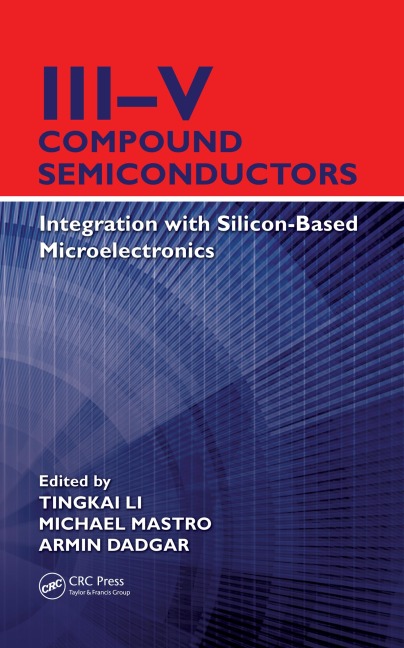
Silicon-based microelectronics has steadily improved in various performance-to-cost metrics. But after decades of processor scaling, fundamental limitations and considerable new challenges have emerged. The integration of compound semiconductors is the leading candidate to address many of these issues and to continue the relentless pursuit of more
Tingkai Li, Ph.D., is currently working at Micron Technology, Inc. as a senior technical member. He published over 100 technical papers, edited three preceding books, and was granted 93 US patents and many awards related in semiconductor and compound semiconductor device and materials research. He is an invited paper reviewer of the Applied Physics Letter, Journal of Applied Physics, IEEE Electron Device Letter, IEEE Transaction of Electron Device, etc., and overseas editor of Journal of Inorganic Materials. He is also honorary professor at Hunan University, Wuhan University of Technologies, and Zhejiang University in China. Dr. Li received a Ph.D. degree in Materials Science and Engineering from Zhejiang University, P. R. China, in 1987, and was a postdoctoral fellow and research scientist at Virginia Polytechnic Institute and State University, Blacksburg, Virginia from 1989-1995. From 1995-1998, he worked as a Staff Scientist in EMCORE Cooperation, New Jersey. He joined Sharp Laboratories in 1998 as a principal member of technical staff and project manager. Michael Mastro, currently a civilian staff scientist at the U.S. Naval Research Lab, has more than 10 years of research experience in thin film growth and characterization, as well as semiconductor device design and nano-fabrication. This includes a number of fundamental advances in the fabrication of planar LEDs and high-power electronic devices, in addition to the development of novel nano-devices, which has resulted in authorship on more than 100 papers and patents. Michael earned a Ph.D. from the University of Florida in 2001 and a B.S. in Chemical Engineering from the Johns Hopkins University in 1997. Armin Dadgar studied physics at University of Heidelberg and at TU-Berlin, where he received his doctor of natural sciences in 1999, successfully developing an alternative method to Fe doping to obtain semiinsulating InP b
Part I: Basic Physical and Chemical Properties Fundamentals and the Future of Semiconductor Device Technology. The Challenge of III-V Materials Integration with Si Microelectronics.Part II: GaN and Related Alloys on Silicon Growth and Integration Techniques III-Nitrides on Si Substrate. New Technology Approaches.Part III: III-V Materials and Device Integration Processes with Si Microelectronics Group III-A Nitrides on Si: Stress and Microstructural Evolution. Direct Growth of III-V Devices on Silicon. Optoelectronic Device Integrated on Si. Reliability of III-V Electronic Devices.Part IV: Defect and Properties Evaluation and Characterization In Situ Curvature Measurements, Strains, and Stresses in the Case of Large Wafer Bending and Multilayer Systems. X-Ray Characterization of Group III-Nitrides. Luminescence in GaN.Part V: Device Structures and Properties GaN-Based Optical Devices on Silicon. The Conventional III-V Materials and Devices on Silicon III-V Solar Cells on Silicon.
Dieses eBook wird im PDF-Format geliefert und ist mit einem Adobe Kopierschutz (DRM) versehen. Sie können dieses eBook mit allen Geräten lesen, die das PDF-Format und den Adobe Kopierschutz (DRM) unterstützen.
Zum Beispiel mit den folgenden Geräten:
• tolino Reader
Laden Sie das eBook direkt über den Reader-Shop auf dem tolino herunter oder übertragen Sie das eBook auf Ihren tolino mit einer kostenlosen Software wie beispielsweise Adobe Digital Editions.
• Sony Reader & andere eBook Reader
Laden Sie das eBook direkt über den Reader-Shop herunter oder übertragen Sie das eBook mit der kostenlosen Software Sony READER FOR PC/Mac oder Adobe Digital Editions auf ein Standard-Lesegeräte mit epub- und Adobe DRM-Unterstützung.
• Tablets & Smartphones
Möchten Sie dieses eBook auf Ihrem Smartphone oder Tablet lesen, finden Sie hier unsere kostenlose Lese-App für iPhone/iPad und Android Smartphone/Tablets.
• PC & Mac
Lesen Sie das eBook direkt nach dem Herunterladen mit einer kostenlosen Lesesoftware, beispielsweise Adobe Digital Editions, Sony READER FOR PC/Mac oder direkt über Ihre eBook-Bibliothek in Ihrem Konto unter „Meine eBooks“ - „online lesen“.
Schalten Sie das eBook mit Ihrer persönlichen Adobe ID auf bis zu sechs Geräten gleichzeitig frei.
Bitte beachten Sie, dass die Kindle-Geräte das Format nicht unterstützen und dieses eBook somit nicht auf Kindle-Geräten lesbar ist.