Und dann auf "Zum Home-Bildschirm [+]".

Stöbern
genialokal zum Startbildschirm hinzufügen
Installieren Sie die genialokal App auf Ihrem Startbildschirm für einen schnellen Zugriff und eine komfortable Nutzung.
Installieren Sie die genialokal App auf Ihrem Startbildschirm für einen schnellen Zugriff und eine komfortable Nutzung.

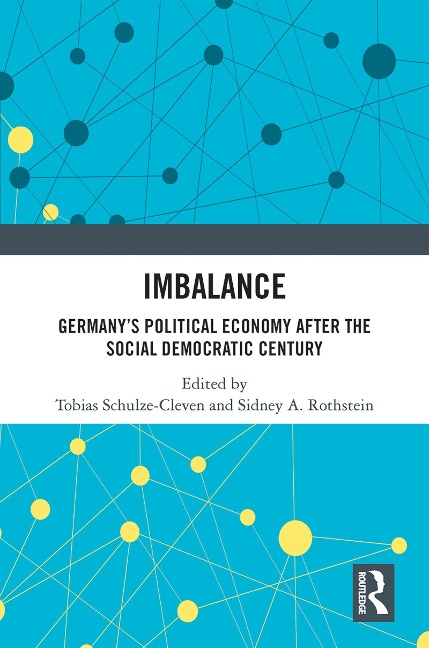
Germany is a central case for research on comparative political economy, which has inspired theorizing on national differences and historical trajectories. This book assesses Germany's political economy after the end of the "social democratic" 20th century to rethink its dominant properties and create new opportunities for using the country as a powerful lens into the evolution of democratic capitalism. Documenting large-scale changes and new tensions in the welfare state, company strategies, interest intermediation, and macroeconomic governance, the volume makes the case for analysing contemporary Germany through the politics of imbalance rather than the long-standing paradigm of institutional stability. This conceptual reorientation around inequalities and disparities provides much-needed traction for clarifying the causal dynamics that govern ongoing processes of institutional recomposition. Delving into the politics of imbalance, the volume explicates the systemic properties of capitalism, multivalent policy feedback, and the organizational foundations of creative adjustment as key vantage points for understanding new forms of distributional conflict within and beyond Germany. The chapters in this book were originally published as a special issue of German Politics.
Tobias Schulze-Cleven is Associate Professor and Co-Director of the Center for Global Work and Employment at the School of Management and Labor Relations at Rutgers University, New Brunswick, USA. His research examines the comparative political economy of labour markets and higher education across the rich democracies. Sidney A. Rothstein is Assistant Professor in the Department of Political Science at Williams College, USA. His research focuses on Europe and the United States, and investigates the politics of digital transformation, explaining how the transition to the knowledge economy reshapes relationships of power, and patterns of inequality, in different countries.
1. Beyond Stability: Rethinking Germany's Political Economy Sidney A. Rothstein and Tobias Schulze-Cleven 2. Germany after the Social Democratic Century: The Political Economy of Imbalance Sidney A. Rothstein and Tobias Schulze-Cleven 3. Going Up-Skill: Exploring the Transformation of the German Skill Formation System Niccolo Durazzi and Chiara Benassi 4. Regulating the Transition from Work to Retirement: Towards a New Distribution of Responsibilities Between the State, Social Partners and Companies? Ute Klammer 5. Strong Firms, Weak Banks: The Financial Consequences of Germany's Export-Led Growth Model Benjamin Braun and Richard Deeg 6. Financial Market Capitalism and Labour in Germany. Merits and Limits of a Sociological Concept Thomas Haipeter 7. The Transnational Activities of German Trade Unions and Works Councils: From Foreign Policy to Active Engagement Stephen J. Silvia 8. Employer Resistance to Works Councils: Evidence from Surveys amongst Trade Unions Martin Behrens and Heiner Dribbusch 9. The Political Economy of the SPD Reconsidered: Evidence from the Great Recession Björn Bremer 10. From Sick Man of Europe to the German Economic Power House. Two Narratives: Ordoliberalism versus Euro-Currency Regime Brigitte Young 11. Inequality in Germany: A Macroeconomic Perspective Jan Behringer, Nikolaus Kowall, Thomas Theobald and Till van Treeck 12. Surplus Germany Wade Jacoby 13. Debating Lessons from Germany after the Social Democratic Century Walther Müller-Jentsch, Britta Rehder, Sidney A. Rothstein and Tobias Schulze-Cleven