Und dann auf "Zum Home-Bildschirm [+]".

Stöbern
genialokal zum Startbildschirm hinzufügen
Installieren Sie die genialokal App auf Ihrem Startbildschirm für einen schnellen Zugriff und eine komfortable Nutzung.
Installieren Sie die genialokal App auf Ihrem Startbildschirm für einen schnellen Zugriff und eine komfortable Nutzung.
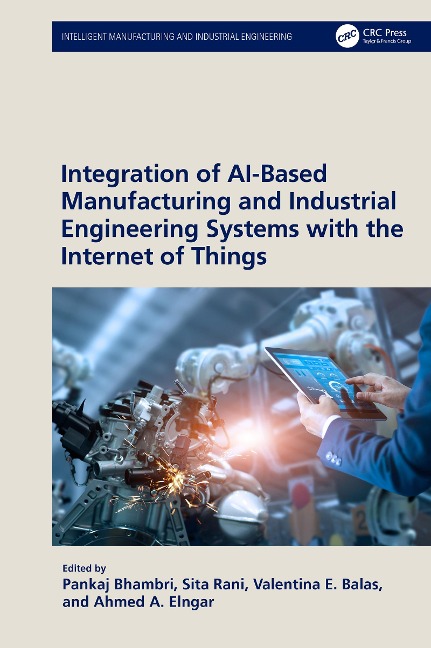
Integration of AI-Based Manufacturing and Industrial Engineering Systems with the Internet of Things describes how AI techniques, such as deep learning, cognitive computing, and Machine Learning, can be used to analyze massive volumes of data produced by IoT devices in manufacturing environments. The potential benefits and challenges associated with the integration of AI and IoT in industrial environments are explored throughout the book as the authors delve into various aspects of the integration process. The role of IoT-enabled sensors, actuators, and smart devices in capturing real-time data from manufacturing processes, supply chains, and equipment is discussed along with how data can be processed and analyzed using AI algorithms to derive actionable insights, optimize production, improve quality control, and enhance overall operational efficiency. A valuable resource for researchers, practitioners, and professionals involved in the fields of AI, IoT, manufacturing systems, and industrial engineering, and combines theoretical foundations, practical applications, and case studies.
Dr. Pankaj Bhambri works in the Department of Information Technology at Ludhiana's Guru Nanak Dev Engineering College. Dr. Bhambri holds a diverse range of professional roles, including those of an educator, editor, author, reviewer, expert speaker, motivator, and technical committee member for prominent national and international organizations. Dr. Sita Rani is an Assistant Professor in the Faculty of Computer Science and Engineering at Guru Nanak Dev Engineering College, Ludhiana. Earlier, she has served as Deputy Dean (Research) at Gulzar Group of Institutions, Khanna (Punjab). Her research interests include Parallel and Distributed Computing, Data Science, Machine Learning, Blockchain, Internet of Things (IoT), and Healthcare. Prof. Valentina E. Balas is currently Full Professor in the Department of Automatics and Applied Software at the Faculty of Engineering, "Aurel Vlaicu" University of Arad, Romania. Her research interests are in Intelligent Systems, Fuzzy Control, Soft Computing, Smart Sensors, Information Fusion, Modeling and Simulation. Dr. Ahmed A. Elngar is an Associate Professor and Head of the Computer Science Department at the Faculty of Computers and Artificial Intelligence, Beni-Suef University, Egypt. Dr. Elngar is also, an Associate Professor of Computer Science at the College of Computer Information Technology, American University in the Emirates, United Arab Emirates.
1. Challenges, Opportunities, and the Future of Industrial Engineering with IoT and AI. 2. Evolution and Future of Industrial Engineering with IOT and AI. 3. Applications of Artificial intelligence and Internet of Things IoT in Marketing. 4. An Introduction to Multi-Objective Decision Programming with Fuzzy Parameters. 5. Data Analytics. 6. Recent advances on deep learning based thermal infrared object tracking in videos: a survey. 7. Heuristics to Secure IoT-based Edge Driven UAV. 8. Phased.js: Automated Software Deployment & Resource Provisioning and Management for AI. 9. Robust Image Enhancement Technique to Automatically Enrich the Visibility of Satellite Captured Snaps. 10. Implementation of FIR Filter and Creation of Custom IP Blocks. 11. Use Cases of Blockchain in Post-Covid Healthcare. 12. A prediction of Telecom Customer Churn Analysis uses the I-GBDT algorithm. 13. Deployment of Machine Learning and Deep Learning Algorithms in Industrial Engineering. 14. Simulation Analysis of AODV and DSDV Routing Protocols for Secure and Reliable Service in Mobile Adhoc Networks (MANETs). 15. Landmine Detection and Classification Based on Machine Learning Algorithms. 16. Application of Queuing Technique in an Educational Institute Canteen- A Case Study. 17. IoT based Driver Drowsiness Detection and Alerting System using Haar Cascade and Eye Aspect Ratio Algorithms. 18. Force/position control of constrained reconfigurable manipulators using hybrid backstepping neural networks based control approach.
Dieses eBook wird im PDF-Format geliefert und ist mit einem Adobe Kopierschutz (DRM) versehen. Sie können dieses eBook mit allen Geräten lesen, die das PDF-Format und den Adobe Kopierschutz (DRM) unterstützen.
Zum Beispiel mit den folgenden Geräten:
• tolino Reader
Laden Sie das eBook direkt über den Reader-Shop auf dem tolino herunter oder übertragen Sie das eBook auf Ihren tolino mit einer kostenlosen Software wie beispielsweise Adobe Digital Editions.
• Sony Reader & andere eBook Reader
Laden Sie das eBook direkt über den Reader-Shop herunter oder übertragen Sie das eBook mit der kostenlosen Software Sony READER FOR PC/Mac oder Adobe Digital Editions auf ein Standard-Lesegeräte mit epub- und Adobe DRM-Unterstützung.
• Tablets & Smartphones
Möchten Sie dieses eBook auf Ihrem Smartphone oder Tablet lesen, finden Sie hier unsere kostenlose Lese-App für iPhone/iPad und Android Smartphone/Tablets.
• PC & Mac
Lesen Sie das eBook direkt nach dem Herunterladen mit einer kostenlosen Lesesoftware, beispielsweise Adobe Digital Editions, Sony READER FOR PC/Mac oder direkt über Ihre eBook-Bibliothek in Ihrem Konto unter „Meine eBooks“ - „online lesen“.
Schalten Sie das eBook mit Ihrer persönlichen Adobe ID auf bis zu sechs Geräten gleichzeitig frei.
Bitte beachten Sie, dass die Kindle-Geräte das Format nicht unterstützen und dieses eBook somit nicht auf Kindle-Geräten lesbar ist.