Und dann auf "Zum Home-Bildschirm [+]".

Stöbern
genialokal zum Startbildschirm hinzufügen
Installieren Sie die genialokal App auf Ihrem Startbildschirm für einen schnellen Zugriff und eine komfortable Nutzung.
Installieren Sie die genialokal App auf Ihrem Startbildschirm für einen schnellen Zugriff und eine komfortable Nutzung.
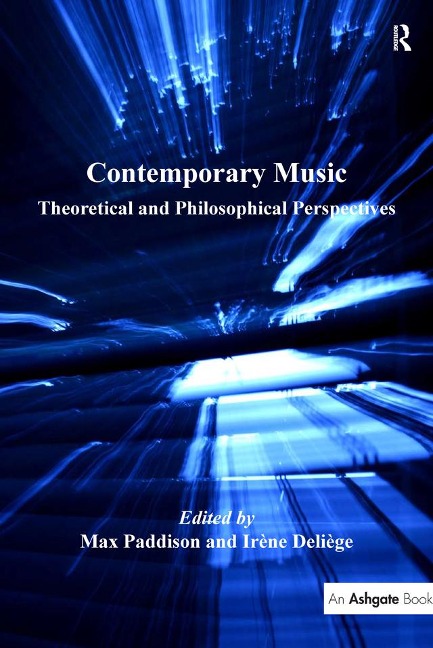
This collection of essays and interviews addresses important theoretical, philosophical and creative issues in Western art music at the end of the twentieth- and the beginning of the twenty-first centuries. Edited by Max Paddison and Irène Deliège, the book offers a wide range of international perspectives from prominent musicologists, philosophers and composers, including Célestin Deliège, Pascal Decroupet, Richard Toop, Rudolf Frisius, Alastair Williams, Herman Sabbe, François Nicolas, Marc Jimenez, Anne Boissière, Max Paddison, Hugues Dufourt, Jonathan Harvey, and new interviews with Pierre Boulez, Brian Ferneyhough, Helmut Lachenmann, and Wolfgang Rihm. Part I is mainly theoretical in emphasis. Issues addressed include the historical rationalization of music and technology, new approaches to the theorization of atonal harmony in the wake of Spectralism, debates on the 'new complexity', the heterogeneity, pluralism and stylistic omnivorousness that characterizes music in our time, and the characterization of twentieth-century and contemporary music as a 'search for lost harmony'. The orientation of Part II is mainly philosophical, examining concepts of totality and inclusivity in new music, raising questions as to what might be expected from an autonomous contemporary musical logic, and considering the problem of the survival of the avant-garde in the context of postmodernist relativism. As well as analytic philosophy and cognitive psychology, critical theory features prominently, with theories of social mediation in music, new perspectives on the concept of musical material in Adorno's late aesthetic theory, and a call for 'an aesthetics of risk' in contemporary art as a means 'to reassert the essential role of criticism, of judgment, and of evaluation as necessary conditions to bring about a real public debate on the art of today'. Part III offers creative perspectives, with new essays and interviews from important contemporary composers who have mad
Max Paddison is Professor of Music Aesthetics, Department of Music, University of Durham, UK. He is the author of Adorno's Aesthetics of Music and Adorno, Modernism and Mass Culture. Irène Deliège, University of Liège, Belgium, is founding editor of the journal Musicae Scientiae and founding member of ESCOM, the European Society of the Cognitive Sciences of Music.
IntroductionContemporary Music: Theory, Aesthetics, Critical Theory; I: Theoretical Perspectives and Retrospectives; 1: The Principles of Music and the Rationalization of Theory 1; 2: Atonal Harmony: From Set to Scale; 3: In Search of Lost Harmony 1; 4: Against a Theory of Musical (New) Complexity 1; 5: Heterogeneity: Or, on the Choice of Being Omnivorous; 6: Varèse, Serialism and the Acoustic Metaphor; 7: 'I Open and Close'? 1; 8: A Period of Confrontation: The Post-Webern Years 1; II: Philosophical Critiques and Speculations After Adorno; 9: A Philosophy of Totality; 10: Possibilities for a Work-Immanent Contemporary Musical Logic; 11: Postmodernism and the Survival of the Avant-garde; 12: Material Constraints: Adorno, Benjamin, Arendt; 13: Towards an Aesthetics of Risk; 14: Music and Social Relations: Towards a Theory of Mediation; III: Creative Orientations; 15: Music, Ambiguity, Buddhism: A Composer's Perspective; 16: Artistic Orientations, Aesthetic Concepts, and the Limits of Explanation: An Interview with Pierre Boulez 1; 17: Failed Time, Successful Time, Shadowtime: An Interview with Brian Ferneyhough; 18: Sound Structures, Transformations, and Broken Magic:; 19: Hunting and Forms: An Interview with Wolfgang Rihm; Postlude:Helmut Lachenmann, Wolfgang Rihm and the Austro-German Tradition
Dieses eBook wird im PDF-Format geliefert und ist mit einem Adobe Kopierschutz (DRM) versehen. Sie können dieses eBook mit allen Geräten lesen, die das PDF-Format und den Adobe Kopierschutz (DRM) unterstützen.
Zum Beispiel mit den folgenden Geräten:
• tolino Reader
Laden Sie das eBook direkt über den Reader-Shop auf dem tolino herunter oder übertragen Sie das eBook auf Ihren tolino mit einer kostenlosen Software wie beispielsweise Adobe Digital Editions.
• Sony Reader & andere eBook Reader
Laden Sie das eBook direkt über den Reader-Shop herunter oder übertragen Sie das eBook mit der kostenlosen Software Sony READER FOR PC/Mac oder Adobe Digital Editions auf ein Standard-Lesegeräte mit epub- und Adobe DRM-Unterstützung.
• Tablets & Smartphones
Möchten Sie dieses eBook auf Ihrem Smartphone oder Tablet lesen, finden Sie hier unsere kostenlose Lese-App für iPhone/iPad und Android Smartphone/Tablets.
• PC & Mac
Lesen Sie das eBook direkt nach dem Herunterladen mit einer kostenlosen Lesesoftware, beispielsweise Adobe Digital Editions, Sony READER FOR PC/Mac oder direkt über Ihre eBook-Bibliothek in Ihrem Konto unter „Meine eBooks“ - „online lesen“.
Schalten Sie das eBook mit Ihrer persönlichen Adobe ID auf bis zu sechs Geräten gleichzeitig frei.
Bitte beachten Sie, dass die Kindle-Geräte das Format nicht unterstützen und dieses eBook somit nicht auf Kindle-Geräten lesbar ist.