Und dann auf "Zum Home-Bildschirm [+]".

Stöbern
genialokal zum Startbildschirm hinzufügen
Installieren Sie die genialokal App auf Ihrem Startbildschirm für einen schnellen Zugriff und eine komfortable Nutzung.
Installieren Sie die genialokal App auf Ihrem Startbildschirm für einen schnellen Zugriff und eine komfortable Nutzung.
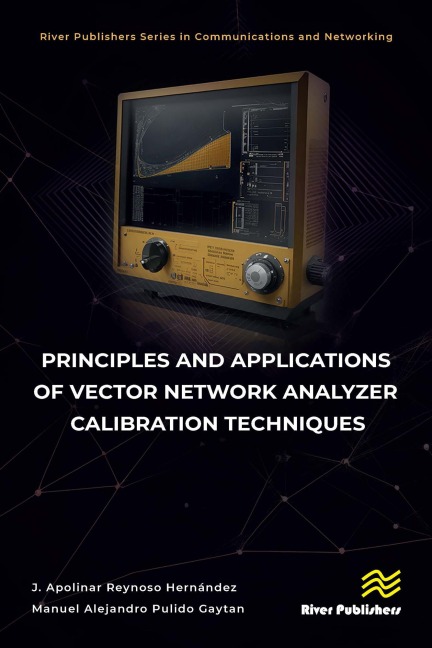
This book summarizes the work developed over more than two decades in the field of advanced calibration techniques for vector network analyzers, by the RF and Microwave Group at The Center for Scientific Research and Higher Education of Ensenada, Baja California, Mexico, which is led by Dr. J. Apolinar Reynoso-Hernández, author of this book. This book is written so that every electrical engineer, with knowledge of electrical circuits and linear algebra basics, can understand the principles of VNA calibration techniques. Vector network analyzers are normally used by engineers and researchers working in the RF and microwave field, which usually requires advanced and specialized courses at graduate level. The reader should be able to implement any VNA calibration technique, decide the most adequate calibration for a given measurement condition, and interpret the measurement results, as a seasoned RF metrology expert. Principles and Applications of Vector Network Analyzer Calibration Techniques is a useful book for beginners and professionals working on: - Microwave de-embedding and test fixture characterization - Characterization of uniform transmission lines - Load-pull measurements It is also: - An ideal tutorial for professionals and postgraduate/research stu-dents taking courses in microwave calibration techniques - A useful textbook for practicing electronics engineering and researchers working in the RF microwave field: calibration techniques and load-pull measurements
J. Apolinar Reynoso-Hernández (Member, IEEE) was born in Tacupa Michoacán, Mexico. He received his degree in electronics and telecommunications engineering from ESIME-IPN, Zacatenco, Mexico in 1984, his M.Sc. degree in solid state physics from CINVESTAV-IPN, Zacatenco in 1985, and his D.E.A. and Ph.D. degrees in electronics from the LAAS, CNRS, Université Paul Sabatier, Toulouse, France in 1987 and 1989, respectively. In 1990, he joined the Department of the Electronics and Telecommunications, CICESE, Ensenada, B. C., Mexico, where he is currently a professor. His areas of specialized research interests include high frequency on-wafer measurements, high frequency device modeling, linear and non-linear active device characterization, and modeling. He led CICESE's Microwave Group to obtain the Best Interactive Forum Paper Award five times. Since 2013, he has been serving as the TPC for ARFTG and ARFTG-MTT Workshop Organizer 2019 and 2020. ExCom ARFTG member from 2021-2023. He has been Associate Editor of Transactions On Microwave Theory and Techniques since 2021 and a reviewer for many IEEE journals. Dr. Manuel A. Pulido Gaytan was born in Mexico in 1986. He received his B.Sc. degree in Electronic Engineering from the Autonomous University of Zacatecas (UAZ), Zacatecas, México in 2010, and his M.Sc. and PhD. degrees from the Center for Scientific Research and Higher Education at Ensenada, Baja California (CICESE), Ensenada, México in 2012 and 2016, respectively. Since 2016, he has worked as RF Device Modeling and Characterization Engineer in different multinational organizations within the USA microwave semiconductor industry. As both graduate student and professional, Dr. Pulido-Gaytan's main activities have been related to the development of new techniques for characterizing and modeling microwave devices, as well as the design of low-noise and power amplifiers, where his work has contributed to the development of several products that have been successfully launched to production in the mobile phone industry.
1. Fundamentals 2. Error Models for Vector Network Analyzers 3. Microwave De-embedding 4. VNA Calibration Techniques 5. Transmission Line Impedance Characterization Methods 6. Load-Pull Characterization of Power Amplifiers Appendix A. Diagonalization of the Matrix Representation of a Uniform Transmission Line
Dieses eBook wird im PDF-Format geliefert und ist mit einem Adobe Kopierschutz (DRM) versehen. Sie können dieses eBook mit allen Geräten lesen, die das PDF-Format und den Adobe Kopierschutz (DRM) unterstützen.
Zum Beispiel mit den folgenden Geräten:
• tolino Reader
Laden Sie das eBook direkt über den Reader-Shop auf dem tolino herunter oder übertragen Sie das eBook auf Ihren tolino mit einer kostenlosen Software wie beispielsweise Adobe Digital Editions.
• Sony Reader & andere eBook Reader
Laden Sie das eBook direkt über den Reader-Shop herunter oder übertragen Sie das eBook mit der kostenlosen Software Sony READER FOR PC/Mac oder Adobe Digital Editions auf ein Standard-Lesegeräte mit epub- und Adobe DRM-Unterstützung.
• Tablets & Smartphones
Möchten Sie dieses eBook auf Ihrem Smartphone oder Tablet lesen, finden Sie hier unsere kostenlose Lese-App für iPhone/iPad und Android Smartphone/Tablets.
• PC & Mac
Lesen Sie das eBook direkt nach dem Herunterladen mit einer kostenlosen Lesesoftware, beispielsweise Adobe Digital Editions, Sony READER FOR PC/Mac oder direkt über Ihre eBook-Bibliothek in Ihrem Konto unter „Meine eBooks“ - „online lesen“.
Schalten Sie das eBook mit Ihrer persönlichen Adobe ID auf bis zu sechs Geräten gleichzeitig frei.
Bitte beachten Sie, dass die Kindle-Geräte das Format nicht unterstützen und dieses eBook somit nicht auf Kindle-Geräten lesbar ist.