Und dann auf "Zum Home-Bildschirm [+]".

Stöbern
genialokal zum Startbildschirm hinzufügen
Installieren Sie die genialokal App auf Ihrem Startbildschirm für einen schnellen Zugriff und eine komfortable Nutzung.
Installieren Sie die genialokal App auf Ihrem Startbildschirm für einen schnellen Zugriff und eine komfortable Nutzung.
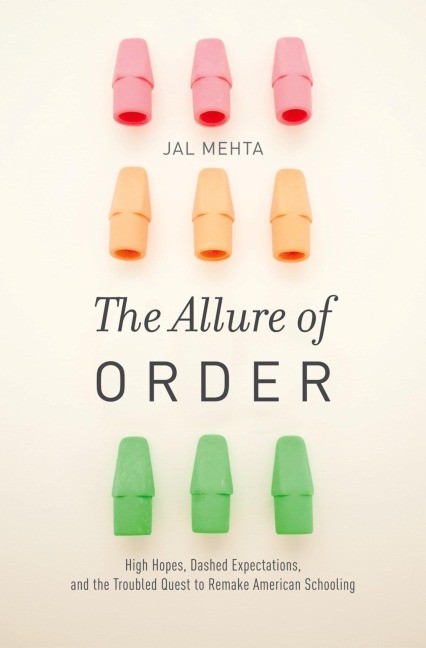
Ted Kennedy and George W. Bush agreed on little, but united behind the No Child Left Behind Act (NCLB). Passed in late 2001, it was hailed as a dramatic new departure in school reform. It would make the states set high standards, measure student progress, and hold failing schools accountable. A decade later, NCLB has been repudiated on both sides of the aisle. According to Jal Mehta, we should have seen it coming. Far from new, it was the same approach to school reform that Americans have tried before. In The Allure of Order, Mehta recounts a century of attempts at revitalizing public education, and puts forward a truly new agenda to reach this elusive goal. Not once, not twice, but three separate times-in the Progressive Era, the 1960s and '70s, and NCLB-reformers have hit upon the same idea for remaking schools. Over and over again, outsiders have been fascinated by the promise of scientific management and have attempted to apply principles of rational administration from above. Each of these movements started with high hopes and ambitious promises, but each gradually discovered that schooling is not easy to "order" from afar: policymakers are too far from schools to know what they need; teachers are resistant to top-down mandates; and the practice of good teaching is too complex for simple external standardization. The larger problem, Mehta argues, is that reformers have it backwards: they are trying to do on the back-end, through external accountability, what they should have done on the front-end: build a strong, skilled and expert profession. Our current pattern is to draw less than our most talented people into teaching, equip them with little relevant knowledge, train them minimally, put them in a weak welfare state, and then hold them accountable when they predictably do not achieve what we seek. What we want, Mehta argues, is the opposite approach which characterizes top-performing educational nations: attract strong candidates into teaching, develop relevant and usable knowledge, train teachers extensively in that knowledge, and support these efforts through a strong welfare state. The Allure of Order boldly challenges conventional wisdom with a sweeping, empirically rich account of the last century of education reform, and offers a new path forward for the century to come.
Jal Mehta is Associate Professor at the Harvard Graduate School of Education. His research explores the underlying structures which shape American schooling, the cultural assumptions which underpin these approaches to education, and the consequences of those decisions for schools, teachers, and students. He is the co-editor of The Futures of School Reform. Mehta received his Ph.D. in Sociology and Social Policy from Harvard University.
Chapter One: The Allure of Order: Rationalizing Schools From the Progressive to the Present
Chapter Two: The Cultural Struggle for Control Over Schooling: The Power of Ideas and the Weakness of the Educational Field
Chapter Three: Taking Control from Above: The Rationalization of Schooling in the Progressive Era
Chapter Four: The Forgotten Standards Movement: The Coleman Report, the Defense Department, and a Nascent Push for Educational Accountability
Chapter Five: Setting the Problem: The Deep Roots and Long Shadows of A Nation at Risk
Chapter Six: A Semi-Profession in an Era of Accountability
Chapter Seven: E Pluribus Unum: How Standards and Accountability Became King
Chapter Eight: Transforming Federal Policy: Ideas and the Triumph of Accountability Politics
Chapter Nine: Rationalizing Schools: Patterns, Ironies, Contradictions
Chapter Ten: Beyond Rationalization: Inverting the Pyramid, Remaking the Educational Sector
Bibliography
Dieses eBook wird im PDF-Format geliefert und ist mit einem Adobe Kopierschutz (DRM) versehen. Sie können dieses eBook mit allen Geräten lesen, die das PDF-Format und den Adobe Kopierschutz (DRM) unterstützen.
Zum Beispiel mit den folgenden Geräten:
• tolino Reader
Laden Sie das eBook direkt über den Reader-Shop auf dem tolino herunter oder übertragen Sie das eBook auf Ihren tolino mit einer kostenlosen Software wie beispielsweise Adobe Digital Editions.
• Sony Reader & andere eBook Reader
Laden Sie das eBook direkt über den Reader-Shop herunter oder übertragen Sie das eBook mit der kostenlosen Software Sony READER FOR PC/Mac oder Adobe Digital Editions auf ein Standard-Lesegeräte mit epub- und Adobe DRM-Unterstützung.
• Tablets & Smartphones
Möchten Sie dieses eBook auf Ihrem Smartphone oder Tablet lesen, finden Sie hier unsere kostenlose Lese-App für iPhone/iPad und Android Smartphone/Tablets.
• PC & Mac
Lesen Sie das eBook direkt nach dem Herunterladen mit einer kostenlosen Lesesoftware, beispielsweise Adobe Digital Editions, Sony READER FOR PC/Mac oder direkt über Ihre eBook-Bibliothek in Ihrem Konto unter „Meine eBooks“ - „online lesen“.
Schalten Sie das eBook mit Ihrer persönlichen Adobe ID auf bis zu sechs Geräten gleichzeitig frei.
Bitte beachten Sie, dass die Kindle-Geräte das Format nicht unterstützen und dieses eBook somit nicht auf Kindle-Geräten lesbar ist.