Und dann auf "Zum Home-Bildschirm [+]".

Stöbern
genialokal zum Startbildschirm hinzufügen
Installieren Sie die genialokal App auf Ihrem Startbildschirm für einen schnellen Zugriff und eine komfortable Nutzung.
Installieren Sie die genialokal App auf Ihrem Startbildschirm für einen schnellen Zugriff und eine komfortable Nutzung.
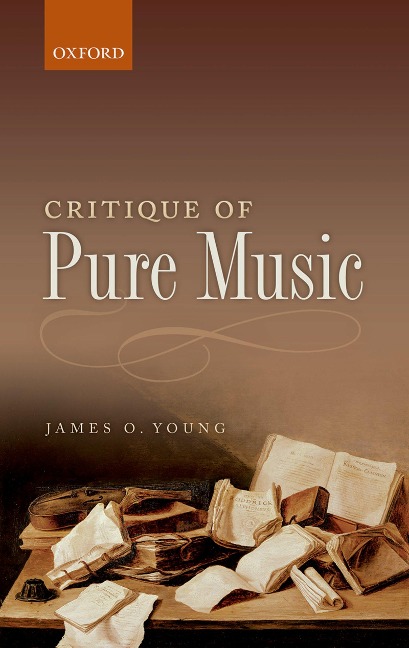
Why do we value music? Many people report that listening to music is one of life's most rewarding activities. In Critique of Pure Music, James O. Young seeks to explain why this is so. Formalists tell us that music is appreciated as pure, contentless form. On this view, listeners receive pleasure, or a pleasurable 'musical' emotion, when they explore the abstract patterns found in music. Music, formalists believe, does not arouse ordinary emotions such as joy, melancholy or fear, nor can it represent emotion or provide psychological insight. Young holds that formalists are wrong on all counts. Drawing upon the latest psychological research, he argues that music is expressive of emotion by resembling human expressive behaviour. By resembling human expressive behaviour, music is able to arouse ordinary emotions in listeners. This, in turn, makes possible the representation of emotion by music. The representation of emotion in music gives music the capacity to provide psychological insight-into the emotional lives of composers, and the emotional lives of individuals from a variety of times and places. And it is this capacity of music to provide psychological insight which explains a good deal of the value of music, both vocal and purely instrumental. Without it, music could not be experienced as profound. Philosophers, psychologists, musicians, musicologists, and music lovers will all find something of interest in this book.
James O. Young is Professor of Philosophy at the University of Victoria, Canada. He is the author of Global Anti-realism (Avebury, 1995), Art and Knowledge (Routledge, 2001), Cultural Appropriation and the Arts (Wiley-Blackwell, 2008), and more than fifty articles in refereed journals. He is the editor of Aesthetics: The Critical Concepts (Routledge, 2005) and (with Conrad G. Brunk) The Ethics of Cultural Appropriation (Wiley-Blackwell, 2009).
- 1: Music and Expressiveness - 2: Music and the Arousal of Emotion - 3: The Content of Music - 4: Music and Lyrics - 5: The Value of Music - Bibliography
Dieses eBook wird im PDF-Format geliefert und ist mit einem Adobe Kopierschutz (DRM) versehen. Sie können dieses eBook mit allen Geräten lesen, die das PDF-Format und den Adobe Kopierschutz (DRM) unterstützen.
Zum Beispiel mit den folgenden Geräten:
• tolino Reader
Laden Sie das eBook direkt über den Reader-Shop auf dem tolino herunter oder übertragen Sie das eBook auf Ihren tolino mit einer kostenlosen Software wie beispielsweise Adobe Digital Editions.
• Sony Reader & andere eBook Reader
Laden Sie das eBook direkt über den Reader-Shop herunter oder übertragen Sie das eBook mit der kostenlosen Software Sony READER FOR PC/Mac oder Adobe Digital Editions auf ein Standard-Lesegeräte mit epub- und Adobe DRM-Unterstützung.
• Tablets & Smartphones
Möchten Sie dieses eBook auf Ihrem Smartphone oder Tablet lesen, finden Sie hier unsere kostenlose Lese-App für iPhone/iPad und Android Smartphone/Tablets.
• PC & Mac
Lesen Sie das eBook direkt nach dem Herunterladen mit einer kostenlosen Lesesoftware, beispielsweise Adobe Digital Editions, Sony READER FOR PC/Mac oder direkt über Ihre eBook-Bibliothek in Ihrem Konto unter „Meine eBooks“ - „online lesen“.
Schalten Sie das eBook mit Ihrer persönlichen Adobe ID auf bis zu sechs Geräten gleichzeitig frei.
Bitte beachten Sie, dass die Kindle-Geräte das Format nicht unterstützen und dieses eBook somit nicht auf Kindle-Geräten lesbar ist.