Und dann auf "Zum Home-Bildschirm [+]".

Stöbern
genialokal zum Startbildschirm hinzufügen
Installieren Sie die genialokal App auf Ihrem Startbildschirm für einen schnellen Zugriff und eine komfortable Nutzung.
Installieren Sie die genialokal App auf Ihrem Startbildschirm für einen schnellen Zugriff und eine komfortable Nutzung.
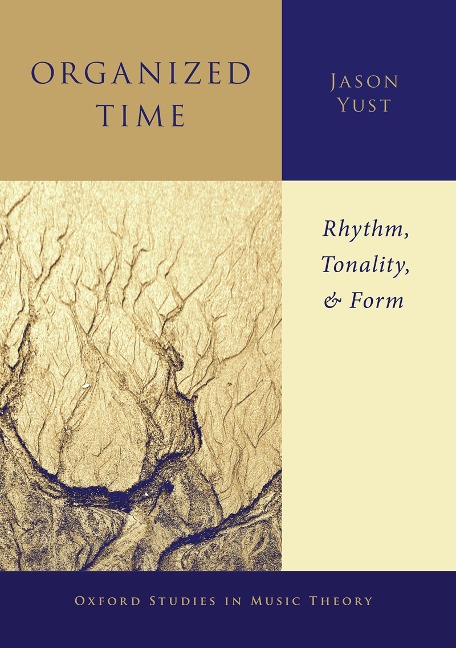
Organized Time is the first attempt to unite theories of harmony, rhythm and meter, and form under a common idea of structured time. Building off of recent advances in music theory in essential subfields-rhythmic theory, tonal structure, and the theory of musical form--author Jason Yust demonstrates that tonal music exhibits similar hierarchical organization in each of these dimensions. Yust develops a network model for temporal structure with an application of mathematical graph theory, which leads ultimately to musical applications of a multi-dimensional polytope called the associahedron. A wealth of analytical examples includes not only the familiar tonal canon-J.S. Bach, Mozart, Schumann--but also lesser known masters of the musical Enlightenment such as C.P.E. and J.C. Bach, Boccherini, and Johann Gottlieb Graun. Yust's approach has wide-ranging ramifications across music theory, enabling new approaches to musical closure, hypermeter, formal function, syncopation, and rhythmic dissonance, as well as historical observations about the development of sonata form and the innovations of Haydn and Beethoven. Making a forceful argument for the independence of musical modalities and for a multivalent approach to music analysis, Organized Time establishes the aesthetic importance of structural disjunction, the conflict of structure in different modalities, in numerous analytical contexts.
Jason Yust is Assistant Professor of Music Theory at Boston University. Born in St. Louis, Missouri, he received a BA in Music at Brown University and a PhD in Music Theory from the University of Washington. His research interests include mathematical theories of harmonic space; metrical, tonal, and formal structure in tonal music; and music perception and cognition.
Contents
Introduction Time and Landscape Dimension Chapter 1: Rhythmic Hierarchy and the Network Model 1.1 Metric and Rhythmic Structures as Temporal Hierarchies 1.2 Rhythmic Classes and Transformations 1.3 Inferring Rhythmic Hierarchies 1.4 Metricality Chapter 2: Tonal Structure 2.1 Melodic Structure 2.2 Backgrounds 2.3 Repetition 2.4 Keys 2.5 Tonal Models for Binary Forms Chapter 3: Formal Structure 3.1 Elements of Form: Repetition, Contrast, Fragmentation 3.2 Small Baroque Forms 3.3 Expositions and the Secondary Theme 3.4 Interactions of Form and Tonal Structure Chapter 4: Structural Networks and the Experience of Musical Time 4.1 Depth, Distance, and the Classification of Structural Shapes 4.2 A Phenomenology of Structure 4.3 Center, Skew, and Bias 4.4 Splitting and Disjunction Chapter 5: Timespan Intervals 5.1 Large-Scale Rhythmic Design in Bach's F Minor Fugue 5.2 Classification of Timespan Intervals 5.3 Hypermetric Hemiola in a Bach Prelude 5.4 Transformations of Rhythmic Structures Chapter 6: Hypermeter 6.1 Hypermeter in the Eye of the Beholder 6.2 Some Criteria for Hypermetric Analysis 6.3 Functions of Hypermetric Shift in Haydn's Symphonies 6.4 Indefinite Hypermeter and Hypermetric Reinterpretation Chapter 7: Hypermeter, Form, and Closure 7.1 Hypermetric Placement in Cadential Syntax 7.2 Mozart's Afterbeat Melodic Ideas 7.3 Main Theme Endings in Haydn's Symphonies 7.4 Elided Cadences and Expositional Closure 7.5 Beethoven's Open Expositions Chapter 8: Syncopation 8.1 Contrapuntal and Tonal versus Structural Syncopation 8.2 Contrapuntal Syncopation and Metrical Dissonance 8.3 Hypermetric Syncopation and Contrapuntal Displacement 8.4 Rhythmic Process as Formal Process in Beethoven Chapter 9: Counterpoint 9.1 Rhythmic Counterpoint 9.2 Brahms's Use of Rhythmic Irregularity and Rhythmic Counterpoint 9.3 Counterpoint of Tonal Structures 9.4 Formal Counterpoint Chapter 10: Harmony Simplified 10.1 Harmonic Syntax and Structure 10.2 Voice Leading on the Tonnetz 10.3 Enharmonicism Chapter 11: Reforming Formal Analysis 11.1 Tonal Disjunction and the Phrase 11.2 Ritornello Form in the Eighteenth-Century Symphony 11.3 Form(s) and Recipes 11.4 Outside the Frame Chapter 12: Tonal-Formal Disjunction 12.1 High-Level Tonal-Formal Disjunction in Sonata Form 12.2 Alternate Subordinate Keys 12.3 Disjunction in the Exposition: Modulating Subordinate Themes 12.4 Off-Tonic Recapitulations Chapter 13: Graph Theory for Temporal Structure 13.1 Planarity and Cycles 13.2 Direction and Confluence 13.3 Chords and Holes 13.4 Reduction Trees, Event Trees, and Spanning Trees over MOPs 13.5 Spanning Trees and the Cycle/Edge-Cut Algebras Chapter 14: A Geometry of Temporal Structure 14.1 Associahedra 14.2 Higher-Dimensional Associahedra and their Facets 14.3 Evenness
Epilogue
Dieses eBook wird im PDF-Format geliefert und ist mit einem Adobe Kopierschutz (DRM) versehen. Sie können dieses eBook mit allen Geräten lesen, die das PDF-Format und den Adobe Kopierschutz (DRM) unterstützen.
Zum Beispiel mit den folgenden Geräten:
• tolino Reader
Laden Sie das eBook direkt über den Reader-Shop auf dem tolino herunter oder übertragen Sie das eBook auf Ihren tolino mit einer kostenlosen Software wie beispielsweise Adobe Digital Editions.
• Sony Reader & andere eBook Reader
Laden Sie das eBook direkt über den Reader-Shop herunter oder übertragen Sie das eBook mit der kostenlosen Software Sony READER FOR PC/Mac oder Adobe Digital Editions auf ein Standard-Lesegeräte mit epub- und Adobe DRM-Unterstützung.
• Tablets & Smartphones
Möchten Sie dieses eBook auf Ihrem Smartphone oder Tablet lesen, finden Sie hier unsere kostenlose Lese-App für iPhone/iPad und Android Smartphone/Tablets.
• PC & Mac
Lesen Sie das eBook direkt nach dem Herunterladen mit einer kostenlosen Lesesoftware, beispielsweise Adobe Digital Editions, Sony READER FOR PC/Mac oder direkt über Ihre eBook-Bibliothek in Ihrem Konto unter „Meine eBooks“ - „online lesen“.
Schalten Sie das eBook mit Ihrer persönlichen Adobe ID auf bis zu sechs Geräten gleichzeitig frei.
Bitte beachten Sie, dass die Kindle-Geräte das Format nicht unterstützen und dieses eBook somit nicht auf Kindle-Geräten lesbar ist.