Und dann auf "Zum Home-Bildschirm [+]".

Stöbern
genialokal zum Startbildschirm hinzufügen
Installieren Sie die genialokal App auf Ihrem Startbildschirm für einen schnellen Zugriff und eine komfortable Nutzung.
Installieren Sie die genialokal App auf Ihrem Startbildschirm für einen schnellen Zugriff und eine komfortable Nutzung.

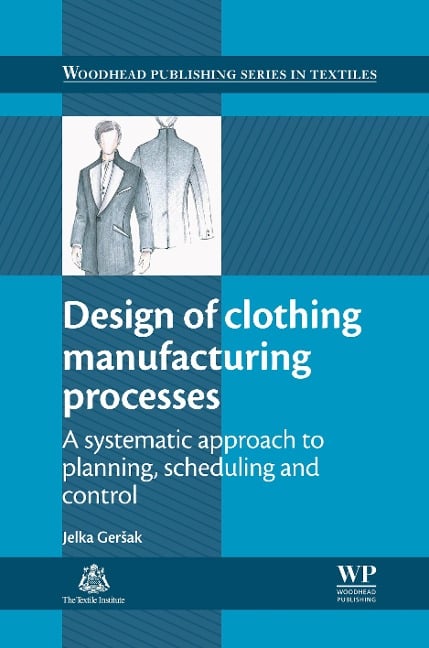
The era of mass manufacturing of clothing and other textile products is coming to an end; what is emerging is a post-industrial production system that is able to achieve the goal of mass-customised, low volume production, where the conventional borders between product design, production and user are beginning to merge. To continue developing knowledge on how to design better products and services, we need to design better clothing manufacturing processes grounded in science, technology, and management to help the clothing industry to compete more effectively. Design of clothing manufacturing processes reviews key issues in the design of more rapid, integrated and flexible clothing manufacturing processes.The eight chapters of the book provide a detailed coverage of the design of clothing manufacturing processes using a systematic approach to planning, scheduling and control. The book starts with an overview of standardised clothing classification systems and terminologies for individual clothing types. Chapter 2 explores the development of standardised sizing systems. Chapter 3 reviews the key issues in the development of a garment collection. Chapters 4 to 7 discuss particular aspects of clothing production, ranging from planning and organization to monitoring and control. Finally, chapter 8 provides an overview of common quality requirements for clothing textile materials.Design of clothing manufacturing processes is intended for R&D managers, researchers, technologists and designers throughout the clothing industry, as well as academic researchers in the field of clothing design, engineering and other aspects of clothing production. - Considers in detail the design of sizing and classification systems - Discusses the planning required in all aspects of clothing production from design and pattern making to manufacture - Overviews the management of clothing production and material quality requirements
Dr. Sc. Jelka GerSak is Professor of Clothing Science and Head of Research and Innovation Centre for Design and Clothing Science at the Faculty of Mechanical Engineering, University of Maribor, Slovenia. She has extensive experience in clothing science related to the design of clothing manufacturing processes, the mechanics of textile structures and their behaviour, objective evaluation of clothing appearance, physiology of clothing and wearing comfort. Her research focuses on clothing science and human thermal physiology, based on the study of complex aspects of clothing system, textile structures and their performance, comfort in the actual environment, and more recently smart clothing. She is internationally renowned for her wide-ranging research in textile materials, clothing science and comfort.
Woodhead Publishing Series in Textiles Preface Chapter 1: Clothing classification systems Abstract: 1.1 Introduction 1.2 General clothing classification 1.3 Harmonised clothing classification systems 1.4 Classification of functional clothing 1.5 Conclusions Chapter 2: Clothing sizing systems Abstract: 2.1 Introduction 2.2 Clothing size and designation systems: a chronological review 2.3 European and international sizing systems 2.4 ISO clothing sizing systems 2.5 European designation of clothing sizes 2.6 The JUS clothing sizing systems 2.7 Conclusions Chapter 3: Key issues in developing a garment collection Abstract: 3.1 Introduction 3.2 New product development 3.3 Garment collection development 3.4 Developing the concept for a new collection 3.5 Collection development management and control 3.6 Design and manufacturing requirements for a collection 3.7 Design aspects of functional protective clothing: a case study 3.8 Fashion trade fairs and garment collections 3.9 Conclusions Chapter 4: Planning and organisation of clothing production Abstract: 4.1 Introduction 4.2 Production planning and organisation within a company 4.3 Clothing-design analysis and activity planning 4.4 Key documentation 4.5 Conclusions Chapter 5: Planning of clothing design, pattern making and cutting Abstract: 5.1 Introduction 5.2 Constructing garment patterns 5.3 Pattern-pieces and their preparation 5.4 Pattern cutting-markers 5.5 Designating cutting-markers 5.6 Defining fabric and other parameters 5.7 Technological requirements when arranging pattern-pieces within a cutting-marker 5.8 Cutting-marker efficiency 5.9 Fabric losses outside the cutting-marker 5.10 Determining fabric consumption 5.11 Conclusions Chapter 6: Planning clothing manufacturing Abstract: 6.1 Introduction 6.2 Analysis of clothing manufacture requirements and selection of appropriate equipment 6.3 Joining technologies 6.4 Work analysis 6.5 Identifying work methods 6.6 Selecting processing equipment 6.7 Types of sewing machine 6.8 Determining standard time 6.9 Planning manufacturing operations 6.10 Planning clothing assembly 6.11 Planning a process system for manufacturing operations 6.12 Planning clothing manufacturing processes 6.13 Conclusions Chapter 7: Clothing production management Abstract: 7.1 Introduction 7.2 Determining production capacity needs 7.3 Production planning 7.4 Production scheduling 7.5 Production monitoring and control 7.6 Costs in production planning and management 7.7 Controlling production planning and management 7.8 Conclusions Chapter 8: Quality requirements for clothing materials Abstract: 8.1 Introduction 8.2 Quality requirements for textile materials for clothing 8.3 Physical characteristics: types, methods of measurement and tolerances 8.4 Performance characteristics: types, methods of measurement and minimum quality standards 8.5 Visible faults 8.6 Care labelling of clothing and textile products 8.7 Ecological labelling of clothing and textile products 8.8 Conclusions Index