Und dann auf "Zum Home-Bildschirm [+]".

Stöbern
genialokal zum Startbildschirm hinzufügen
Installieren Sie die genialokal App auf Ihrem Startbildschirm für einen schnellen Zugriff und eine komfortable Nutzung.
Installieren Sie die genialokal App auf Ihrem Startbildschirm für einen schnellen Zugriff und eine komfortable Nutzung.
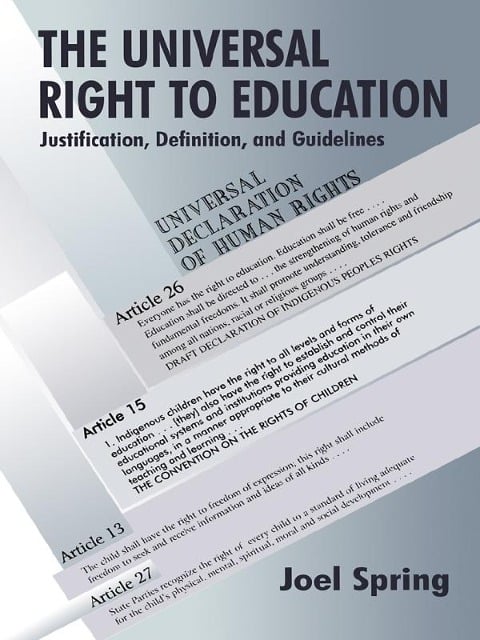
In this book, Joel Spring offers a powerful and closely reasoned justification and definition for the universal right to education--applicable to all cultures--as provided for in Article 26 of the United Nation's Universal Declaration of Human Rights. One sixth of the world's population, nearly 855 million people, are functionally illiterate, and 130 million children in developing countries are without access to basic education. Spring argues that in our crowded global economy, educational deprivation has dire consequences for human welfare. Such deprivation diminishes political power. Education is essential for providing citizens with the tools for resisting totalitarian and repressive governments and economic exploitation. What is to be done? The historically grounded, highly original analysis and proposals Spring sets forth in this book go a long way toward answering this urgent question. Spring first looks at the debates leading up to the Universal Declaration of Human Rights in 1948, to see how the various writers dealt with the issue of cultural differences. These discussions provide a framework for examining the problem of reconciling cultural differences with universal concepts. He next expands on the issue of education and cultural differences by proposing a justification for education that is applicable to indigenous peoples and minority cultures and languages. This justification is then applied to all people within the current global economy. Acknowledging that the right to an education is inseparable from children's rights, he uses the concept of a universal right to education to justify children's rights, and, in turn, applies his definition of children's liberty rights to the concept of education. His synthesis of cultural, language, and children's rights provides the basis for a universal justification and definition for the right to education -- which, in the concluding chapters, Spring uses to propose universal guidelines for human rights education, and instruction in literacy, numeracy, cultural centeredness, and moral economy.
Contents: Preface. Justifying Human and Educational Rights. Justifying a Universal Right to Education for Indigenous and Minority Cultures. The Right to Education in a Global Culture and Economy. Universal Justification for Education and Children's Rights. A Universal Concept of Education: Human Rights Education and Moral Duties. A Universal Concept of Education: Guidelines for Literacy and Numeracy Instruction. Mediating the Effects of World Culture and Economy. Summary: The Universal Right to Education.
Dieses eBook wird im PDF-Format geliefert und ist mit einem Adobe Kopierschutz (DRM) versehen. Sie können dieses eBook mit allen Geräten lesen, die das PDF-Format und den Adobe Kopierschutz (DRM) unterstützen.
Zum Beispiel mit den folgenden Geräten:
• tolino Reader
Laden Sie das eBook direkt über den Reader-Shop auf dem tolino herunter oder übertragen Sie das eBook auf Ihren tolino mit einer kostenlosen Software wie beispielsweise Adobe Digital Editions.
• Sony Reader & andere eBook Reader
Laden Sie das eBook direkt über den Reader-Shop herunter oder übertragen Sie das eBook mit der kostenlosen Software Sony READER FOR PC/Mac oder Adobe Digital Editions auf ein Standard-Lesegeräte mit epub- und Adobe DRM-Unterstützung.
• Tablets & Smartphones
Möchten Sie dieses eBook auf Ihrem Smartphone oder Tablet lesen, finden Sie hier unsere kostenlose Lese-App für iPhone/iPad und Android Smartphone/Tablets.
• PC & Mac
Lesen Sie das eBook direkt nach dem Herunterladen mit einer kostenlosen Lesesoftware, beispielsweise Adobe Digital Editions, Sony READER FOR PC/Mac oder direkt über Ihre eBook-Bibliothek in Ihrem Konto unter „Meine eBooks“ - „online lesen“.
Schalten Sie das eBook mit Ihrer persönlichen Adobe ID auf bis zu sechs Geräten gleichzeitig frei.
Bitte beachten Sie, dass die Kindle-Geräte das Format nicht unterstützen und dieses eBook somit nicht auf Kindle-Geräten lesbar ist.