Und dann auf "Zum Home-Bildschirm [+]".

Stöbern
genialokal zum Startbildschirm hinzufügen
Installieren Sie die genialokal App auf Ihrem Startbildschirm für einen schnellen Zugriff und eine komfortable Nutzung.
Installieren Sie die genialokal App auf Ihrem Startbildschirm für einen schnellen Zugriff und eine komfortable Nutzung.
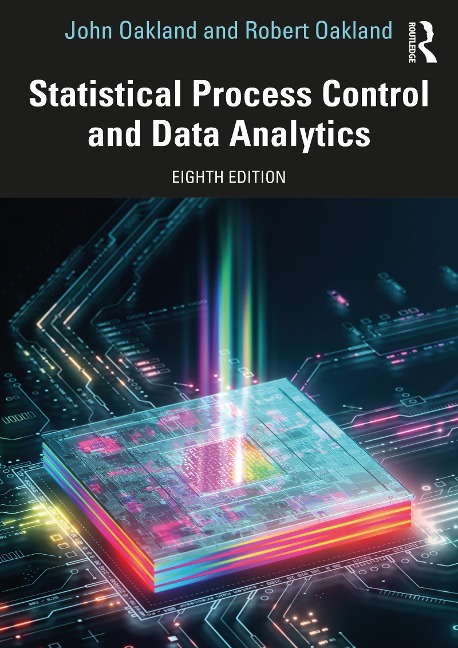
The business, commercial and public-sector world has changed dramatically since John Oakland wrote the first edition of Statistical Process Control in the mid-1980s. Then, people were rediscovering statistical methods of 'quality control,' and the book responded to an often desperate need to find out about the techniques and use them on data. Pressure over time from organizations supplying directly to the consumer, typically in the automotive and high technology sectors, forced those in charge of the supplying, production and service operations to think more about preventing problems than how to find and fix them. Subsequent editions retained the 'tool kit' approach of the first but included some of the 'philosophy' behind the techniques and their use. Now entitled Statistical Process Control and Data Analytics, this revised and updated eighth edition retains its focus on processes that require understanding, have variation, must be properly controlled, have a capability and need improvement - as reflected in the five sections of the book. In this book the authors provide not only an instructional guide for the tools but communicate the management practices which have become so vital to success in organizations throughout the world. The book is supported by the authors' extensive consulting work with thousands of organizations worldwide. A new chapter on data governance and data analytics reflects the increasing importance of big data in today's business environment. Fully updated to include real-life case studies, new research based on client work from an array of industries and integration with the latest computer methods and software, the book also retains its valued textbook quality through clear learning objectives and online end-of-chapter discussion questions. It can still serve as a textbook for both student and practicing engineers, scientists, technologists, managers and anyone wishing to understand or implement modern statistical process control techniques and data analytics.
John Oakland is one of the world's top ten gurus in quality and operational excellence; Executive Chairman, Oakland Group; Emeritus Professor of Quality & Business Excellence at Leeds University Business School; Fellow of the Chartered Quality Institute (CQI); Fellow of the Royal Statistical Society (RSS); Fellow of the Cybernetics Society (CybSoc); Fellow of Research Quality Association (RQA). Robert Oakland is Director in the Oakland Group and works across the globe helping complex organizations to unlock the power in their data using advanced analytical and statistical techniques to improve the quality, cost and delivery of their products and services.
Preface Part 1 Process understanding 1 Quality, processes and control Objectives 1.1 The basic concepts 1.2 Design, conformance and costs 1.3 Quality, processes, systems, teams, tools and SPC 1.4 Some basic tools 1.5 SPC, 'big data' and data analytics Chapter highlights References and further reading 2 Understanding the process Objectives 2.1 Improving customer satisfaction through process management 2.2 Information about the process 2.3 Process mapping and flowcharting 2.4 Process analysis 2.5 Statistical process control and process understanding Chapter highlights References and further reading 3 Process data collection and presentation Objectives 3.1 The systematic approach 3.2 Data collection 3.3 Bar charts and histograms 3.4 Graphs, run charts and other pictures 3.5 Data quality and sharing 3.6 Conclusions Chapter highlights References and further reading Part 2 Process variability 4 Variation - understanding and decision making Objectives 4.1 How some managers look at data 4.2 Interpretation of data 4.3 Causes of variation 4.4 Accuracy and precision 4.5 Variation and management Chapter highlights References and further reading 5 Variables and process variation Objectives 5.1 Measures of accuracy or centering 5.2 Measures of precision or spread 5.3 The normal distribution 5.4 Sampling and averages Chapter highlights Worked examples using the normal distribution References and further reading Part 3 Process control 6 Process control using variables Objectives 6.1 Means, ranges and charts 6.2 Are we in control? 6.3 Do we continue to be in control? 6.4 Choice of sample size and frequency and control limits 6.5 Short-, medium- and long-term variation 6.6 Process control of variables in the world of big data Chapter highlights Worked examples References and further reading 7 Other types of control charts for variables Objectives 7.1 Beyond the mean and range chart 7.2 Process control for individual data 7.3 Median, mid-range and multi-vari charts 7.4 Moving mean, moving range and exponentially weighted moving average (EWMA) charts 7.5 Control charts for standard deviation (s) 7.6 Techniques for short-run SPC 7.7 Summarizing control charts for variables and big data Chapter highlights Worked example References and further reading 8 Process control by attributes Objectives 8.1 Underlying concepts 8.2 Process control for number of defectives or non-conforming units 8.3 Process control for proportion defective or non-conforming units 8.4 Process control for number of defects/non-conformities 8.5 Attribute data in non-manufacturing Chapter highlights Worked examples References and further reading 9 Cumulative sum (cusum) charts Objectives 9.1 Introduction to cusum charts 9.2 Interpretation of simple cusum charts 9.3 Product screening and pre-selection 9.4 Cusum decision procedures Chapter highlights Worked examples References and further reading Part 4 Process capability 10 Process capability for variables and its measurement Objectives 10.1 Will it meet the requirements? 10.2 Process capability indices 10.3 Interpreting capability indices 10.4 The use of control chart and process capability data 10.5 Service industry example of process capability analysis Chapter highlights Worked examples References and further reading Part 5 Process improvement 11 Process problem solving and improvement Objectives 11.1 Introduction 11.2 Pareto analysis 11.3 Cause and effect analysis 11.4 Scatter diagrams 11.5 Stratification 11.6 Summarizing problem solving and improvement Chapter highlights Worked examples References and further reading 12 Managing out-of-control processes Objectives 12.1 Introduction 12.2 Process improvement strategy 12.3 Use of control charts and data analytics for trouble-shooting 12.4 Assignable or special causes of variation and big data Chapter highlights References and further reading 13 Designing the statistical process control system with big data Objectives 13.1 SPC and the quality management system 13.2 Teamwork and process control/improvement 13.3 Improvements in the process 13.4 Taguchi methods 13.5 System performance - the confusion matrix 13.6 Moving forward with big data analytics and SPC Chapter highlights References and further reading 14 Six-sigma process quality Objectives 14.1 Introduction 14.2 The six-sigma improvement model 14.3 Six-sigma and the role of design of experiments 14.4 Building a six-sigma organization and culture 14.5 Ensuring the financial success of six-sigma projects 14.6 Concluding observations and links with excellence models and data analytics Chapter highlights References and further reading 15 Data governance and data analytics Objectives 15.1 Introduction - data attributes 15.2 Data governance strategies 15.3 Data analytics and insight 15.4 Future of process control and assurance Chapter highlights References and further reading Appendices A The normal distribution and non-normality B Constants used in the design of control charts for mean C Constants used in the design of control charts for range D Constants used in the design of control charts for median and range E Constants used in the design of control charts for standard deviation F Cumulative Poisson probability curves G Confidence limits and tests of significance H OC curves and ARL curves for X and R charts I Autocorrelation J Approximations to assist in process control of attributes K Glossary of terms and symbols Index
Dieses eBook wird im PDF-Format geliefert und ist mit einem Adobe Kopierschutz (DRM) versehen. Sie können dieses eBook mit allen Geräten lesen, die das PDF-Format und den Adobe Kopierschutz (DRM) unterstützen.
Zum Beispiel mit den folgenden Geräten:
• tolino Reader
Laden Sie das eBook direkt über den Reader-Shop auf dem tolino herunter oder übertragen Sie das eBook auf Ihren tolino mit einer kostenlosen Software wie beispielsweise Adobe Digital Editions.
• Sony Reader & andere eBook Reader
Laden Sie das eBook direkt über den Reader-Shop herunter oder übertragen Sie das eBook mit der kostenlosen Software Sony READER FOR PC/Mac oder Adobe Digital Editions auf ein Standard-Lesegeräte mit epub- und Adobe DRM-Unterstützung.
• Tablets & Smartphones
Möchten Sie dieses eBook auf Ihrem Smartphone oder Tablet lesen, finden Sie hier unsere kostenlose Lese-App für iPhone/iPad und Android Smartphone/Tablets.
• PC & Mac
Lesen Sie das eBook direkt nach dem Herunterladen mit einer kostenlosen Lesesoftware, beispielsweise Adobe Digital Editions, Sony READER FOR PC/Mac oder direkt über Ihre eBook-Bibliothek in Ihrem Konto unter „Meine eBooks“ - „online lesen“.
Schalten Sie das eBook mit Ihrer persönlichen Adobe ID auf bis zu sechs Geräten gleichzeitig frei.
Bitte beachten Sie, dass die Kindle-Geräte das Format nicht unterstützen und dieses eBook somit nicht auf Kindle-Geräten lesbar ist.