Und dann auf "Zum Home-Bildschirm [+]".

Stöbern
genialokal zum Startbildschirm hinzufügen
Installieren Sie die genialokal App auf Ihrem Startbildschirm für einen schnellen Zugriff und eine komfortable Nutzung.
Installieren Sie die genialokal App auf Ihrem Startbildschirm für einen schnellen Zugriff und eine komfortable Nutzung.
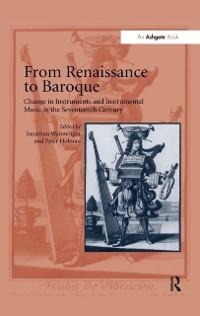
Historians of instruments and instrumental music have long recognised that there was a period of profound change in the seventeenth century, when the consorts or families of instruments developed during the Renaissance were replaced by the new models of the Baroque period. Yet the process is still poorly understood, in part because each instrument has traditionally been considered in isolation, and changes in design have rarely been related to changes in the way instruments were used, or what they played. The essays in this book are by distinguished international authors that include specialists in particular instruments together with those interested in such topics as the early history of the orchestra, iconography, pitch and continuo practice. The book will appeal to instrument makers and academics who have an interest in achieving a better understanding of the process of change in the seventeenth century, but the book also raises questions that any historically aware performer ought to be asking about the performance of Baroque music. What sorts of instruments should be used? At what pitch? In which temperament? In what numbers and/or combinations? For this reason, the book will be invaluable to performers, academics, instrument makers and anyone interested in the fascinating period of change from the 'Renaissance' to the 'Baroque'.
Jonathan Wainwright is Senior Lecturer in Music at the University of York, UK. Peter Holman is Reader in Music at the University of Leeds, UK.
Contents: Preface; Introduction: From 'Renaissance' to 'Baroque'?, Jonathan P. Wainwright; Baptiste's Hautbois: the metamorphosis from Shawm to Hautboy in France, 1620-70, Bruce Haynes; A commentary on the letter by Michel de La Barre concerning the history of musettes and hautboys, Marc Ecochard; The woodwind instruments of Richard Haka (1645/6-1705), Jan Bouterse; Basstals or Curtoons: the search for a transitional Fagott, Graham Lyndon-Jones; The iconographic background to the seventeenth-century recorder, Anthony Rowland-Jones; The Renaissance flute in the 17th century, Nancy Hadden; The flute at Dresden: ramifications for 18th-century woodwind performance in Germany, Mary Oleskiewicz; How did 17th-century English violins really sound?, Peter Trevelyan; The development of French lute style 1600-50, Matthew Spring; The early Air de Cour, the Theorbo, and the Continuo principle in France, Jonathan Le Cocq; From stops organical to stops of variety: the English organ from 1630 to 1730, Dominic Gwynn; Upgrading from consorts to orchestra at the WÃ-rttemberg court, Samantha Owens; From violin band to orchestra, Peter Holman; Organological Gruyère, Jeremy Montagu. Workshop Reports: J.S. Bach's Actus tragicus: 'Gottes Zeit ist die allerbeste Zeit' (BWV 106), Andrew Parrott; The French Baroque orchestra: Lully, Charpentier, Couperin, Graham Sadler. Bibliography; Index.
Dieses eBook wird im PDF-Format geliefert und ist mit einem Adobe Kopierschutz (DRM) versehen. Sie können dieses eBook mit allen Geräten lesen, die das PDF-Format und den Adobe Kopierschutz (DRM) unterstützen.
Zum Beispiel mit den folgenden Geräten:
• tolino Reader
Laden Sie das eBook direkt über den Reader-Shop auf dem tolino herunter oder übertragen Sie das eBook auf Ihren tolino mit einer kostenlosen Software wie beispielsweise Adobe Digital Editions.
• Sony Reader & andere eBook Reader
Laden Sie das eBook direkt über den Reader-Shop herunter oder übertragen Sie das eBook mit der kostenlosen Software Sony READER FOR PC/Mac oder Adobe Digital Editions auf ein Standard-Lesegeräte mit epub- und Adobe DRM-Unterstützung.
• Tablets & Smartphones
Möchten Sie dieses eBook auf Ihrem Smartphone oder Tablet lesen, finden Sie hier unsere kostenlose Lese-App für iPhone/iPad und Android Smartphone/Tablets.
• PC & Mac
Lesen Sie das eBook direkt nach dem Herunterladen mit einer kostenlosen Lesesoftware, beispielsweise Adobe Digital Editions, Sony READER FOR PC/Mac oder direkt über Ihre eBook-Bibliothek in Ihrem Konto unter „Meine eBooks“ - „online lesen“.
Schalten Sie das eBook mit Ihrer persönlichen Adobe ID auf bis zu sechs Geräten gleichzeitig frei.
Bitte beachten Sie, dass die Kindle-Geräte das Format nicht unterstützen und dieses eBook somit nicht auf Kindle-Geräten lesbar ist.