Und dann auf "Zum Home-Bildschirm [+]".

Stöbern
genialokal zum Startbildschirm hinzufügen
Installieren Sie die genialokal App auf Ihrem Startbildschirm für einen schnellen Zugriff und eine komfortable Nutzung.
Installieren Sie die genialokal App auf Ihrem Startbildschirm für einen schnellen Zugriff und eine komfortable Nutzung.
Ihr gewünschter Artikel ist in 0 Buchhandlungen vorrätig - wählen Sie hier eine Buchhandlung in Ihrer Nähe aus:

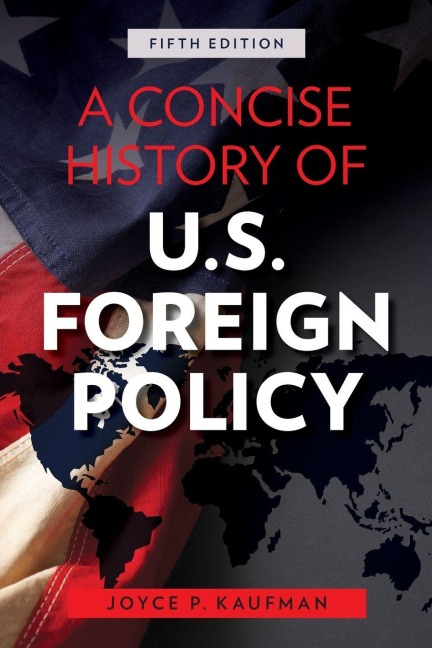
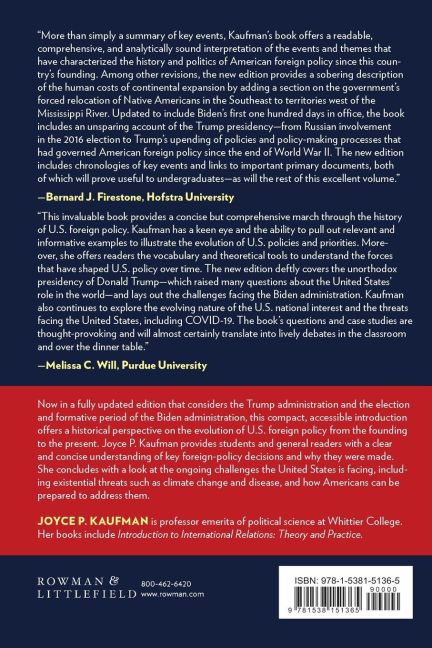
Now in a fully updated edition that considers the Trump administration and the election and formative period of the Biden administration, this compact and accessible introduction offers a historical perspective on the evolution of U.S. foreign policy from the founding of the country to the present.
Joyce P. Kaufman is professor emerita of political science at Whittier College. Her books include Introduction to International Relations: Theory and Practice.
Preface to the Fifth Edition Part I: The Framework 1 Setting the Stage for Understanding U.S. Foreign Policy Introduction to U.S. Foreign Policy What Is Foreign Policy? National Interest Foreign Policy Orientations Unilateralism and Isolationism Engagement/Internationalism Theory and Context Identifying Themes Who Makes Foreign Policy, and Why Are Particular Decisions Made? The Actors Role of Economics Role of Domestic Politics and Factors Who Is Affected by U.S. Foreign Policy Decisions? Impact of U.S. Foreign Policy Decisions on Other Countries Domestic Constituencies The "Powerless": The Feminist Perspective Setting the Stage Primary Sources Part II: The Formative Years 2 Unilateralism to Engagement: The Founding to the End of World War I, 1777-1920 The Beginning Creating a Foreign Policy Framework Beware of Entangling Alliances Manifest Destiny, the Monroe Doctrine, and Westward Expansion The War of 1812 The Monroe Doctrine Continued Expansion Mexican-American War The American Genocide Expansion into the Pacific The Civil War The Spanish-American War Implications of the Spanish-American War The Scramble for Concessions The Roosevelt Corollary to the Monroe Doctrine March to World War I Wilsonian Idealism and U.S. Foreign Policy Wilson's Fourteen Points U.S. Involvement in Russia Domestic Issues: The Executive and Legislative Branches The Shifting National Interest Chronology from the Founding to the End of World War I Selected Primary Sources 3 From Isolationism to Superpower: The Interwar Years through World War II, 1920-1945 Interwar America U.S. Foreign Policy, 1920-1930 Escalation to World War II: 1930-1941 Neutrality Acts From Neutrality to Nonbelligerency War Executive Order 9066 Preparing for Peace The Impact of World War II Technology and World War II The Decision to Bomb Hiroshima and Nagasaki The United Nations: Defining the Postwar World Creation of the United Nations From Isolationism to Engagement The Domestic Context for the Postwar Period Chronology, 1920-1945 Selected Primary Sources Part III: The Cold War 4 The Making of a Superpower: The Evolution of U.S. Cold War Policy, 1945-1968 Background of the Cold War The Early Years of the Cold War George Kennan and Early Cold War Policy 1947: Outlining U.S. Cold War Policy The Truman Doctrine The National Security Act of 1947 The Marshall Plan The Escalation of the Cold War: Berlin to Korea The Creation of NATO The End of the Decade NSC 68 War in Korea The Cold War at Home The Domino Theory Eisenhower Doctrine of Massive Retaliation The U-2 Incident The Kennedy Years Berlin Cuba Vietnam Johnson: Vietnam, and the Great Society The Tonkin Gulf Resolution The Great Society The End of the Decade: Changes in U.S. Policy The 1960s into the 1970s Chronology, 1946-1968 Selected Primary Sources 5 The Cold War Continued: Nixon through Reagan, 1969-1989 Nixon Nixon and Vietnam War Powers The Soviet Union, Détente, and Arms Control Nixon and Europe China and Normalization Gerald Ford Carter The Carter Administration: Successes and Failures Reagan From Cold War to Democratic Revolutions Continuing the Arms Control Process Iran-Contra The Cold War and Beyond Chronology, 1969-1988 Selected Primary Sources Part IV: The Post-Cold War Period 6 The Period of American Hegemony: Bush-Clinton-Bush (1989-2009) George H. W. Bush and the "New World Order" The Persian Gulf War The End of the Soviet Union The Balkans and Ethnic Conflict The Clinton Years Somalia Haiti The Balkans NATO Enlargement Economics: Trade and Globalization The Environment: The Kyoto Protocol Terrorism Rethinking U.S. Foreign Policy under Clinton George W. Bush: From Election to 9/11 Contested Election and Implications for U.S. Foreign Policy September 11 and the Responses War with Afghanistan The Bush Doctrine and the War with Iraq The War with Iraq and Its Aftermath Freedom and Democracy for All President Bush and Wilsonian Idealism The Iraq War: A Postscript Chronology 1989-2009 Selected Primary Sources 7 Obama and Trump: 2009 to 2021 President Obama and his Foreign Policy Direction The Obama Administration in Retrospect Challenges Facing the Obama Administration Obama and Iraq and Afghanistan Relations with the Middle East Ties to the Islamic World Iran and the Nuclear Arms Deal The United States and Israel The "Arab Spring" and Civil War in Syria U.S. Relations with Other Parts of the World under Obama Relations with Russia U.S. Relations with Europe "Pivot to the Pacific" U.S. Relations with Africa Other Challenges to the United States under Obama Obama's Legacy The Election of Donald Trump An "America First" Foreign Policy The Early Outlines for a Trump Foreign Policy The Political Emergence of Donald J. Trump Coronavirus Pandemic U.S. Relations with Russia U.S. Relations with the Western Allies U.S. Relations with China under Trump North Korea The Middle East Other Noteworthy Foreign Policy Issues U.S. Foreign Policy Post-Trump Chronology 2009-present Selected Primary Sources 8 Biden and Beyond: The Future of U.S. Foreign Policy The Election of 2020 and the Transition The Challenges and Threats U.S. Relations with other Nations Relations with China The United States and the Iran Nuclear Agreement The United States, Russia, and Arms Control Relations with Europe Other Threats Threats from Disease: Pandemics Climate Change The Future of U.S. Foreign Policy: Returning to First Principles The Cold War as a Framework for U.S. Foreign Policy The Changing Notion of Power U.S. Power and National Interest The Changing Notion of Threat The Actors and the Domestic Balance of Power Challenges to U.S. Foreign Policy in the Future Selected Primary Sources Notes Index About the Author