Und dann auf "Zum Home-Bildschirm [+]".

Stöbern
genialokal zum Startbildschirm hinzufügen
Installieren Sie die genialokal App auf Ihrem Startbildschirm für einen schnellen Zugriff und eine komfortable Nutzung.
Installieren Sie die genialokal App auf Ihrem Startbildschirm für einen schnellen Zugriff und eine komfortable Nutzung.
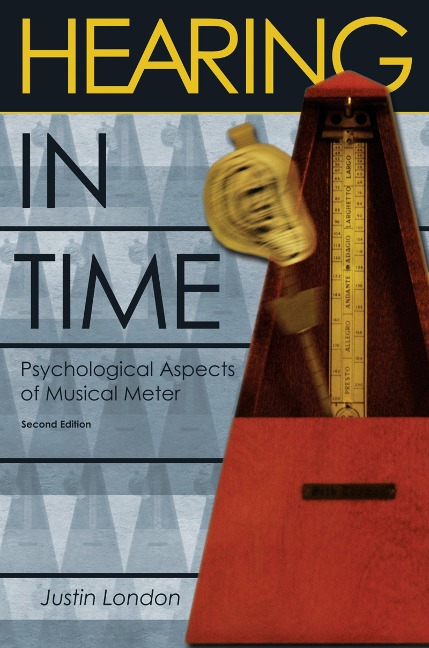
Our sense that a waltz is "in three" or a blues song is "in four with a shuffle" comes from our sense of musical meter. Hearing in Time explores the metric aspect of our musical experience from a psychological point of view. Musical meter is subject to a number of fundamental perceptual and cognitive constraints. These constraints are the cornerstones of Hearing in Time's account of musical meter. Hearing in Time also takes into account the fact that listening to music, like many other rhythmic activities, is something that we do a lot. It also approaches meter in the context of music as it is actually performed, with nuances of timing and dynamics, rather than as a theoretical idealization. Hearing in Time's approach to meter is not based on any particular musical style or cultural practice, and it discusses musical examples from a wide range of musical styles and cultures--from Beethoven and Bach to Brubeck and Ghanaian (Ewe) drumming. In taking this broad approach a number of fundamental similarities between a variety of different metric phenomena--such as the difference between so-called simple versus complex or additive meters - become apparent. Requiring only a modest ability to read a musical score, Hearing in Time is written for musicians, musicologists, and music theorists, as well as psychologists, linguists and cognitive scientists who are interested in rhythm and meter.
Justin London is Professor of Music at Carleton College in Northfield, MN, USA. Trained as a classical guitarist, he holds the Ph.D. in Music History and Theory from the University of Pennsylvania where he studied with Leonard Meyer. His main research area is the perception and cognition of musical meter, though he is also interested in musical aesthetics, linguistic pragmatics, and the Delta Blues. He served as President of the Society for Music Theory in 2007-2009.
Table of Contents
Introduction Meter as a Kind of Attentional Behavior Relevant research on Rhythmic Perception and Production The Neurobiology and Development of Rhythm Meter-Rhythm Interactions I: Ground Rules Metric Representations and Metric Well-Formedness Meter-Rhythm Interactions II: Problems Metric Flux in Beethoven's Fifth Non-Isochronous Meters NI-Meters in Theory and Practice The Many Meters Hypothesis Conclusion Notes Bibliography Index
Dieses eBook wird im PDF-Format geliefert und ist mit einem Adobe Kopierschutz (DRM) versehen. Sie können dieses eBook mit allen Geräten lesen, die das PDF-Format und den Adobe Kopierschutz (DRM) unterstützen.
Zum Beispiel mit den folgenden Geräten:
• tolino Reader
Laden Sie das eBook direkt über den Reader-Shop auf dem tolino herunter oder übertragen Sie das eBook auf Ihren tolino mit einer kostenlosen Software wie beispielsweise Adobe Digital Editions.
• Sony Reader & andere eBook Reader
Laden Sie das eBook direkt über den Reader-Shop herunter oder übertragen Sie das eBook mit der kostenlosen Software Sony READER FOR PC/Mac oder Adobe Digital Editions auf ein Standard-Lesegeräte mit epub- und Adobe DRM-Unterstützung.
• Tablets & Smartphones
Möchten Sie dieses eBook auf Ihrem Smartphone oder Tablet lesen, finden Sie hier unsere kostenlose Lese-App für iPhone/iPad und Android Smartphone/Tablets.
• PC & Mac
Lesen Sie das eBook direkt nach dem Herunterladen mit einer kostenlosen Lesesoftware, beispielsweise Adobe Digital Editions, Sony READER FOR PC/Mac oder direkt über Ihre eBook-Bibliothek in Ihrem Konto unter „Meine eBooks“ - „online lesen“.
Schalten Sie das eBook mit Ihrer persönlichen Adobe ID auf bis zu sechs Geräten gleichzeitig frei.
Bitte beachten Sie, dass die Kindle-Geräte das Format nicht unterstützen und dieses eBook somit nicht auf Kindle-Geräten lesbar ist.