Und dann auf "Zum Home-Bildschirm [+]".

Stöbern
genialokal zum Startbildschirm hinzufügen
Installieren Sie die genialokal App auf Ihrem Startbildschirm für einen schnellen Zugriff und eine komfortable Nutzung.
Installieren Sie die genialokal App auf Ihrem Startbildschirm für einen schnellen Zugriff und eine komfortable Nutzung.
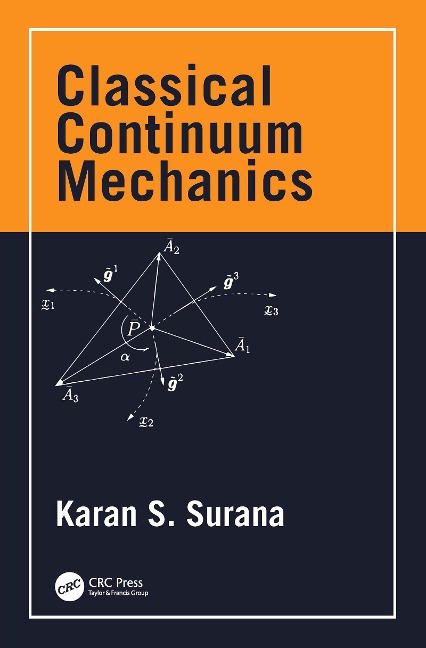
This book provides physical and mathematical foundation as well as complete derivation of the mathematical descriptions and constitutive theories for deformation of solid and fluent continua, both compressible and incompressible with clear distinction between Lagrangian and Eulerian descriptions as well as co- and contra-variant bases. Definitions of co- and contra-variant tensors and tensor calculus are introduced using curvilinear frame and then specialized for Cartesian frame. Both Galilean and non-Galilean coordinate transformations are presented and used in establishing objective tensors and objective rates. Convected time derivatives are derived using the conventional approach as well as non-Galilean transformation and their significance is illustrated in finite deformation of solid continua as well as in the case of fluent continua. Constitutive theories are derived using entropy inequality and representation theorem. Decomposition of total deformation for solid and fluent continua into volumetric and distortional deformation is essential in providing a sound, general and rigorous framework for deriving constitutive theories. Energy methods and the principle of virtual work are demonstrated to be a small isolated subset of the calculus of variations. Differential form of the mathematical models and calculus of variations preclude energy methods and the principle of virtual work. The material in this book is developed from fundamental concepts at very basic level with gradual progression to advanced topics. This book contains core scientific knowledge associated with mathematical concepts and theories for deforming continuous matter to prepare graduate students for fundamental and basic research in engineering and sciences. The book presents detailed and consistent derivations with clarity and is ideal for self-study.
Karan S. Surana attended undergraduate school at Birla Institute of Technology and Science (BITS), Pilani, India and received a B.E. in mechanical engineering in 1965. He then attended the University of Wisconsin, Madison where he obtained M.S. and Ph.D. in mechanical engineering in 1967 and 1970. He joined The University of Kansas, Department of Mechanical Engineering faculty where he is currently serving as Deane E. Ackers University Distinguished Professor of Mechanical Engineering. His areas of interest and expertise are computational mathematics, computational mechanics, and continuum mechanics. He is the author of over 350 research reports, conference papers, and journal papers.
Chapter 1: Introduction. Chapter 2: Concepts and Mathematical Preliminaries. Chapter 3: Kinematics of Motion, Deformation and their Measures. Chapter 4: Definitions and Measures of Stresses. Chapter 5: Rate of Deformation, Area, Volume, Strain Rate Tensors, Spin Tensor and Convected Time Derivatives of Stress and Strain Tensors. Chapter 6: Conservation and Balance Laws in Eulerian Description. Chapter 7: Conservation and Balance Laws in Langragian Description. Chapter 8: General considerations in the constitutive theories for solids and fluids. Chapter 9: Constitutive theories for thermoelastic solids. Chapter 10: Ordered Rate Constitutive Theories for Thermoviscoelastic Solids without Memory. Chapter 11: Ordered Rate Constitutive Theories for Thermoviscoelastic Solids with Memory. Chapter 12: Ordered Rate Constitutive Theories for Thermofluids. Chapter 13: Ordered Rate Constitutive Theories for Thermoviscoelastic Fluids. Chapter 14: Mathematical Models with Thermodynamic Relations. Chapter 15: Calculus of variations, energy methods and principle of virtual work. Chapter 16: Advanced Topics
Dieses eBook wird im PDF-Format geliefert und ist mit einem Adobe Kopierschutz (DRM) versehen. Sie können dieses eBook mit allen Geräten lesen, die das PDF-Format und den Adobe Kopierschutz (DRM) unterstützen.
Zum Beispiel mit den folgenden Geräten:
• tolino Reader
Laden Sie das eBook direkt über den Reader-Shop auf dem tolino herunter oder übertragen Sie das eBook auf Ihren tolino mit einer kostenlosen Software wie beispielsweise Adobe Digital Editions.
• Sony Reader & andere eBook Reader
Laden Sie das eBook direkt über den Reader-Shop herunter oder übertragen Sie das eBook mit der kostenlosen Software Sony READER FOR PC/Mac oder Adobe Digital Editions auf ein Standard-Lesegeräte mit epub- und Adobe DRM-Unterstützung.
• Tablets & Smartphones
Möchten Sie dieses eBook auf Ihrem Smartphone oder Tablet lesen, finden Sie hier unsere kostenlose Lese-App für iPhone/iPad und Android Smartphone/Tablets.
• PC & Mac
Lesen Sie das eBook direkt nach dem Herunterladen mit einer kostenlosen Lesesoftware, beispielsweise Adobe Digital Editions, Sony READER FOR PC/Mac oder direkt über Ihre eBook-Bibliothek in Ihrem Konto unter „Meine eBooks“ - „online lesen“.
Schalten Sie das eBook mit Ihrer persönlichen Adobe ID auf bis zu sechs Geräten gleichzeitig frei.
Bitte beachten Sie, dass die Kindle-Geräte das Format nicht unterstützen und dieses eBook somit nicht auf Kindle-Geräten lesbar ist.