Und dann auf "Zum Home-Bildschirm [+]".

Stöbern
genialokal zum Startbildschirm hinzufügen
Installieren Sie die genialokal App auf Ihrem Startbildschirm für einen schnellen Zugriff und eine komfortable Nutzung.
Installieren Sie die genialokal App auf Ihrem Startbildschirm für einen schnellen Zugriff und eine komfortable Nutzung.
Ihr gewünschter Artikel ist in 0 Buchhandlungen vorrätig - wählen Sie hier eine Buchhandlung in Ihrer Nähe aus:

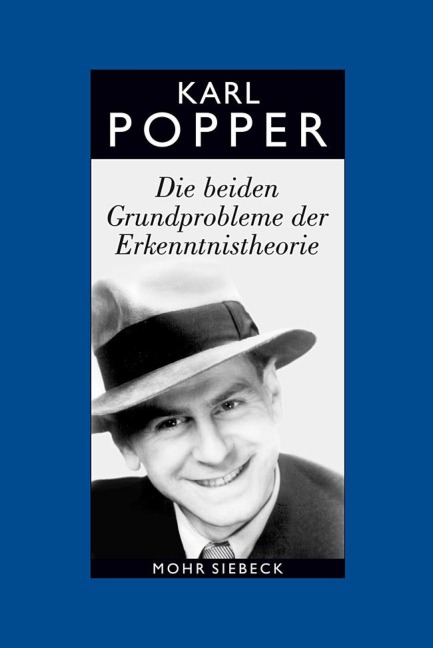
In his investigations of the problem of induction and the problem of demarcation - the two fundamental problems of the theory of knowledge - Popper criticizes in great detail apriorism (Kant, Fries and Nelson) and logical positivism (Wittgenstein, Schlick and Carnap). He also gives a severe criticism of conventionalism (Poincaré, Duhem and Dingler), and presents his own new and distinct solution to the two problems: There is no such thing as induction, and it is only using the criterion of falsifiability and methodological rules that makes it possible to distinguish between empirical sciences on the one hand and mathematics, logic and metaphysics on the other. It was not until 1979 that the remaining manuscripts were published, along with an introduction and many new notes by Popper. And it was not until 2009 that an English translation was published (Routledge). To this new edition two new appendices (1993), a postscript (2010) and many new notes have been added.
If you would like to receive a special brochure on Karl Popper's Gesammelte Werke, please contact us.
(1902-1994) 1928 Dr.phil.; 1948 D.Litt. an der Universität London; bis 1945 Senior Lecturer an der University of New Zealand; 1945-49 Reader; 1949-69 Professor of Logic and Scientific Method an der London School of Economics and Political Science; 1969 Emeritierung. Sir Karl Popper war mehrfacher Ehrendoktor und Träger hoher Auszeichnungen, zuletzt der Otto Hahn-Friedensmedaille der Vereinten Nationen.