Und dann auf "Zum Home-Bildschirm [+]".

Stöbern
genialokal zum Startbildschirm hinzufügen
Installieren Sie die genialokal App auf Ihrem Startbildschirm für einen schnellen Zugriff und eine komfortable Nutzung.
Installieren Sie die genialokal App auf Ihrem Startbildschirm für einen schnellen Zugriff und eine komfortable Nutzung.
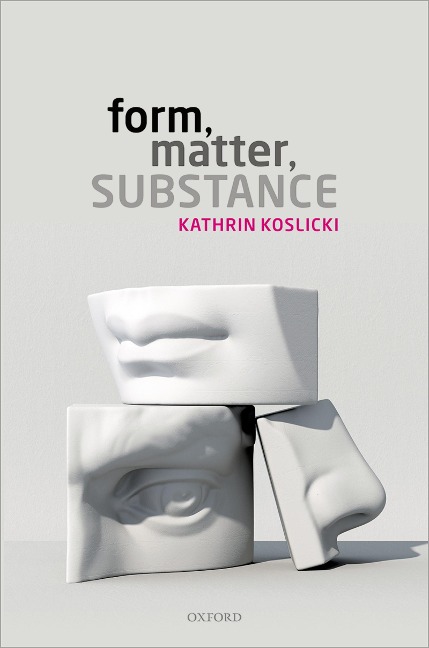
In Form, Matter, Substance, Kathrin Koslicki develops a contemporary defense of the Aristotelian doctrine of hylomorphism. According to this approach, objects are compounds of matter (hule) and form (morphe or eidos) and a living organism is not exhausted by the body, cells, organs, tissue and the like that compose it. Koslicki argues that a hylomorphic analysis of concrete particular objects is well equipped to compete with alternative approaches when measured against a wide range of criteria of success. However, a plausible application of the doctrine of hylomorphism to the special case of concrete particular objects hinges on how hylomorphists conceive of the matter composing a concrete particular object, its form, and the hylomorphic relations which hold between a matter-form compound, its matter and its form. Koslicki offers detailed answers these questions surrounding a hylomorphic approach to the metaphysics of concrete particular objects. As a result, matter-form compounds emerge as occupying the privileged ontological status traditionally associated with substances due to their high degree of unity.
Kathrin Koslicki is Professor of Theoretical Philosophy at the University of Neuchâtel. Koslicki is originally from Munich, Germany, and moved to the United States when she was twenty. She completed her B.A. in philosophy at SUNY Stony Brook in 1990 and her Ph.D at MIT in 1995. Prior to returning to Europe in 2020 to join the University of Neuchâtel's Institute of Philosophy, she held faculty positions in many parts of the United States and in Canada. Most recently, she was Tier 1 Canada Research Chair in Epistemology and Metaphysics at the University of Alberta. Koslicki's research interests in philosophy lie mainly in metaphysics, the philosophy of language and ancient Greek philosophy, particularly Aristotle. In her two books (The Structure of Objects, Oxford University Press, 2008; and Form, Matter, Substance, Oxford University Press, 2018), she defends a neo-Aristotelian analysis of concrete particular objects as compounds of matter (hule) and form (morphe).
- Introduction - Part I: A Hylomorphic Analysis of Concrete Particular Objects - 1: Concrete Particular Objects - 2: Matter - 3: Form - 4: Hylomorphic Relations - Part II: Substance - 5: Ontological Dependence - 6: Independence Criteria of Substancehood - 7: Unity - 8: Artifacts - Conclusion
Dieses eBook wird im PDF-Format geliefert und ist mit einem Adobe Kopierschutz (DRM) versehen. Sie können dieses eBook mit allen Geräten lesen, die das PDF-Format und den Adobe Kopierschutz (DRM) unterstützen.
Zum Beispiel mit den folgenden Geräten:
• tolino Reader
Laden Sie das eBook direkt über den Reader-Shop auf dem tolino herunter oder übertragen Sie das eBook auf Ihren tolino mit einer kostenlosen Software wie beispielsweise Adobe Digital Editions.
• Sony Reader & andere eBook Reader
Laden Sie das eBook direkt über den Reader-Shop herunter oder übertragen Sie das eBook mit der kostenlosen Software Sony READER FOR PC/Mac oder Adobe Digital Editions auf ein Standard-Lesegeräte mit epub- und Adobe DRM-Unterstützung.
• Tablets & Smartphones
Möchten Sie dieses eBook auf Ihrem Smartphone oder Tablet lesen, finden Sie hier unsere kostenlose Lese-App für iPhone/iPad und Android Smartphone/Tablets.
• PC & Mac
Lesen Sie das eBook direkt nach dem Herunterladen mit einer kostenlosen Lesesoftware, beispielsweise Adobe Digital Editions, Sony READER FOR PC/Mac oder direkt über Ihre eBook-Bibliothek in Ihrem Konto unter „Meine eBooks“ - „online lesen“.
Schalten Sie das eBook mit Ihrer persönlichen Adobe ID auf bis zu sechs Geräten gleichzeitig frei.
Bitte beachten Sie, dass die Kindle-Geräte das Format nicht unterstützen und dieses eBook somit nicht auf Kindle-Geräten lesbar ist.