Und dann auf "Zum Home-Bildschirm [+]".

Stöbern
genialokal zum Startbildschirm hinzufügen
Installieren Sie die genialokal App auf Ihrem Startbildschirm für einen schnellen Zugriff und eine komfortable Nutzung.
Installieren Sie die genialokal App auf Ihrem Startbildschirm für einen schnellen Zugriff und eine komfortable Nutzung.
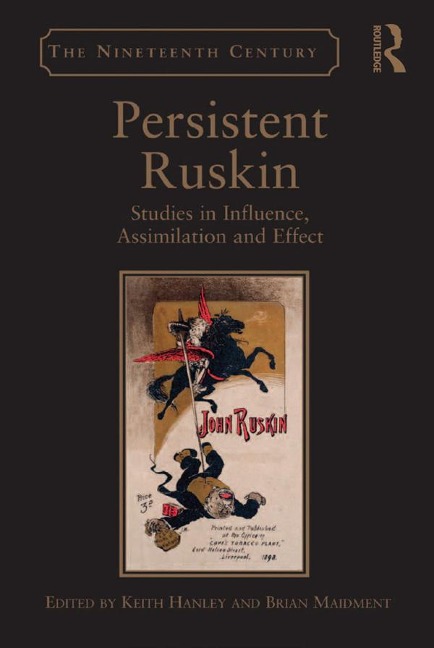
Examining the wide-ranging implications of Ruskin's engagement with his contemporaries and followers, this collection is organized around three related themes: Ruskin's intellectual legacy and the extent to which its address to working men and women and children was realised in practice; Ruskin's followers and their sites of influence, especially those related to the formation of collections, museums, archives and galleries representing values and ideas associated with Ruskin; and the extent to which Ruskin's work constructed a world-wide network of followers, movements and social gestures that acknowledge his authority and influence. As the introduction shows, Ruskin's continuing digital presence is striking and makes a case for Ruskin's persistent presence. The collection begins with essays on Ruskin's intellectual presence in nineteenth-century thought, with some emphasis on his interest in the education of women. This section is followed by one on Ruskin's followers from the mid-nineteenth century into twentieth-century modernism that looks at a broad range of cultural activities that sought to further, repudiate, or exemplify Ruskin's work and teaching. Working-class education, the Ruskinian periodical, plays, and science fiction are all considered along with the Bloomsbury Group's engagement with Ruskin's thought and writing. Essays on Ruskin abroad-in America, Australia, and India round out the collection.
Keith Hanley is Professor of English Literature at Lancaster University, where he directed the Ruskin Centre from 2000-2008. Other Ruskin-related publications include John Ruskin's Romantic Tours 1837-1838: Travelling North (2007) and, with John Walton, Constructing Cultural Travel:John Ruskin and the Direction of the Tourist Gaze (2011). Brian Maidment is Professor of the History of Print in the English Department at Liverpool John Moores University. He is the author of Comedy, Caricature and the Social Order 1820-1850.
Introduction Ruskin's 'Common Treasuries', Keith Hanley, Brian Maidment; Part 1 Spreading the Word - Readerships, Audiences, Listeners; Chapter 1 John Ruskin and the Working Classes in Mid-Victorian Britain, Lawrence Goldman; Chapter 2 John Ruskin and the Idea of a Museum, Marcus Waithe; Chapter 3 Of Ruskin, Women and Power, Rachel Dickinson; Chapter 4 Influence, Presence, Appropriation - Ruskinian Periodicals 1890-1910, Brian Maidment; Part 2 Followers and Their Sites of Influence; Chapter 5 1This is one of a sequence of articles on the topic of Ruskin and influence. See also F. O'Gorman, 'Ruskin's Aesthetic of Failure in The Stones of Venice', Review of English Studies, 55 (), 374-91; 'Ruskin, Venice, and the Endurance of Authorship', Nineteenth Century Studies, 19 (), 83-97; and 'Ruskin's Mountain Gloom' in ed. Keith Hanley and Rachel Dickinson, Ruskin and the Struggle for Coherence (Cambridge: Cambridge Scholars P 2007), pp.123-50. See also chapter 4 of my book Victorian Literature and the Unbounded Life (Manchester: Manchester UP )., Francis O'Gorman; Chapter 6 Christian Socialism on the Stage: Henry Arthur Jones's Wealth (1889) and the Dramatisation of Ruskinian Political Economy, Peter Yeandle; Chapter 7 Enduring Ruskin? Bloomsbury's Anxieties of Influence, Andrew Leng; Chapter 8 Ruskin's Theory of the Ideal Dress and Textile Analogy in Medieval Architecture, Anuradha Chatterjee; Part 3 World-wide Ruskin; Chapter 9 Deep Seers: John Ruskin, Charles Herbert Moore and the Teaching of Art at Harvard, Melissa Renn; Chapter 10 Masters and Men: Ruskin and the Sydney Building World of the 1890s, Mark Stiles; Chapter 11 Ruskin, Morris and the Terraforming of Mars, Tony Pinkney; Chapter 12 1Some ideas in this essay were first broached in my lecture, 'The Ruskin Diaspora', delivered at Kyoto University of Art and Design, on 24 May 2005, and subsequently translated into Japanese in the Ruskin Library News (Tokyo 2005)., Keith Hanley;
Dieses eBook wird im PDF-Format geliefert und ist mit einem Adobe Kopierschutz (DRM) versehen. Sie können dieses eBook mit allen Geräten lesen, die das PDF-Format und den Adobe Kopierschutz (DRM) unterstützen.
Zum Beispiel mit den folgenden Geräten:
• tolino Reader
Laden Sie das eBook direkt über den Reader-Shop auf dem tolino herunter oder übertragen Sie das eBook auf Ihren tolino mit einer kostenlosen Software wie beispielsweise Adobe Digital Editions.
• Sony Reader & andere eBook Reader
Laden Sie das eBook direkt über den Reader-Shop herunter oder übertragen Sie das eBook mit der kostenlosen Software Sony READER FOR PC/Mac oder Adobe Digital Editions auf ein Standard-Lesegeräte mit epub- und Adobe DRM-Unterstützung.
• Tablets & Smartphones
Möchten Sie dieses eBook auf Ihrem Smartphone oder Tablet lesen, finden Sie hier unsere kostenlose Lese-App für iPhone/iPad und Android Smartphone/Tablets.
• PC & Mac
Lesen Sie das eBook direkt nach dem Herunterladen mit einer kostenlosen Lesesoftware, beispielsweise Adobe Digital Editions, Sony READER FOR PC/Mac oder direkt über Ihre eBook-Bibliothek in Ihrem Konto unter „Meine eBooks“ - „online lesen“.
Schalten Sie das eBook mit Ihrer persönlichen Adobe ID auf bis zu sechs Geräten gleichzeitig frei.
Bitte beachten Sie, dass die Kindle-Geräte das Format nicht unterstützen und dieses eBook somit nicht auf Kindle-Geräten lesbar ist.