Und dann auf "Zum Home-Bildschirm [+]".

Stöbern
genialokal zum Startbildschirm hinzufügen
Installieren Sie die genialokal App auf Ihrem Startbildschirm für einen schnellen Zugriff und eine komfortable Nutzung.
Installieren Sie die genialokal App auf Ihrem Startbildschirm für einen schnellen Zugriff und eine komfortable Nutzung.
Ihr gewünschter Artikel ist in 0 Buchhandlungen vorrätig - wählen Sie hier eine Buchhandlung in Ihrer Nähe aus:

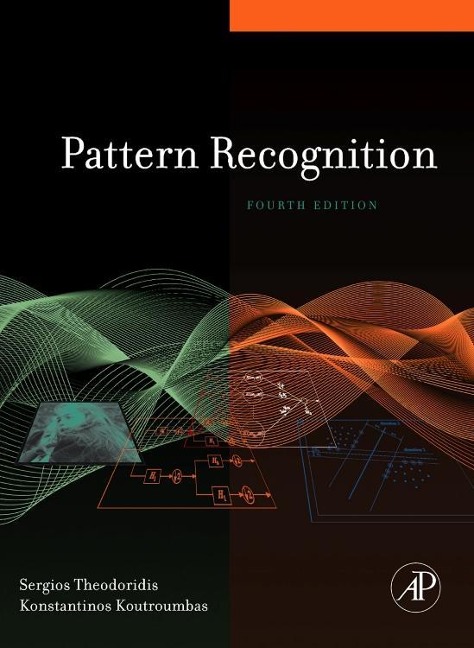
This book considers classical and current theory and practice, of supervised, unsupervised and semi-supervised pattern recognition, to build a complete background for professionals and students of engineering. The authors, leading experts in the field of pattern recognition, have provided an up-to-date, self-contained volume encapsulating this wide spectrum of information. The very latest methods are incorporated in this edition: semi-supervised learning, combining clustering algorithms, and relevance feedback. · Thoroughly developed to include many more worked examples to give greater understanding of the various methods and techniques · Many more diagrams included--now in two color--to provide greater insight through visual presentation · Matlab code of the most common methods are given at the end of each chapter. · More Matlab code is available, together with an accompanying manual, via this site · Latest hot topics included to further the reference value of the text including non-linear dimensionality reduction techniques, relevance feedback, semi-supervised learning, spectral clustering, combining clustering algorithms. · An accompanying book with Matlab code of the most common methods and algorithms in the book, together with a descriptive summary, and solved examples including real-life data sets in imaging, and audio recognition. The companion book will be available separately or at a special packaged price (ISBN: 9780123744869).
Konstantinos Koutroumbas acquired a degree from the University of Patras, Greece in Computer Engineering and Informatics in 1989, a MSc in Computer Science from the University of London, UK in 1990, and a Ph.D. degree from the University of Athens in 1995. Since 2001 he has been with the Institute for Space Applications and Remote Sensing of the National Observatory of Athens.
1. Introduction2. Classifiers based on Bayes Decision 3. Linear Classifiers4. Nonlinear Classifiers5. Feature Selection6. Feature Generation I: Data Transformation and Dimensionality Reduction7. Feature Generation II8. Template Matching 9. Context Depedant Clarification10. System Evaultion11. Clustering: Basic Concepts12. Clustering Algorithms: Algorithms L Sequential 13. Clustering Algorithms II: Hierarchical 14. Clustering Algorithms III: Based on Function Optimization 15. Clustering Algorithms IV: Clustering16. Cluster Validity