Und dann auf "Zum Home-Bildschirm [+]".

Stöbern
genialokal zum Startbildschirm hinzufügen
Installieren Sie die genialokal App auf Ihrem Startbildschirm für einen schnellen Zugriff und eine komfortable Nutzung.
Installieren Sie die genialokal App auf Ihrem Startbildschirm für einen schnellen Zugriff und eine komfortable Nutzung.
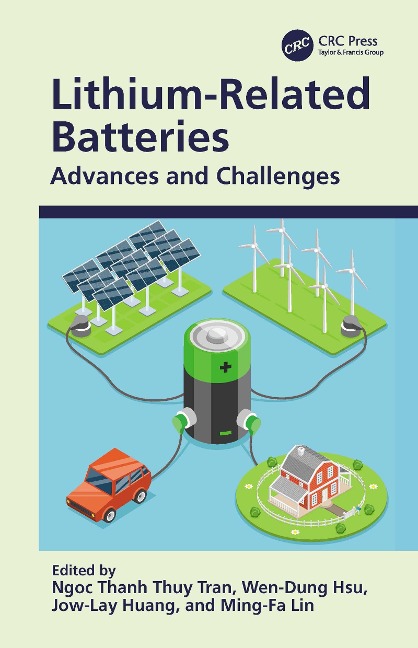
This book serves as a comprehensive treatment of the advanced microscopic properties of lithium- and sodium-based batteries. It focuses on the development of the quasiparticle framework and the successful syntheses of cathode/electrolyte/anode materials in these batteries. FEATURES - Highlights lithium-ion and sodium-ion batteries as well as lithium sulfur-, aluminum-, and iron-related batteries - Describes advanced battery materials and their fundamental properties - Addresses challenges to improving battery performance - Develops theoretical predictions and experimental observations under a unified quasiparticle framework - Targets core issues such as stability and efficiencies Lithium-Related Batteries: Advances and Challenges will appeal to researchers and advanced students working in battery development, including those in the fields of materials, chemical, and energy engineering.
Ngoc Thanh Thuy Tran works as a postdoctoral researcher at Center for Micro/Nano Science and Technology, National Cheng Kung University. Wen-Dung Hsu is Associate Professor, Department of Materials Science and Engineering, National Cheng Kung University. Jow-Lay Huang is Professor, Department of Materials Science and Engineering, National Cheng Kung University. Ming-Fa Lin is NCKU Distinguished Professor of Physics, National Cheng Kung University.
1. Introduction 2. Small Polaron-Li-Ion Complex Diffusion in the Cathodes of Rechargeable Li-Ion Batteries 3. Enrichment of Optical Excitations of LiFeO2 4. Positive Electrode Stability in Higher Voltage Region 5. Layered Cathode Materials for Sodium-Ion Batteries (SIBs): Synthesis, Structure, and Characterization 6. Essential Geometric and Electronic Properties in Stage-n FeCl3-Graphite Intercalation Compounds 7. Studying the Anisotropic Lithiation Mechanisms of Silicon Anode in Li-Ion Batteries Using Molecular Dynamic Simulations 8. Optical Properties of Monolayer and Lithium-Intercalated HfX2 (X = S, Se, or Te) for Lithium-Ion Batteries 9. Mn-Based Oxide Nanocomposite with Reduced Graphene Oxide as Anode Material in Li-Ion Battery 10. In-situ Synthesis of Solid-State Polymer Electrolytes for Lithium-Ion Batteries 11. Rich Quasiparticle Properties of Li2S Electrolyte in Lithium-Sulfur Battery 12. Diversified Quasiparticle Phenomena of P2S5: Electrolyte in Lithium-Sulfur Battery 13. Cathode/Electrolyte Interface in High-Voltage Lithium-Ion Batteries: A First-Principles Study 14. Electrode/Electrolyte Interfaces in Sodium-Ion Battery: Roles, Structure, and Properties 15. Concluding Remarks 16. Open Issues and Challenges 17. Problems
Dieses eBook wird im PDF-Format geliefert und ist mit einem Adobe Kopierschutz (DRM) versehen. Sie können dieses eBook mit allen Geräten lesen, die das PDF-Format und den Adobe Kopierschutz (DRM) unterstützen.
Zum Beispiel mit den folgenden Geräten:
• tolino Reader
Laden Sie das eBook direkt über den Reader-Shop auf dem tolino herunter oder übertragen Sie das eBook auf Ihren tolino mit einer kostenlosen Software wie beispielsweise Adobe Digital Editions.
• Sony Reader & andere eBook Reader
Laden Sie das eBook direkt über den Reader-Shop herunter oder übertragen Sie das eBook mit der kostenlosen Software Sony READER FOR PC/Mac oder Adobe Digital Editions auf ein Standard-Lesegeräte mit epub- und Adobe DRM-Unterstützung.
• Tablets & Smartphones
Möchten Sie dieses eBook auf Ihrem Smartphone oder Tablet lesen, finden Sie hier unsere kostenlose Lese-App für iPhone/iPad und Android Smartphone/Tablets.
• PC & Mac
Lesen Sie das eBook direkt nach dem Herunterladen mit einer kostenlosen Lesesoftware, beispielsweise Adobe Digital Editions, Sony READER FOR PC/Mac oder direkt über Ihre eBook-Bibliothek in Ihrem Konto unter „Meine eBooks“ - „online lesen“.
Schalten Sie das eBook mit Ihrer persönlichen Adobe ID auf bis zu sechs Geräten gleichzeitig frei.
Bitte beachten Sie, dass die Kindle-Geräte das Format nicht unterstützen und dieses eBook somit nicht auf Kindle-Geräten lesbar ist.