Und dann auf "Zum Home-Bildschirm [+]".

Stöbern
genialokal zum Startbildschirm hinzufügen
Installieren Sie die genialokal App auf Ihrem Startbildschirm für einen schnellen Zugriff und eine komfortable Nutzung.
Installieren Sie die genialokal App auf Ihrem Startbildschirm für einen schnellen Zugriff und eine komfortable Nutzung.
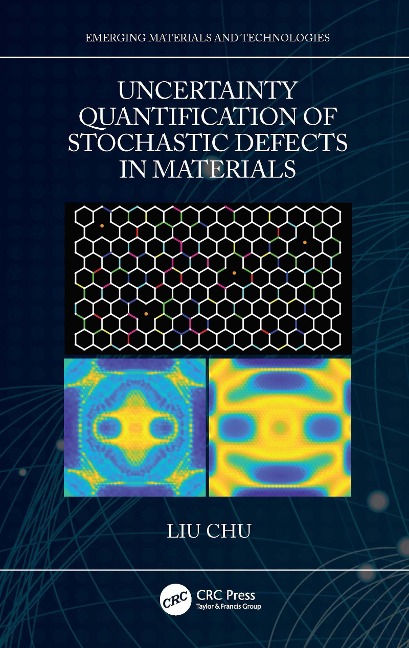
Uncertainty Quantification of Stochastic Defects in Materials investigates the uncertainty quantification methods for stochastic defects in material microstructures. It provides effective supplementary approaches for conventional experimental observation with the consideration of stochastic factors and uncertainty propagation. Pursuing a comprehensive numerical analytical system, this book establishes a fundamental framework for this topic, while emphasizing the importance of stochastic and uncertainty quantification analysis and the significant influence of microstructure defects on the material macro properties. Key Features - Consists of two parts: one exploring methods and theories and the other detailing related examples - Defines stochastic defects in materials and presents the uncertainty quantification for defect location, size, geometrical configuration, and instability - Introduces general Monte Carlo methods, polynomial chaos expansion, stochastic finite element methods, and machine learning methods - Provides a variety of examples to support the introduced methods and theories - Applicable to MATLAB® and ANSYS software This book is intended for advanced students interested in material defect quantification methods and material reliability assessment, researchers investigating artificial material microstructure optimization, and engineers working on defect influence analysis and nondestructive defect testing.
Dr. Liu Chu received her B.E. degree in Materials Science and Engineering, and M.E. degree in Mechanics from Dalian Maritime University, China, and the Ph.D. in Mechanics from the Institut national des sciences appliquées de Rouen (INSA Rouen), France. Dr. Chu focuses on research in computational material mechanics and structural reliability. Her recent research interests include low-dimensional nanomaterial vacancy defects quantification, artificial material microstructure optimization, and mechanical structure reliability analysis. Since 2018, Dr. Chu has published 18 peer-reviewed science and technical papers in international journals and conferences. She is a member of IEEE and has served as a reviewer of several international journals.
1. Overview. 2. Stochastic Defects. Part I: Methods and Theories. 3. Monte Carlo Methods. 4. Polynomial Chaos Expansion. 5. Stochastic Finite Element Method. 6. Machine Learning Methods. Part II: Examples. 7. Numerical Examples. 8. Monte Carlo-based Finite Element Method. 9. Impacts of Vacancy Defects in Resonant Vibration. 10. Uncertainty Quantification in Nanomaterial. 11. Equivalent Young's Modulus Prediction. 12. Strengthen Possibility by Random Vacancy Defects.
Dieses eBook wird im PDF-Format geliefert und ist mit einem Adobe Kopierschutz (DRM) versehen. Sie können dieses eBook mit allen Geräten lesen, die das PDF-Format und den Adobe Kopierschutz (DRM) unterstützen.
Zum Beispiel mit den folgenden Geräten:
• tolino Reader
Laden Sie das eBook direkt über den Reader-Shop auf dem tolino herunter oder übertragen Sie das eBook auf Ihren tolino mit einer kostenlosen Software wie beispielsweise Adobe Digital Editions.
• Sony Reader & andere eBook Reader
Laden Sie das eBook direkt über den Reader-Shop herunter oder übertragen Sie das eBook mit der kostenlosen Software Sony READER FOR PC/Mac oder Adobe Digital Editions auf ein Standard-Lesegeräte mit epub- und Adobe DRM-Unterstützung.
• Tablets & Smartphones
Möchten Sie dieses eBook auf Ihrem Smartphone oder Tablet lesen, finden Sie hier unsere kostenlose Lese-App für iPhone/iPad und Android Smartphone/Tablets.
• PC & Mac
Lesen Sie das eBook direkt nach dem Herunterladen mit einer kostenlosen Lesesoftware, beispielsweise Adobe Digital Editions, Sony READER FOR PC/Mac oder direkt über Ihre eBook-Bibliothek in Ihrem Konto unter „Meine eBooks“ - „online lesen“.
Schalten Sie das eBook mit Ihrer persönlichen Adobe ID auf bis zu sechs Geräten gleichzeitig frei.
Bitte beachten Sie, dass die Kindle-Geräte das Format nicht unterstützen und dieses eBook somit nicht auf Kindle-Geräten lesbar ist.