Und dann auf "Zum Home-Bildschirm [+]".

Stöbern
genialokal zum Startbildschirm hinzufügen
Installieren Sie die genialokal App auf Ihrem Startbildschirm für einen schnellen Zugriff und eine komfortable Nutzung.
Installieren Sie die genialokal App auf Ihrem Startbildschirm für einen schnellen Zugriff und eine komfortable Nutzung.


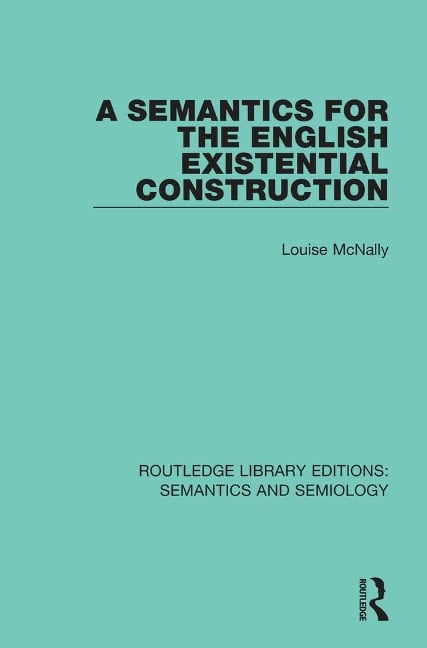
First published in 1997, this book addresses the question: What is the interpretation of English there-existential construction? One of the principal goals is to develop an interpretation for the construction that will specifically address other properties of the postcopular DP. After outlining the problem, the author goes on to present a syntactic motivation for the claim that the postcopular DP is the sole complement to the existential predicate, as well as for the claim that the optional final phrase is a predictive adjunct. In chapter 3 the interpretation for the basic existential construction is developed and then compared to analyses that take the postcopular DP to denote an ordinary individual or a generalised quantifier of individuals. This analysis is then augmented to account for the contribution of the final XP and shows how the predicate restriction can be derived from a more general condition on depictive/circumstantial VP-adjuncts. The final chapter contain some speculative discussion of the broader implications of the proposal in the context of data such as "list" existential and "presentational-there" sentences.
Louise McNally
1 The Problem; 1.1 Introduction 1.2 Facts of be Accounted For 1.2.1 The Definiteness Effect 1.2.2 The Predicate Restriction 1.3 Previous Analyses 1.3.1 There-Insertion and Its Descendants 1.3.2 Previous Characterizations of the DE 1.3.3 The Predicate Restriction 1.4 Outline of Remaining Chapters; 2 Existential Syntax; 2.1 Introduction 2.2 Identifying VP-Adjuncts 2.2.1 Description 2.2.2 A Proposal for Depictive Adjuncts 2.3 Why a DP-External XP Must Be Posited 2.3.1 Arguments for Independence 2.3.2 Williams' Counterarguments 2.4 Supporting the Adjunct Analysis 2.4.1 Stowell's Small clause Diagnostics 2.4.2 Extraction 2.5 Chapter Summary; 3 The Existential, Descriptions, and Instantiation; 3.1 Introduction 3.2 Data to Be Accounted For 3.2.1 Quantificational DPs 3.2.2 Scope 3.2.3 Contact Clauses 3.2.4 Relative Clauses 3.3 Property Theory 3.3.1 The Syntax of PT 3.3.2 The Interpretation of PT 3.4 Interpreting the Existential 3.4.1 A Dynamic PT Fragment of English 3.4.2 Interpreting Existential Sentences 3.5 Definites and the Other Half of the DE 3.5.1 Augmenting the Fragment 3.5.2 A Felicity Condition on Existentials 3.5.3 Summary 3.6 Advantages of the Analysis 3.6.1 Acceptability of Quantified Kind DPs 3.6.2 Quantification and Scope 3.6.3 Contact Clauses 3.6.4 Relativization 3.6.5 Summary; 4 Adjunct Predicates and the Predicate Restriction; 4.1 Introduction 4.2 Interpreting Depictive Adjuncts 4.2.1 The Adjunct Rule 4.2.2 Individual/Stage Sensitivity 4.3 Extending the Analysis 4.3.1 Nominalized Functions as Controllers 4.3.2 The Predicate Restriction Revisited 4.4 Eventive Existentials 4.4.1 The Problem 4.4.2 Eventive Participles 4.4.3 Why These Existentials Are Not Passives 4.4.4 A Proposal 4.5 Chapter Summary; 5 Some Final Remarks; 5.1 Introduction 5.2 Definites in the Existential 5.2.1 List Existentials 5.2.2 Focus and Existential 5.3 Other Expectations 5.3.1 Other Expletive There Sentences 5.3.2 The Existential and Other Indexicals; References; Index
Dieses eBook wird im PDF-Format geliefert und ist mit einem Adobe Kopierschutz (DRM) versehen. Sie können dieses eBook mit allen Geräten lesen, die das PDF-Format und den Adobe Kopierschutz (DRM) unterstützen.
Zum Beispiel mit den folgenden Geräten:
• tolino Reader
Laden Sie das eBook direkt über den Reader-Shop auf dem tolino herunter oder übertragen Sie das eBook auf Ihren tolino mit einer kostenlosen Software wie beispielsweise Adobe Digital Editions.
• Sony Reader & andere eBook Reader
Laden Sie das eBook direkt über den Reader-Shop herunter oder übertragen Sie das eBook mit der kostenlosen Software Sony READER FOR PC/Mac oder Adobe Digital Editions auf ein Standard-Lesegeräte mit epub- und Adobe DRM-Unterstützung.
• Tablets & Smartphones
Möchten Sie dieses eBook auf Ihrem Smartphone oder Tablet lesen, finden Sie hier unsere kostenlose Lese-App für iPhone/iPad und Android Smartphone/Tablets.
• PC & Mac
Lesen Sie das eBook direkt nach dem Herunterladen mit einer kostenlosen Lesesoftware, beispielsweise Adobe Digital Editions, Sony READER FOR PC/Mac oder direkt über Ihre eBook-Bibliothek in Ihrem Konto unter „Meine eBooks“ - „online lesen“.
Schalten Sie das eBook mit Ihrer persönlichen Adobe ID auf bis zu sechs Geräten gleichzeitig frei.
Bitte beachten Sie, dass die Kindle-Geräte das Format nicht unterstützen und dieses eBook somit nicht auf Kindle-Geräten lesbar ist.