Und dann auf "Zum Home-Bildschirm [+]".

Stöbern
genialokal zum Startbildschirm hinzufügen
Installieren Sie die genialokal App auf Ihrem Startbildschirm für einen schnellen Zugriff und eine komfortable Nutzung.
Installieren Sie die genialokal App auf Ihrem Startbildschirm für einen schnellen Zugriff und eine komfortable Nutzung.

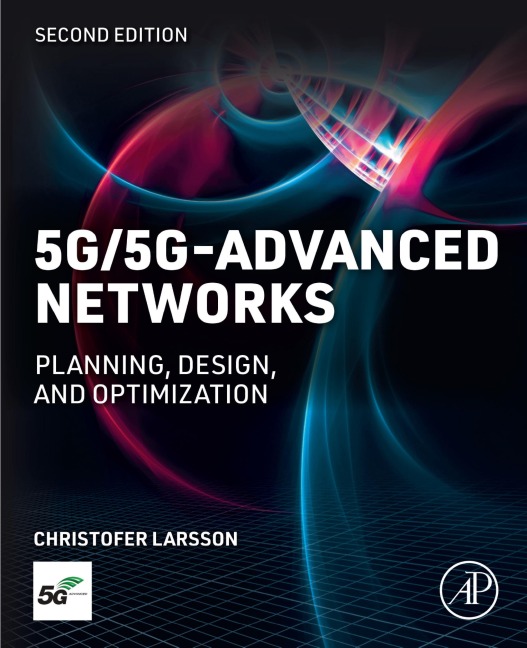
5G/5G Advanced Networks: Planning, Design and Optimization, 2nd edition, presents practical methods and algorithms for the design of 5G/5G Advanced Networks, covering topics that range from network resilience to how streaming data analytics can be used in network orchestration and slice optimization. The book addresses 5G optimization issues that are data driven, high dimensional and clustered The new edition is extensively revised and updated with 5 new chapters: - Information theory applied to design targets and performance limits - 5G+radio interface and radio planning - Heavy traffic analysis - Network slicing - Machine learning methods for offline analytics This new edition now gives a broad and complete foundation in network optimization techniques for all subsystems of the cellular network by: - Showing how to optimize networks end-to-end, including dependencies between subsystems - Presenting network tuning methods to improve capacity, service quality, energy efficiency, and resilience - in relation to cost - Presenting designs of network slices with multi-objective performance targets The new edition also includes new practical hints sections that show algorithm implementation (end-to-end and unit testing), solution validation, bench-marking, potential pitfalls, the use of open-source software, illustration of code objects with examples in Python. 5G/5G Advanced Networks: Planning, Design and Optimization, 2nd edition, is an invaluable resource for telecom operators and service providers, university researchers, graduate students and network planners interested in practical methods for optimizing networks for large performance improvements and cost savings. - 5G/5G Advanced concepts, how they are linked and their effect on the architecture of a 5G/5G Advanced network - Models of 5G/5G Advanced at a network level, including economic aspects of operating a network - The economic implications of scale and service diversity, and the incentive for optimal design and operational strategies - Network topologies from a transport to a cloud perspective - Theoretic foundations for network design and network optimization - Algorithms for practical design and optimization of 5G subsystems based on live network projects - The trade-off and multi-objective character of QoS management and cost saving - Practical traffic and resilience measurement and QoS supervision - Frameworks for performance analytics and network control - Design, optimization and management of network slices
Christofer Larsson, an Engineering Physics graduate of the Royal Institute of Technology in Stockholm, Sweden, is a consultant in network design and optimization, and a textbook author. Taking a strong interest in engineering mathematics, Christofer has during three decades in IT and telecommunications participated in the design and implementation of several successful innovative network solutions. Christofer has held positions as system designer, software architect, tester, trainer, technical writer, and manager. After a decade with Ericsson, he has been a consulting partner with system vendors, network operators and software providers, including Ericsson, NSN, Siemens, Deutsche Telekom, Vodafone-Hutchinson, and Orange
1. 5G Concepts and ArchitecturePART I - PRELIMINARIES2. Network Modeling and Analysis3. Clustering, Partitioning, and Assignment4. Optimization TechniquesPART II - THE RADIO SUBSYSTEM5. Information, Coding, and Modulation6. Radio Network Design7. Access Network DesignPART III - THE CORE SUBSYSTEM8. Reliability and Performance Analysis9. Capacitated Network Design10. Resilient Backbone DesignPART IV - TRAFFIC ENGINEERING11. Traffic Routing12. Traffic Modeling and Effective Bandwidth13. Heavy Traffic AnalysisPART V - NETWORK MONITORING AND CONTROL14. Batch Data Analytics15. Streaming Data Analytics16. Dynamic Resource ManagementPART VI - SERVICE DIFFERENTIATION17. Network Slicing18. Internet of Things