Und dann auf "Zum Home-Bildschirm [+]".

Stöbern
genialokal zum Startbildschirm hinzufügen
Installieren Sie die genialokal App auf Ihrem Startbildschirm für einen schnellen Zugriff und eine komfortable Nutzung.
Installieren Sie die genialokal App auf Ihrem Startbildschirm für einen schnellen Zugriff und eine komfortable Nutzung.
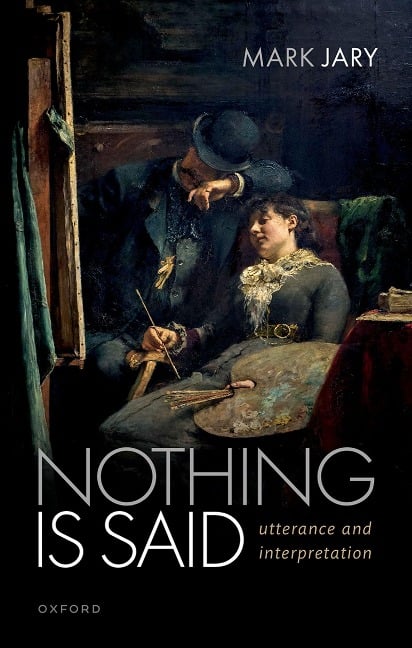
In everyday talk about language, we distinguish between what someone said and what they implied, or otherwise conveyed. This distinction has been carried over into theorising about language and communication, resulting in much debate about how the notion of what is said should be defined. Against the underlying assumption of these disputes, Nothing is Said argues that it is a mistake to import the notion of saying into our models of basic linguistic communication.
Rather than belonging to our basic linguistic competence, the notion of saying is a reflective one resulting from a higher-order metacommunicative competence that is relatively late-developing. This competence allows us to reflect simultaneously on the form and content of an utterance, and hence characterise it as an act of saying. The study shows how this notion of saying can be accounted for without assuming that identifying what is said is a necessary step in basic utterance interpretation.
The idea that linguistic interpretation relies on identifying what is said is deeply ingrained. Mark Jary considers the consequences for semantic and pragmatic theory of dropping this assumption, focusing on lexical pragmatics, scalar implicature, assertion, lying, and other topics that have received significant attention in the recent literature. The claims made are supported by reference to empirical data from experimental psychology.
Mark Jary is Emeritus Professor of Linguistics and Philosophy at the University of Roehampton, where he taught for over 20 years. He has published widely on topics relating to speech acts, linguistic mood, theory of mind, and the interaction between these.
- Introduction - 1: Varieties of what is said - 2: Linguistic vs. behavioural communication - 3: Linguistic communication proper - 4: What is said and behavioural communication - 5: Pragmatics when nothing is said - 6: Assertion when nothing is said - 7: The Brandomian substrate - Conclusion
Dieses eBook wird im PDF-Format geliefert und ist mit einem Adobe Kopierschutz (DRM) versehen. Sie können dieses eBook mit allen Geräten lesen, die das PDF-Format und den Adobe Kopierschutz (DRM) unterstützen.
Zum Beispiel mit den folgenden Geräten:
• tolino Reader
Laden Sie das eBook direkt über den Reader-Shop auf dem tolino herunter oder übertragen Sie das eBook auf Ihren tolino mit einer kostenlosen Software wie beispielsweise Adobe Digital Editions.
• Sony Reader & andere eBook Reader
Laden Sie das eBook direkt über den Reader-Shop herunter oder übertragen Sie das eBook mit der kostenlosen Software Sony READER FOR PC/Mac oder Adobe Digital Editions auf ein Standard-Lesegeräte mit epub- und Adobe DRM-Unterstützung.
• Tablets & Smartphones
Möchten Sie dieses eBook auf Ihrem Smartphone oder Tablet lesen, finden Sie hier unsere kostenlose Lese-App für iPhone/iPad und Android Smartphone/Tablets.
• PC & Mac
Lesen Sie das eBook direkt nach dem Herunterladen mit einer kostenlosen Lesesoftware, beispielsweise Adobe Digital Editions, Sony READER FOR PC/Mac oder direkt über Ihre eBook-Bibliothek in Ihrem Konto unter „Meine eBooks“ - „online lesen“.
Schalten Sie das eBook mit Ihrer persönlichen Adobe ID auf bis zu sechs Geräten gleichzeitig frei.
Bitte beachten Sie, dass die Kindle-Geräte das Format nicht unterstützen und dieses eBook somit nicht auf Kindle-Geräten lesbar ist.