Und dann auf "Zum Home-Bildschirm [+]".

Stöbern
genialokal zum Startbildschirm hinzufügen
Installieren Sie die genialokal App auf Ihrem Startbildschirm für einen schnellen Zugriff und eine komfortable Nutzung.
Installieren Sie die genialokal App auf Ihrem Startbildschirm für einen schnellen Zugriff und eine komfortable Nutzung.
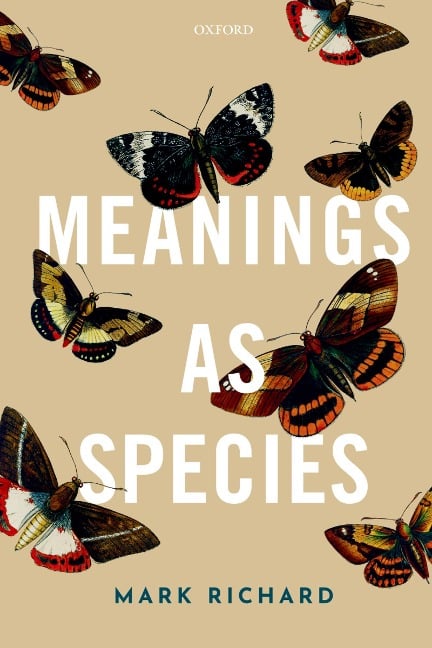
Mark Richard presents an original picture of meaning according to which a word's meaning is analogous to the biological lineages we call species. His primary thesis is that a word's meaning - in the sense of what one needs to track in order to be a competent speaker - is the collection of assumptions its users make in using it and expect their hearers to recognize as being made. Meaning is something that is spread across a population, inherited by each new generation of speakers from the last, and typically evolving in so far as what constitutes a meaning changes in virtue of the interactions of speakers with their (linguistic and social) environment. Meanings as Species develops and defends the analogy between the biological and the linguistic, and includes a discussion of the senses in which the processes of meaning change are and are not like evolution via natural selection. Richard argues that thinking of meanings as species supports Quine's insights about analyticity without rendering talk about meaning theoretically useless. He also discusses the relations between meaning as what the competent speaker knows about her language, meaning as the determinant of reference and truth conditions, and meaning qua what determines what sentence uses say. This book contains insightful discussions of a wide range of topics in the philosophy of language, including: relations between meaning and philosophical analysis, the project of 'conceptual engineering', the senses in which meaning is and is not compositional, the degree to which to which referential meaning is indeterminate, and what such indeterminacy might tells us about propositional attitudes like belief and assertion.
Mark Richard is Professor of Philosophy at Harvard University. He is the author of Propositional Attitudes: An Essay on Thoughts and How We Ascribe Them (Cambridge 1990), When Truth Gives Out (Oxford 2008), and Context and the Attitudes: Meaning in Context, Volume 1 (Oxford 2013) and Truth and Truth Bearers: Meaning in Context, Volume 2 (Oxford 2015).
- Introduction - 1: Quine and the Species Problem - 2: Internalism to the Rescue? - 3: What Are Meanings, that We Might Share Them? - 4: Conceptual Evolution - 5: Meaning, Thought, and its Ascription - 6: Sex and Conversation - Coda - Bibliography
Dieses eBook wird im PDF-Format geliefert und ist mit einem Adobe Kopierschutz (DRM) versehen. Sie können dieses eBook mit allen Geräten lesen, die das PDF-Format und den Adobe Kopierschutz (DRM) unterstützen.
Zum Beispiel mit den folgenden Geräten:
• tolino Reader
Laden Sie das eBook direkt über den Reader-Shop auf dem tolino herunter oder übertragen Sie das eBook auf Ihren tolino mit einer kostenlosen Software wie beispielsweise Adobe Digital Editions.
• Sony Reader & andere eBook Reader
Laden Sie das eBook direkt über den Reader-Shop herunter oder übertragen Sie das eBook mit der kostenlosen Software Sony READER FOR PC/Mac oder Adobe Digital Editions auf ein Standard-Lesegeräte mit epub- und Adobe DRM-Unterstützung.
• Tablets & Smartphones
Möchten Sie dieses eBook auf Ihrem Smartphone oder Tablet lesen, finden Sie hier unsere kostenlose Lese-App für iPhone/iPad und Android Smartphone/Tablets.
• PC & Mac
Lesen Sie das eBook direkt nach dem Herunterladen mit einer kostenlosen Lesesoftware, beispielsweise Adobe Digital Editions, Sony READER FOR PC/Mac oder direkt über Ihre eBook-Bibliothek in Ihrem Konto unter „Meine eBooks“ - „online lesen“.
Schalten Sie das eBook mit Ihrer persönlichen Adobe ID auf bis zu sechs Geräten gleichzeitig frei.
Bitte beachten Sie, dass die Kindle-Geräte das Format nicht unterstützen und dieses eBook somit nicht auf Kindle-Geräten lesbar ist.