Und dann auf "Zum Home-Bildschirm [+]".

Stöbern
genialokal zum Startbildschirm hinzufügen
Installieren Sie die genialokal App auf Ihrem Startbildschirm für einen schnellen Zugriff und eine komfortable Nutzung.
Installieren Sie die genialokal App auf Ihrem Startbildschirm für einen schnellen Zugriff und eine komfortable Nutzung.
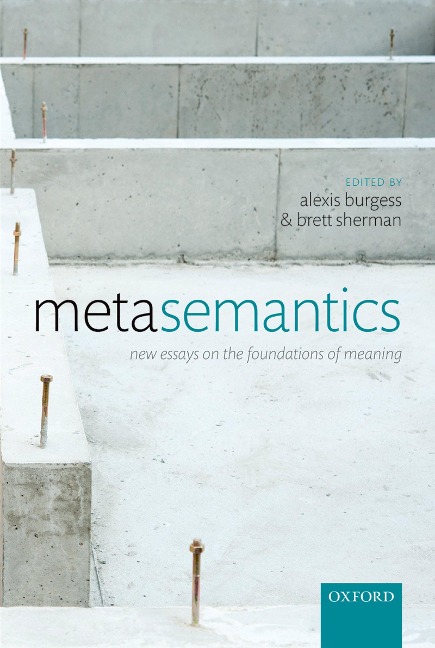
Metasemantics comprises new work on the philosophical foundations of linguistic semantics, by a diverse group of established and emerging experts in the philosophy of language, metaphysics, and the theory of content. The science of semantics aspires to systematically specify the meanings of linguistic expressions in context. The paradigmatic metasemantic question is accordingly: what more basic or fundamental features of the world metaphysically determine these semantic facts? Efforts to answer this question inevitably raise others. Where are the boundaries of semantics? What is the essence of the meaning relation? Which framework should we use for semantic theorizing? What are the intrinsic natures of semantic values? Are the semantic facts metaphysically determinate? What is semantic competence? Metasemantic inquiry has long been recognized as a central part of the philosophy of language, but recent developments in metaphysics and semantics itself now allow us to approach these classic questions with an unprecedented degree of precision. The essays collected here provide promising new perspectives on old problems, pose questions that suggest novel research projects, and taken together, greatly sharpen our understanding of linguistic representation.
Alexis Burgess is an assistant professor of philosophy at Stanford University. He works mainly at the intersection of metaphysics and the philosophy of language. His articles have appeared in journals like Linguistics and Philosophy, Noûs, and The Australasian Journal of Philosophy. With John P. Burgess, he is co-author of Truth (Princeton University Press). ; Brett Sherman is an assistant professor of philosophy at the University of Rochester. His research centers on problems in the philosophy of language and epistemology.
- Preface - Introduction: A Plea for the Metaphysics of Meaning - 1: Seth Yalcin: Semantics and Metasemantics in the Context of Generative Grammar - 2: Michael Caie: Metasemantics and Metaphysical Indeterminacy - 3: Jeffrey C. King: The Metasemantics of Contextual-Sensitivity - 4: Alejandro Pérez Carballo: Semantic Hermeneutics - 5: Mark Greenberg: Troubles for Content I - 6: Mark Greenberg: Troubles for Content II: Explaining Grounding - 7: Amie L. Thomasson: Deflationism in Semantics and Metaphysics - 8: Sam Cumming: Discourse Content - 9: Karen S. Lewis: Do We Need Dynamic Semantics? - 10: Michael Glanzberg: Explanation and Partiality in Semantic Theory - 11: Matti Eklund: Replacing Truth? - 12: Isidora Stojanovic: Prepragmatics: Widening the Semantics/Pragmatics Boundary - 13: Richard G. Heck, Jr.: Semantics and Context-Dependence: Towards a Strawsonian Account
Dieses eBook wird im PDF-Format geliefert und ist mit einem Adobe Kopierschutz (DRM) versehen. Sie können dieses eBook mit allen Geräten lesen, die das PDF-Format und den Adobe Kopierschutz (DRM) unterstützen.
Zum Beispiel mit den folgenden Geräten:
• tolino Reader
Laden Sie das eBook direkt über den Reader-Shop auf dem tolino herunter oder übertragen Sie das eBook auf Ihren tolino mit einer kostenlosen Software wie beispielsweise Adobe Digital Editions.
• Sony Reader & andere eBook Reader
Laden Sie das eBook direkt über den Reader-Shop herunter oder übertragen Sie das eBook mit der kostenlosen Software Sony READER FOR PC/Mac oder Adobe Digital Editions auf ein Standard-Lesegeräte mit epub- und Adobe DRM-Unterstützung.
• Tablets & Smartphones
Möchten Sie dieses eBook auf Ihrem Smartphone oder Tablet lesen, finden Sie hier unsere kostenlose Lese-App für iPhone/iPad und Android Smartphone/Tablets.
• PC & Mac
Lesen Sie das eBook direkt nach dem Herunterladen mit einer kostenlosen Lesesoftware, beispielsweise Adobe Digital Editions, Sony READER FOR PC/Mac oder direkt über Ihre eBook-Bibliothek in Ihrem Konto unter „Meine eBooks“ - „online lesen“.
Schalten Sie das eBook mit Ihrer persönlichen Adobe ID auf bis zu sechs Geräten gleichzeitig frei.
Bitte beachten Sie, dass die Kindle-Geräte das Format nicht unterstützen und dieses eBook somit nicht auf Kindle-Geräten lesbar ist.