Und dann auf "Zum Home-Bildschirm [+]".

Stöbern
genialokal zum Startbildschirm hinzufügen
Installieren Sie die genialokal App auf Ihrem Startbildschirm für einen schnellen Zugriff und eine komfortable Nutzung.
Installieren Sie die genialokal App auf Ihrem Startbildschirm für einen schnellen Zugriff und eine komfortable Nutzung.
Ihr gewünschter Artikel ist in 0 Buchhandlungen vorrätig - wählen Sie hier eine Buchhandlung in Ihrer Nähe aus:

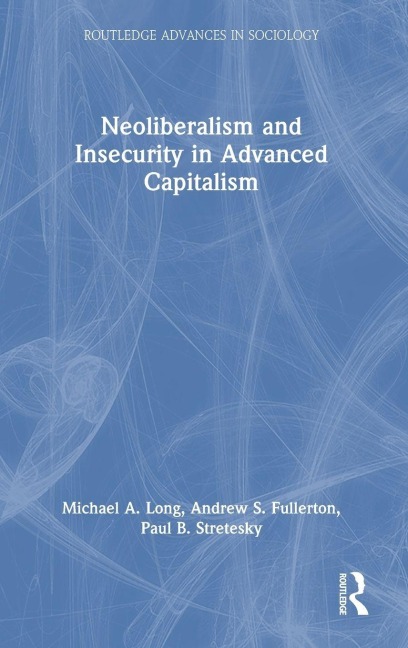

This book examines the relationship between neoliberalism and insecurity beginning with the post-World War II period and continuing up through the present.
Michael A. Long is Professor of Sociology and Director of the Center for Insecurity and Inequality Research at Oklahoma State University. He has written widely on food insecurity, environmental sociology, sustainability, public health, and quantitative methodology. His most recent book is Applying Benford's Law for Assessing the Validity of Social Science Data (with P. Stretesky, K. Berry, J. Johnston, M. Lynch, 2023). Andrew S. Fullerton is Professor of Sociology at Oklahoma State University. He has written widely on job insecurity, quantitative methodology, social stratification, and political sociology. He has published several articles on regression models for ordinal outcomes and a book titled Ordered Regression Models: Parallel, Partial, and Non-Parallel Alternatives (with J. Xu, 2016). Paul B. Stretesky is Professor of Criminology and Director of Teaching and Learning in the School of Social and Political Sciences at the University of Lincoln, UK. His research interests include food insecurity, environmental crime and justice, quantitative methods, and violence. His most recent book, Applying Benford's Law for Assessing the Validity of Social Science Data (2023), was cöauthored with M. Long, K. Berry, J. Johnston, and M. Lynch.
1. Introduction 2. Neoliberalism in the Global North and South 3. The Political Economy of Food and Food Insecurity 4. The Political Economy of Energy and Energy Insecurity 5. The Political Economy of Work and Job Insecurity 6. Neoliberal Governmentality, Competition, Individual Responsibility, and Insecurity 7. The Space of US Neoliberal Capitalism 8. Conclusion