Und dann auf "Zum Home-Bildschirm [+]".

Stöbern
genialokal zum Startbildschirm hinzufügen
Installieren Sie die genialokal App auf Ihrem Startbildschirm für einen schnellen Zugriff und eine komfortable Nutzung.
Installieren Sie die genialokal App auf Ihrem Startbildschirm für einen schnellen Zugriff und eine komfortable Nutzung.
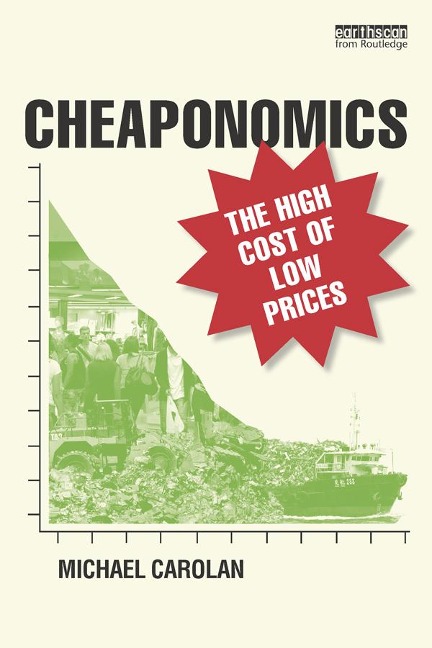
Do you really think you are getting a good deal when given that free mobile phone for switching service providers, if a multinational retailer undercuts its competitors or by the fact that food is relatively cheaper today in many countries than ever before? Think again! As Michael Carolan clearly shows in this compelling book, cheapness is an illusion. The real cost of low prices is alarmingly high. It is shown for example that citizens are frequently subsidising low prices through welfare support to poorly-paid workers in their own country, or relying on the exploitation of workers in poor countries for cheap goods. Environmental pollution may not be costed into goods and services, but is paid for indirectly by people living away from its source or by future generations. Even with private cars, when the total costs of this form of mobility are tallied it proves to be an astronomically expensive model of transportation. All of these costs need to be accounted for. The author captures these issues by the concept of "cheaponomics". The key point is that costs and risks are socialised: we all pay for cheapness, but not at the point of purchase. Drawing on a wide range of examples and issues from over-consumption and waste to over-work, unemployment, inequality, and the depersonalising of communities, it is convincingly shown that cheapness can no longer be seen as such a bargain. Instead we need to refocus for a better sense of well-being, social justice and a balanced approach to prosperity.
Michael Carolan is Professor and Chair of Sociology at Colorado State University, USA. He is the author of several books, including "The Real Cost of Cheap Food", "The Sociology of Food and Agriculture", "Reclaiming Food Security" and "Society and the Environment: Pragmatic Solutions to Ecological Issues".
1. Free Enterprise, Socialism, and Cheaponomics Part 1: Cheap Stuff 2. You Bought that Computer but Someone Else Paid for It 3. Free Plastic Bags (and Other Costly Ephemeral Commodities) 4. The High Cost of Cheap Foods Part 2: Cheap Economies and Communities 5. The Real Cost of Automobiles and Car-munities 6. Retail Concentration and Rock-bottom Prices...But at What Cost? 7. Working Less for More Part 3: Transitioning toward Affordability 8. Comforting the Productivist Zombie 9. Real Prosperity is Priceless 10. Ten Recommendations for the Good, Affordable, and Affording
Dieses eBook wird im PDF-Format geliefert und ist mit einem Adobe Kopierschutz (DRM) versehen. Sie können dieses eBook mit allen Geräten lesen, die das PDF-Format und den Adobe Kopierschutz (DRM) unterstützen.
Zum Beispiel mit den folgenden Geräten:
• tolino Reader
Laden Sie das eBook direkt über den Reader-Shop auf dem tolino herunter oder übertragen Sie das eBook auf Ihren tolino mit einer kostenlosen Software wie beispielsweise Adobe Digital Editions.
• Sony Reader & andere eBook Reader
Laden Sie das eBook direkt über den Reader-Shop herunter oder übertragen Sie das eBook mit der kostenlosen Software Sony READER FOR PC/Mac oder Adobe Digital Editions auf ein Standard-Lesegeräte mit epub- und Adobe DRM-Unterstützung.
• Tablets & Smartphones
Möchten Sie dieses eBook auf Ihrem Smartphone oder Tablet lesen, finden Sie hier unsere kostenlose Lese-App für iPhone/iPad und Android Smartphone/Tablets.
• PC & Mac
Lesen Sie das eBook direkt nach dem Herunterladen mit einer kostenlosen Lesesoftware, beispielsweise Adobe Digital Editions, Sony READER FOR PC/Mac oder direkt über Ihre eBook-Bibliothek in Ihrem Konto unter „Meine eBooks“ - „online lesen“.
Schalten Sie das eBook mit Ihrer persönlichen Adobe ID auf bis zu sechs Geräten gleichzeitig frei.
Bitte beachten Sie, dass die Kindle-Geräte das Format nicht unterstützen und dieses eBook somit nicht auf Kindle-Geräten lesbar ist.