Und dann auf "Zum Home-Bildschirm [+]".

Stöbern
genialokal zum Startbildschirm hinzufügen
Installieren Sie die genialokal App auf Ihrem Startbildschirm für einen schnellen Zugriff und eine komfortable Nutzung.
Installieren Sie die genialokal App auf Ihrem Startbildschirm für einen schnellen Zugriff und eine komfortable Nutzung.
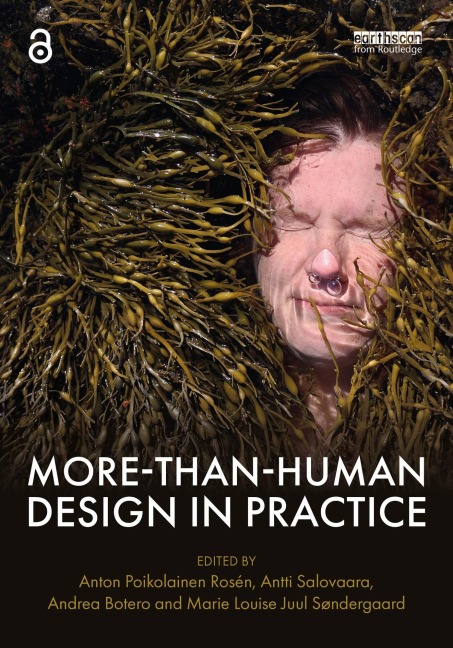
This book provides an overview of the diverse multidisciplinary field of more-than-human design, offering a philosophical grounding of more-than-human design in posthumanism while putting practical design examples and methods to the forefront. There is an urgent need to radically re-imagine design, as its current processes are contributing to global warming, pollution, deforestation, ocean acidification, ozone layer depletion, loss of biodiversity and species extinction. Given this need, 'more-than-human design' has emerged as a perspective that widens our thinking beyond solely human-oriented considerations and needs, such as animals, plants and microbes. The book explores the relationship between sustainability and design, touching on topics such as AI, systems thinking, futures studies and pedagogy, and discusses a range of case study projects that are grounded in more-than-human thinking, demonstrating how this can be incorporated into practice. This easily accessible and theoretically grounded book will provide design researchers and educators an excellent introduction to more-than-human thinking. It will also be of interest to students and scholars studying design more broadly, sustainability, environmental studies and service design, as well as to practicing designers interested in sustainability. Chapters Introduction, 7, 10 and 15 of this book are freely available as a downloadable Open Access PDF at http://www.taylorfrancis.com under a Creative Commons Attribution-Non Commercial-No Derivatives (CC-BY-NC-ND) 4.0 license.
Anton Poikolainen Rosén is a postdoctoral researcher in Human-Computer Interaction at the Department of Design, Aalto University, Helsinki, Finland, and the Department of Computer and Systems Sciences, Stockholm University, Sweden, studying design for sustainable futures and the more-than-human world. His research themes include critical, circular and multisensory approaches to farming and waste management. Antti Salovaara is a Senior University Lecturer at the Department of Design, Aalto University, Finland. His research develops methods for HCI researchers to anticipate possible futures, particularly with a goal that futuring in HCI would not only consider technology-based factors. Andrea Botero is an Associate Professor at the School of Arts, Design and Architecture of Aalto University. Her research and practice aim to understand how collectives (broadly speaking) come to understand the design spaces available to them, what counts as design, what other practices for world making are there, and which ones we need to call into being. Marie Louise Juul Søndergaard is a designer and researcher exploring feminist design of technologies for human and environmental health. She is curious about how the materiality of human bodies relate with ecologies, and uses research-through-design, participation of communities and speculative storytelling to design for social and environmental justice. She has a PhD in Interaction Design from Aarhus University in Denmark and has been a postdoc at KTH Royal Institute of Technology in Sweden and the Oslo School of Architecture and Design in Norway, where she researched somatic approaches in design and more-than-human design.
Prologue: A perspective on posthumanism from outside design Part 1: Focus Areas 1. Design by/for/with/about/without Animals: Tactics for Animal Liberation 2. Being with Plants through Collective Fabulation, Critical Companionship and Cohabitation 3. Biomenstrual: Designing with the More-than-Human Body 4. Trying out Shit: Experimental Approaches for Relating with Microbes 5. Designing with Bodies of Water in the Hydrocene 6. Weathering with storms and grounds as a more-than-human design practice: encountering winds, soils, and rocks 7. Designing with Planetary Artificial Intelligence 8. Creative AI as More-than-Human - Design Practices, Aesthetics and Cultural Imaginaries Part 2: Methods and Pedagogy 9. Multispecies Ethnography in Design Research and Practice 10. Four Questions for Systemic More-Than-Human Design in Practice 11. Staying with Complexity through Multispecies Companionship at the I.N.S.E.C.T. Summercamp 2023 12. How can we design with a multi-species mindset towards regenerative practices? 13. Temporalities of Care in More-than-Human Design 14. Envisioning Multispecies Futures in Multispecies Environments: Methods, Outcomes and Learnings From A Future Scenario Workshop 15. Peering through Time: Harnessing Anticipation in More-than-Human Design 16. Teaching for More-than-human Values and Perspectives in Technology Design 17. Stepping out of the Classroom and Into the Worlds of Other Species Epilogue: Towards Creaturely Ways of Designing
Dieses eBook wird im PDF-Format geliefert und ist mit einem Adobe Kopierschutz (DRM) versehen. Sie können dieses eBook mit allen Geräten lesen, die das PDF-Format und den Adobe Kopierschutz (DRM) unterstützen.
Zum Beispiel mit den folgenden Geräten:
• tolino Reader
Laden Sie das eBook direkt über den Reader-Shop auf dem tolino herunter oder übertragen Sie das eBook auf Ihren tolino mit einer kostenlosen Software wie beispielsweise Adobe Digital Editions.
• Sony Reader & andere eBook Reader
Laden Sie das eBook direkt über den Reader-Shop herunter oder übertragen Sie das eBook mit der kostenlosen Software Sony READER FOR PC/Mac oder Adobe Digital Editions auf ein Standard-Lesegeräte mit epub- und Adobe DRM-Unterstützung.
• Tablets & Smartphones
Möchten Sie dieses eBook auf Ihrem Smartphone oder Tablet lesen, finden Sie hier unsere kostenlose Lese-App für iPhone/iPad und Android Smartphone/Tablets.
• PC & Mac
Lesen Sie das eBook direkt nach dem Herunterladen mit einer kostenlosen Lesesoftware, beispielsweise Adobe Digital Editions, Sony READER FOR PC/Mac oder direkt über Ihre eBook-Bibliothek in Ihrem Konto unter „Meine eBooks“ - „online lesen“.
Schalten Sie das eBook mit Ihrer persönlichen Adobe ID auf bis zu sechs Geräten gleichzeitig frei.
Bitte beachten Sie, dass die Kindle-Geräte das Format nicht unterstützen und dieses eBook somit nicht auf Kindle-Geräten lesbar ist.