Und dann auf "Zum Home-Bildschirm [+]".

Stöbern
genialokal zum Startbildschirm hinzufügen
Installieren Sie die genialokal App auf Ihrem Startbildschirm für einen schnellen Zugriff und eine komfortable Nutzung.
Installieren Sie die genialokal App auf Ihrem Startbildschirm für einen schnellen Zugriff und eine komfortable Nutzung.
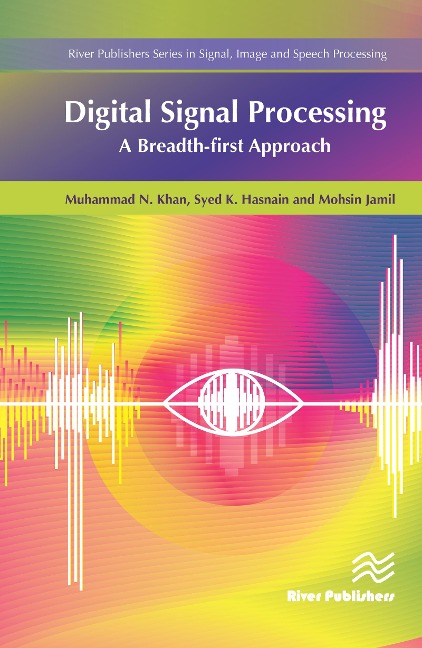
The subject of Digital Signal Processing (DSP) is enormously complex, involving many concepts, probabilities, and signal processing that are woven together in an intricate manner. To cope with this scope and complexity, many DSP texts are often organized around the "numerical examples" of a communication system. With such organization, readers can see through the complexity of DSP, they learn about the distinct concepts and protocols in one part of the communication system while seeing the big picture of how all parts fit together. From a pedagogical perspective, our personal experience has been that such approach indeed works well.Based on the authors' extensive experience in teaching and research, Digital Signal Processing: a breadth-first approach is written with the reader in mind. The book is intended for a course on digital signal processing, for seniors and undergraduate students. The subject has high popularity in the field of electrical and computer engineering, and the authors consider all the needs and tools used in analysis and design of discrete time systems for signal processing.Key features of the book include:. The extensive use of MATLAB based examples to illustrate how to solve signal processing problems. The textbook includes a wealth of problems, with solutions. Worked-out examples have been included to explain new and difficult concepts, which help to expose the reader to real-life signal processing problems. The inclusion of FIR and IIR filter design further enrich the contents
Muhammad Khan, Syed K. Hasnain, Mohsin Jamil
Preface, Acknowledgments, List of Figures, List of Tables, List of Abbreviations, 1. Introduction, 2. Signals and Systems (Continuous and Discrete), 3. Convolution and Correlation, 4. Z-Transform, 5. Solution of Difference Equation, 6. Discrete-Time Fourier Transform Discrete Fourier Transform, 7. Structure for FIR and IIR Filters, 8. Introduction to Digital Filters, 9. Step-by-Step Design of Digital FIR Filters, 10. Step-by-Step Design of IIR Filters, 11. Finite Word-Length Effects in Digital Filters, 12. Review Question with Answers and Multiple Choice Questions, 13. Examination Question Papers, References, Index, About the Authors
Dieses eBook wird im PDF-Format geliefert und ist mit einem Adobe Kopierschutz (DRM) versehen. Sie können dieses eBook mit allen Geräten lesen, die das PDF-Format und den Adobe Kopierschutz (DRM) unterstützen.
Zum Beispiel mit den folgenden Geräten:
• tolino Reader
Laden Sie das eBook direkt über den Reader-Shop auf dem tolino herunter oder übertragen Sie das eBook auf Ihren tolino mit einer kostenlosen Software wie beispielsweise Adobe Digital Editions.
• Sony Reader & andere eBook Reader
Laden Sie das eBook direkt über den Reader-Shop herunter oder übertragen Sie das eBook mit der kostenlosen Software Sony READER FOR PC/Mac oder Adobe Digital Editions auf ein Standard-Lesegeräte mit epub- und Adobe DRM-Unterstützung.
• Tablets & Smartphones
Möchten Sie dieses eBook auf Ihrem Smartphone oder Tablet lesen, finden Sie hier unsere kostenlose Lese-App für iPhone/iPad und Android Smartphone/Tablets.
• PC & Mac
Lesen Sie das eBook direkt nach dem Herunterladen mit einer kostenlosen Lesesoftware, beispielsweise Adobe Digital Editions, Sony READER FOR PC/Mac oder direkt über Ihre eBook-Bibliothek in Ihrem Konto unter „Meine eBooks“ - „online lesen“.
Schalten Sie das eBook mit Ihrer persönlichen Adobe ID auf bis zu sechs Geräten gleichzeitig frei.
Bitte beachten Sie, dass die Kindle-Geräte das Format nicht unterstützen und dieses eBook somit nicht auf Kindle-Geräten lesbar ist.