Und dann auf "Zum Home-Bildschirm [+]".

Stöbern
genialokal zum Startbildschirm hinzufügen
Installieren Sie die genialokal App auf Ihrem Startbildschirm für einen schnellen Zugriff und eine komfortable Nutzung.
Installieren Sie die genialokal App auf Ihrem Startbildschirm für einen schnellen Zugriff und eine komfortable Nutzung.
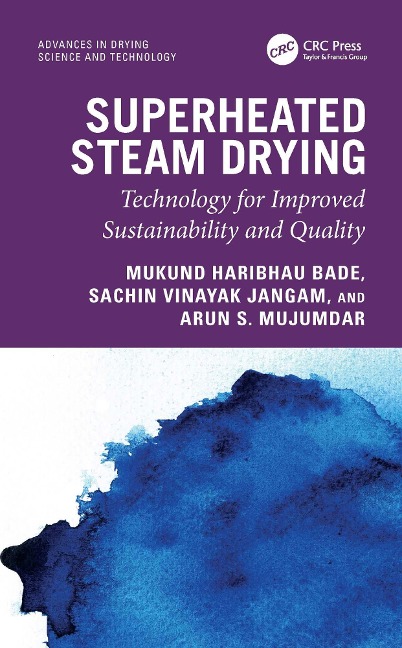
Superheated steam drying (SSD) has long been recognized for several major advantages it offers over other convective dryers, including high energy efficiency by utilization of energy in the exhaust steam, higher product quality due to the absence of oxygen, and avoidance of fire and explosion hazards. Offering a global critical overview of the current state of art, Superheated Steam Drying: Technology for Improved Sustainability and Quality assesses future needs and opportunities for industry adoption and further innovation in SSD. It covers SSD technologies for various industrial sectors and mathematical modeling approaches to help with design and scale-up. The effects of SSD on drying kinetics as well as product quality are also discussed with examples. This book serves as a useful reference for technicians, graduate students, and researchers in the field of drying technology. It can also be used in courses on industrial drying, processing and drying of food, advanced drying technology, and superheated steam drying.
Mukund Haribhau Bade holds a PhD in energy modeling and process integration from the Department of Energy Science and Engineering, IIT Bombay, Mumbai, India. He has over 24 years of teaching and research experience in various technical institutes. He is currently working as an associate professor at the Department of Mechanical Engineering, SV National Institute of Technology, Surat, Gujarat, India. His main research interests are energy management, energy analysis and modeling, pinch analysis, drying technology including superheated steam drying, and pump as turbine for micro-hydro applications. He has published more than 50 articles in reputed international journals and conferences. He works as a reviewer for many reputed journals, like Energy Conversion and Management, Drying Technology, Clean Technologies and Environmental Policy, and ISH Journal of Hydraulic Engineering. In addition, he is also working on funded projects related to energy analysis and modeling for performance enhancements including textile dryers. He has mentored over four PhD students and guided projects of many master and undergraduate students. Sachin Vinayak Jangam is a senior lecturer in the Department of Chemical and Bimolecular Engineering at the National University of Singapore (NUS). He completed his PhD in Chemical Engineering at the Institute of Chemical Technology, Mumbai, India. He has worked on mathematical modeling and experimental analysis of industrial drying of various products as a major part of his PhD thesis. He then worked as a research fellow at the Minerals, Metals and Materials Technology Center at NUS, developing cost-effective drying techniques for minerals. He has published several research articles, review papers, and book chapters on drying and related fields. He is a co-author of a book on foundational concepts of chemical engineering and edited several free e-books on drying. His current work focuses on drying, energy minimization, and pedagogy in chemical engineering education. He has been part of the editorial team of the archival journal Drying Technology (Taylor & Francis) since 2015. Arun S. Mujumdar holds a PhD in Chemical Engineering from McGill University, Canada, and Doctor Honoris Causa from Lodz Technical University, Poland, University of Lyon, France, and Western University, Canada. He was a professor of Mechanical Engineering at the National University of Singapore (NUS), following a long tenure as a professor of Chemical Engineering at McGill University, Canada. He has mentored over 100 PhD students at several universities and published over 600 peer-reviewed papers which have attracted over 55,000 citations. He is the author of three books and 70 edited books on heat and mass transfer, drying, and mathematical modeling in transport processes. He holds honorary professorships in several universities. His research areas are transport phenomena, thermal management of fuel cells and battery stacks, energy systems, dewatering and drying and innovative drying processes in diverse industries, including foods, paper, products of biological origin, minerals, pharmaceuticals, and sludge.
1. Introduction. 2. Basics of Superheated Steam Drying. 3. Superheated Steam Drying for Biological Products. 4. Lab/Pilot Scale or Commercial SSD Systems. 5. Low-Pressure SSD. 6. Integration of SSD with Other Drying Technology. 7. Modeling of SSD and LPSSD. 8. Advances, Prospects, and Global Market Demands: SSD.
Dieses eBook wird im PDF-Format geliefert und ist mit einem Adobe Kopierschutz (DRM) versehen. Sie können dieses eBook mit allen Geräten lesen, die das PDF-Format und den Adobe Kopierschutz (DRM) unterstützen.
Zum Beispiel mit den folgenden Geräten:
• tolino Reader
Laden Sie das eBook direkt über den Reader-Shop auf dem tolino herunter oder übertragen Sie das eBook auf Ihren tolino mit einer kostenlosen Software wie beispielsweise Adobe Digital Editions.
• Sony Reader & andere eBook Reader
Laden Sie das eBook direkt über den Reader-Shop herunter oder übertragen Sie das eBook mit der kostenlosen Software Sony READER FOR PC/Mac oder Adobe Digital Editions auf ein Standard-Lesegeräte mit epub- und Adobe DRM-Unterstützung.
• Tablets & Smartphones
Möchten Sie dieses eBook auf Ihrem Smartphone oder Tablet lesen, finden Sie hier unsere kostenlose Lese-App für iPhone/iPad und Android Smartphone/Tablets.
• PC & Mac
Lesen Sie das eBook direkt nach dem Herunterladen mit einer kostenlosen Lesesoftware, beispielsweise Adobe Digital Editions, Sony READER FOR PC/Mac oder direkt über Ihre eBook-Bibliothek in Ihrem Konto unter „Meine eBooks“ - „online lesen“.
Schalten Sie das eBook mit Ihrer persönlichen Adobe ID auf bis zu sechs Geräten gleichzeitig frei.
Bitte beachten Sie, dass die Kindle-Geräte das Format nicht unterstützen und dieses eBook somit nicht auf Kindle-Geräten lesbar ist.