Und dann auf "Zum Home-Bildschirm [+]".

Stöbern
genialokal zum Startbildschirm hinzufügen
Installieren Sie die genialokal App auf Ihrem Startbildschirm für einen schnellen Zugriff und eine komfortable Nutzung.
Installieren Sie die genialokal App auf Ihrem Startbildschirm für einen schnellen Zugriff und eine komfortable Nutzung.
Ihr gewünschter Artikel ist in 0 Buchhandlungen vorrätig - wählen Sie hier eine Buchhandlung in Ihrer Nähe aus:

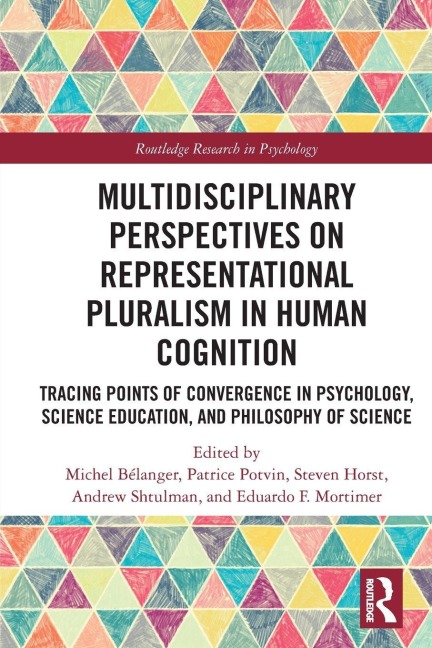

Bringing together diverse theoretical and empirical contributions from the fields of social and cognitive psychology, philosophy, and science education, this volume explores representational pluralism as a phenomenon characteristic of human cognition.
Michel Bélanger is Professor of Science Education, University of Québec at Rimouski, Canada. Patrice Potvin is Professor of Science Education, University of Québec at Montréal, Canada. Steven Horst is Professor of Philosophy at Wesleyan University, Middletown, CT, USA. Andrew Shtulman is Professor in the Departments of Psychology & Cognitive Science, Occidental College, USA. Eduardo Mortimer is Professor of Science Education, Federal University of Minas Gerai, Brazil.
Section 1: Introduction 1. Introduction to representational pluralism 2. Bridging pluralisms Section 2: Psychology 3. Satisfying epistemic and existential needs: Representational pluralism across scientific domains 4. Computational modeling of representational pluralism in explanations 5. Representational pluralism in the service of learning: The case of thought experiments 6. Navigating the conflict between science and intuition Section 3: Science education 7. From conceptual change to conceptual prevalence: What the acknowledgement of representational plurality could mean for science teaching 8. Examining evidence for the effects and antecedents of plurality in revising science misconceptions 9. Heterogeneity and pluralism in science education from the perspective of conceptual profiles 10. Unity in plurality: The emergence of pluralist expertise Section 4: Philosophy of science 11. More than one right answer: An introduction to the varieties of pluralism 12. Rise and (impending) fall of physics fundamentalism 13. Dissipation, integration and practical pluralism: The case of cognitive science 14. Representational pluralism, realism and the prospects of integration 15. Why pluralism?