Und dann auf "Zum Home-Bildschirm [+]".

Stöbern
genialokal zum Startbildschirm hinzufügen
Installieren Sie die genialokal App auf Ihrem Startbildschirm für einen schnellen Zugriff und eine komfortable Nutzung.
Installieren Sie die genialokal App auf Ihrem Startbildschirm für einen schnellen Zugriff und eine komfortable Nutzung.
Ihr gewünschter Artikel ist in 0 Buchhandlungen vorrätig - wählen Sie hier eine Buchhandlung in Ihrer Nähe aus:


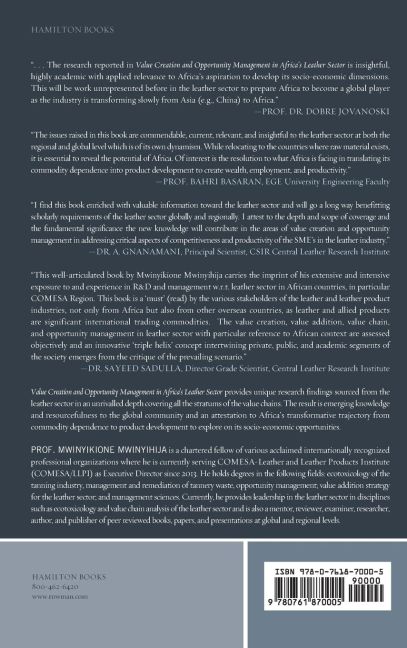
This book provides unique research findings from the leather sector in African and the stratums of the value chains. The result is emerging knowledge and resourcefulness to the global community and an attestation to Africa’s transformative trajectory from commodity dependence to product development to explore on its socio-economic opportunities.
Mwinyikione Mwinyihija
Chapter 1: Introduction 1.1 Statement of the Problem 1.2 Importance of the Study 1.3 Research Design and Approach 1.4 Research Questions and Hypotheses 1.5 Assumptions, Limitations and Delimitations 1.5.1 Assumptions 1.5.2 Limitations 1.5.3 Delimitations 1.6 Expected Findings 1.7 Definition of Terms 1.7.1 Organization of the Study 1.8 Summary Chapter 2: Opportunity Management and its Relevance to Leather Value Addition 2.1 Introduction 2.1.1 Objective of the Review 2.2. Value Addition 2.2.1 Characteristics of Value Addition 2.2.2 Leather Sector Performance 2.2.3 Livestock and Raw Material 2.2.4 Leather Processing 2.2.5 Leather Goods 2.3 Value Chain Composition and Analysis 2.3.1 Value Chain Composition 2.3.2 Value Chain Analysis 2.4 Opportunity Management 2.5 Strategy for the Leather Value Chain 2.6 Revealed Gaps in the Review 2.6.1 Comprehensive Leather Value Chain Analysis 2.6.2 Opportunity Management Criteria 2.6.3 Concept Driven Strategies Conclusion References Chapter 3: Emerging Leather and Leather goods Trends and Continental Shifts 3.1 Introduction 3.2 Exports Trend of Hides and Skins Worldwide 3.3. Comparative Review of Leather Processing 3.3.1 Factors of Success on Selected Countries 3.3.2 Preview of Africa's Leather Sector 3.3.3 Value Chain Performance 3.4 Leather Footwear Industry 3.4.1 Opportunities to the Leather Sector 3.5 Opportunities in Africa 3.6 Conclusion References Chapter 4: The Intrigues of Leather of Value Addition Initiatives in Africa 4.1 Introduction 4.1.1 Background. 4.2 Purpose of the Study 4.3 Performance Trends in the Leather Sector 4.3.1 Production patterns at Global, Africa and Selected Country Level 4.3.2 Impact to Socio-Economic Indicators 4.4. What are the Problems of the Leather Sector in Africa? 4.4.1 Kenya as an Example 4.5 Importance of Value Addition Chains 4.5.1 Complexities of the Leather Value Chain 4.5.2 Intrinsic and Extrinsic Factors of Leather Value Addition 4.6 Strategy Towards Leather Development Conclusion References Chapter 5: Diagnostics and Redefined Novel Approach 'Triple Helix' Towards Africa's Leather Development 5.1 Introduction 5.2 Methodology 5.3 Analysis and Presentation of Results 5.3.1 Gender and Age Group in Leather Strata 5.4 Discussion of Results 5.4.1 Limitations 5.5 Conclusion References Chapter 6: Prognosis of the Africa's Leather Sector Upheavals, Challenges and Antidotes Related to Value Creation; A Case Study of Kenya 6.1 Introduction 6.1.1 Background 6.1.2 Purpose of the Study 6.2. Leather Sector's Role in the Economy 6.2.1 Dilemma Towards Value Addition 6.3 Roadmap Towards Vision 2030 6.3.1 Are There Any Indications of Value Addition Initiatives in the Leather Sector? 6.3.2 Market Potential and Opportunities 6.3.3. Investment Preview 6.3.4 Challenges and Possible Interventions to the Roadmap Conclusion References Chapter 7: Trade Analysis of Africa's Leather Value Chain Strata 7.1 Introduction 7.1.1 Purpose of the Study 7.1.2 Research Question and Hypothesis 7.2 Methodology 7.2.1 Sample Size 7.2.2 Sampling Procedures 7.2.3 Data Collection Methodology 7.3. Analysis and Presentation of Results 7.3.1 Trade 7.4. Discussion of Results 7.5. Conclusion References Chapter 8: Competitiveness as a Preamble to Value Addition related to the Leather Sector 8.1. Introduction 8.1.1 Research Question and Hypothesis 8.2. Methodology 8.2.1 Sample Size 8.2.2 Sampling Procedures 8.2.3 Data Collection Methodology 8.3. Analysis and Presentation of Results 8.3.1 Competitiveness 8.4. Discussion of Results 8.5. Conclusion References Chapter 9: Productivity as a Fundamental Aspect of the Leather Value Chain Development 9.1. Introduction 9.2. Methodology 9.2.1 Sample Size 9.2.2 Sampling Procedures 9.2.3 Data Collection Methodology 9.3. Analysis and Presentation of Results 9.3.1 Productivity 9.4 Discussion of Results 9.5 Conclusion References Chapter 10: Innovation as Key to Development of the Leather Value Chain 10.1 Introduction 10.2 Research Questions 10.3 Theoretical Framework 10.4 Methodology 10.5 Results 10.5.1 Technology and Research 10.6 Research and Development (R&D) 10.6.1 Innovation Towards Processing or Product Development 10.7 Discussion 10.8 Conclusion References Chapter 11: Conclusions and Recommendations 11.1 Summary of the Results 11.2 Discussion of the Results and Conclusions 11.3 Limitations 11.4 Implications for Theory and Research 11.5 Implications for Practice 11.6 Recommendations 11.6.1 Professional Practice/Practitioners 11.6.2 Further Research 11.7 Conclusion References