Und dann auf "Zum Home-Bildschirm [+]".

Stöbern
genialokal zum Startbildschirm hinzufügen
Installieren Sie die genialokal App auf Ihrem Startbildschirm für einen schnellen Zugriff und eine komfortable Nutzung.
Installieren Sie die genialokal App auf Ihrem Startbildschirm für einen schnellen Zugriff und eine komfortable Nutzung.
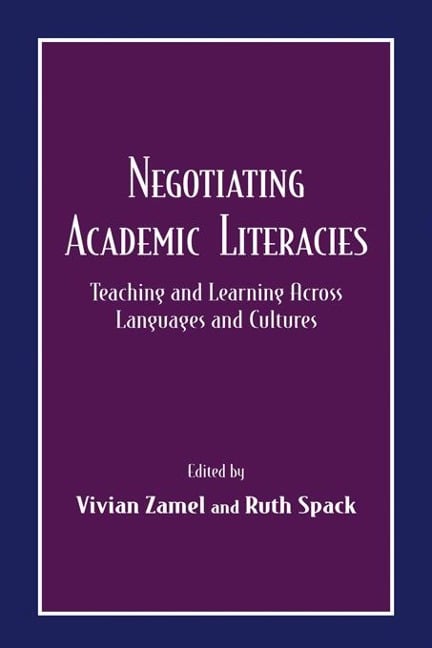
Negotiating Academic Literacies: Teaching and Learning Across Languages and Cultures is a cross-over volume in the literature between first and second language/literacy. This anthology of articles brings together different voices from a range of publications and fields and unites them in pursuit of an understanding of how academic ways of knowing are acquired. The editors preface the collection of readings with a conceptual framework that reconsiders the current debate about the nature of academic literacies. In this volume, the term academic literacies denotes multiple approaches to knowledge, including reading and writing critically. College classrooms have become sites where a number of languages and cultures intersect. This is the case not only for students who are in the process of acquiring English, but for all learners who find themselves in an academic situation that exposes them to a new set of expectations. This book is a contribution to the effort to discover ways of supporting learning across languages and cultures--and to transform views about what it means to teach and learn, to read and write, and to think and know. Unique to this volume is the inclusion of the perspectives of writers as well as those of teachers and researchers. Furthermore, the contributors reveal their own struggles and accomplishments as they themselves have attempted to negotiate academic literacies. The chronological ordering of articles provides a historical perspective, demonstrating ways in which issues related to teaching and learning across cultures have been addressed over time. The readings have consistency in terms of quality, depth, and passion; they raise important philosophical questions even as they consider practical classroom applications. The editors provide a series of questions that enable the reader to engage in a generative and exciting process of reflection and inquiry. This book is both a reference for teachers who work or plan to work with diverse learners, and a text for graduate-level courses, primarily in bilingual and ESL studies, composition studies, English education, and literacy studies.
Vivian Zamel, Ruth Spack
Contents: Preface. M. Shaughnessy, Diving In: An Introduction to Basic Writing. M. Rose, The Language of Exclusion: Writing Instruction at the University. M. Cliff, A Journey Into Speech. E. Kutz, Between Students' Language and Academic Discourse: Interlanguage as Middle Ground. J.P. Gee, What Is Literacy? B. Mellix, From Outside, In. M-Z. Lu, From Silence to Words: Writing as Struggle. R. Spack, Initiating ESL Students Into the Academic Discourse Community: How Far Should We Go? K. Spellmeyer, A Common Ground: The Essay in the Academy. F. Shen, The Classroom and the Wider Culture: Identity as a Key to Learning English Composition. R.E. Land, Jr., C. Whitley, Evaluating Second Language Essays in Regular Composition Classes: Toward a Pluralistic U.S. Rhetoric. P. Elbow, Reflections on Academic Discourse: How It Relates to Freshmen and Colleagues. M.L. Pratt, Arts of the Contact Zones. V. Zamel, Questioning Academic Discourse. P.N. Limerick, Dancing With Professors: The Trouble With Academic Prose. L.D. Delpit, The Politics of Teaching Literate Discourse. L.L. Blanton, Discourse, Artifacts, and the Ozarks: Understanding Academic Literacy. H.G. Widdowson, The Ownership of English. V. Zamel, Strangers in Academia: The Experiences of Faculty and ESL Students Across the Curriculum. A. Pennycook, Borrowing Others' Words: Text, Ownership, Memory, and Plagiarism. R. Spack, The (In)visibility of the Person(al) in Academe. N. González, Blurred Voices: Who Speaks for the Subaltern?
Dieses eBook wird im PDF-Format geliefert und ist mit einem Adobe Kopierschutz (DRM) versehen. Sie können dieses eBook mit allen Geräten lesen, die das PDF-Format und den Adobe Kopierschutz (DRM) unterstützen.
Zum Beispiel mit den folgenden Geräten:
• tolino Reader
Laden Sie das eBook direkt über den Reader-Shop auf dem tolino herunter oder übertragen Sie das eBook auf Ihren tolino mit einer kostenlosen Software wie beispielsweise Adobe Digital Editions.
• Sony Reader & andere eBook Reader
Laden Sie das eBook direkt über den Reader-Shop herunter oder übertragen Sie das eBook mit der kostenlosen Software Sony READER FOR PC/Mac oder Adobe Digital Editions auf ein Standard-Lesegeräte mit epub- und Adobe DRM-Unterstützung.
• Tablets & Smartphones
Möchten Sie dieses eBook auf Ihrem Smartphone oder Tablet lesen, finden Sie hier unsere kostenlose Lese-App für iPhone/iPad und Android Smartphone/Tablets.
• PC & Mac
Lesen Sie das eBook direkt nach dem Herunterladen mit einer kostenlosen Lesesoftware, beispielsweise Adobe Digital Editions, Sony READER FOR PC/Mac oder direkt über Ihre eBook-Bibliothek in Ihrem Konto unter „Meine eBooks“ - „online lesen“.
Schalten Sie das eBook mit Ihrer persönlichen Adobe ID auf bis zu sechs Geräten gleichzeitig frei.
Bitte beachten Sie, dass die Kindle-Geräte das Format nicht unterstützen und dieses eBook somit nicht auf Kindle-Geräten lesbar ist.