Und dann auf "Zum Home-Bildschirm [+]".

Stöbern
genialokal zum Startbildschirm hinzufügen
Installieren Sie die genialokal App auf Ihrem Startbildschirm für einen schnellen Zugriff und eine komfortable Nutzung.
Installieren Sie die genialokal App auf Ihrem Startbildschirm für einen schnellen Zugriff und eine komfortable Nutzung.
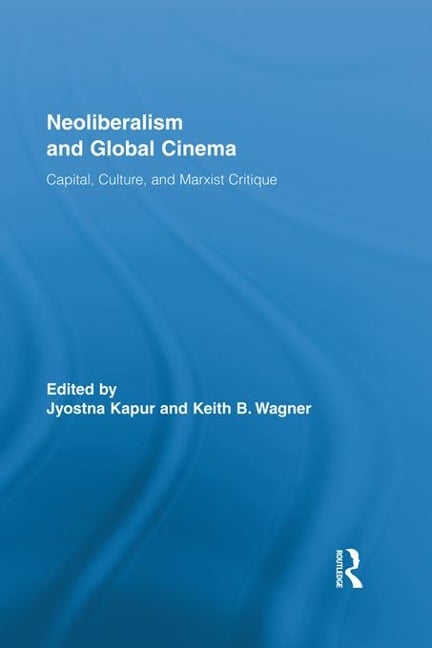
In cinema studies today, rarely do we find a direct investigation into the culture of capitalism and how it has been refracted and fabricated in global cinema production under neoliberalism. However, the current economic crisis and the subsequent Wall Street bailout in 2008 have brought about a worldwide skepticism regarding the last four decades of economic restructuring and the culture that has accompanied it. In this edited volume, an international ensemble of scholars looks at neoliberalism, both as culture and political economy, in the various cinemas of the world. In essays encompassing the cinemas of Asia, Africa, Latin America, Europe, and the United States the authors outline how the culture and subjectivities engendered by neoliberalism have been variously performed, contested, and reinforced in these cinemas. The premise of this book is that the cultural and economic logic of neoliberalism, i.e., the radical financialization and market-driven calculations, of all facets of society are symptoms best understood by Marxist theory and its analysis of the central antagonisms and contradictions of capital. Taking a variety of approaches, ranging from political economy, ideological critique, the intersection of aesthetics and politics, social history and critical-cultural theory, this volume offers a fresh, broad-based Marxist analysis of contemporary film/media. Topics include: the global albeit antagonistic nature of neoliberal culture; the search for a new aesthetic and documentary language; the contestation between labor and capital in cultural producion; the political economy of hollywood, and questions of gender, sexuality, and the nation state in relation to neoliberalism.
Jyotsna Kapur is an Associate Professor of Cinema Studies and Sociology at Southern Illinois University, Carbondale and founding coeditor of Studies in South Asian Film and Media. She is the author of Coining for Capital: Movies, Marketing and the Transformation of Childhood and has co-edited with Sunny Yoon a special issue of Visual Anthropology on Neoliberalism and Asian Cinemas (Vol. 22 Issue 2/3 2009). Keith B. Wagner is a PhD candidate in Film Studies and Political Theory at King's College, University of London. He also holds an M.Phil degree from the University of Cambridge and has published work with Film International and has articles under review with Historical Materialism and positions: east asia cultures critique. Keith has previously taught film and politics at the University of Rhode Island and London South Bank University.
Section 1: Hollywood and Global Dominance 1. 'For a better deal, Harass Your Governor!': Neoliberalism and Hollywood, Toby Miller and Richard Maxwell 2. A Legacy of Neoliberalism: Patterns in Media Conglomeration, Eileen R. Meehan 3. 21st Century Neoliberal Man, Deborah Tudor Section 2: Latin America 4. Cuban Cinema: A Case of Accelerated Underdevelopment, Michael Chanan 5. Politics and Privatization in Peruvian Cinema: Grupo Chaski's Aesthetics of Survival, Sophia A. McClennen 6. Form, Politics and Culture: a case study of The Take, The Revolution Will Not Be Televised and Listen To Venezuela, Mike Wayne and Deirdre O'Neill Section 3: Asia 7. Market Socialism and Its Discontent: Jia Zhangke's Cinematic Narrative of China's Transition in the Age of Global Capital, Xudong Zhang 8. "Leitmotif": State, Market, and Postsocialist Film Industry Under Neoliberal Globalization, Ying Xiao 9. From Exploitation to Playful Exploits: The Rise of Collectives and the Redefinition of Labor, Life, and Representation in Neoliberal Japan, Sharon Hayashi 10. The Underdevelopment of Development: Neoliberalism and the Crisis of Bourgeois Individualism, Jyotsna Kapur 11. Fragments of Labor: Neoliberal Attitudes and Architectures in Contemporary South Korean Cinema, Keith B. Wagner 12. Mainlandization and Neoliberalism with Post-colonial and Chinese Characteristics: Challenges for the Hong Kong Film Industry, Mirana M. Szeto and Yun-chung Chen 13. Neoliberalism and Authoritarianism in Singaporean Cinema: A Case Study of Perth, Jenna Ng 14. Gambling on Life and Death: Neoliberal Rationality and the Films of Jeffrey Jeturian, Bliss Cua Lim Section 4: Africa and Europe 15. Nollywood in Lagos, Lagos in Nollywood Films, Jonathan Haynes 16. French Cinema: Counter-model, Cultural exception, Resistances, Martin O'Shaughnessy
Dieses eBook wird im PDF-Format geliefert und ist mit einem Adobe Kopierschutz (DRM) versehen. Sie können dieses eBook mit allen Geräten lesen, die das PDF-Format und den Adobe Kopierschutz (DRM) unterstützen.
Zum Beispiel mit den folgenden Geräten:
• tolino Reader
Laden Sie das eBook direkt über den Reader-Shop auf dem tolino herunter oder übertragen Sie das eBook auf Ihren tolino mit einer kostenlosen Software wie beispielsweise Adobe Digital Editions.
• Sony Reader & andere eBook Reader
Laden Sie das eBook direkt über den Reader-Shop herunter oder übertragen Sie das eBook mit der kostenlosen Software Sony READER FOR PC/Mac oder Adobe Digital Editions auf ein Standard-Lesegeräte mit epub- und Adobe DRM-Unterstützung.
• Tablets & Smartphones
Möchten Sie dieses eBook auf Ihrem Smartphone oder Tablet lesen, finden Sie hier unsere kostenlose Lese-App für iPhone/iPad und Android Smartphone/Tablets.
• PC & Mac
Lesen Sie das eBook direkt nach dem Herunterladen mit einer kostenlosen Lesesoftware, beispielsweise Adobe Digital Editions, Sony READER FOR PC/Mac oder direkt über Ihre eBook-Bibliothek in Ihrem Konto unter „Meine eBooks“ - „online lesen“.
Schalten Sie das eBook mit Ihrer persönlichen Adobe ID auf bis zu sechs Geräten gleichzeitig frei.
Bitte beachten Sie, dass die Kindle-Geräte das Format nicht unterstützen und dieses eBook somit nicht auf Kindle-Geräten lesbar ist.