Und dann auf "Zum Home-Bildschirm [+]".

Stöbern
genialokal zum Startbildschirm hinzufügen
Installieren Sie die genialokal App auf Ihrem Startbildschirm für einen schnellen Zugriff und eine komfortable Nutzung.
Installieren Sie die genialokal App auf Ihrem Startbildschirm für einen schnellen Zugriff und eine komfortable Nutzung.
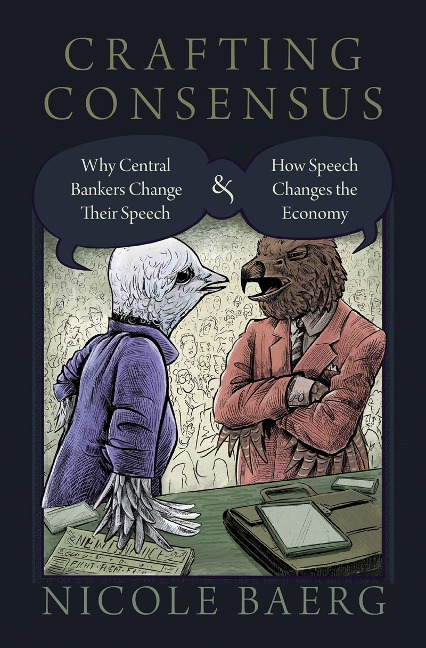
In a world dependent on the constant sharing of information, central bankers increasingly communicate their policies to the mass public. Central bank communications are drafted in monetary policy committee meetings composed of policymakers with differing interests. Despite their differences, committee members must come together, write, and agree to an official policy statement. Once released to the public, central bank communications then affect citizens' actions and ultimately, the economy. But how exactly does this work? In Crafting Consensus, Nicole Baerg explains how the transparency of central bank communication depends on the configuration of committee members' preferences. Baerg argues that monetary policy committees composed of members with differing preferences over inflation are better suited to communicating precise information with the public. These diverse committees produce central bank statements of higher quality and less uncertainty than those from more homogeneous committees. Additionally, she argues that higher quality statements more effectively shape individuals' inflation expectations and move the economy in ways that policymakers intend. Baerg demonstrates that central bankers are not impartial technocrats and that their preferences and the institutional rules where they work matter for understanding the politics of monetary policy and variations in economic performance over time. Conducting empirical analysis from historical archival data, textual analysis, machine-learning, survey experiments, and cross-sectional time-series data, Crafting Consensus offers a new theory of committee decision making and a battery of empirical tests to provide a rich understanding of modern-day central banking.
Nicole Baerg is Assistant Professor in Government and co-director of the Essex Summer School in Social Science Data Analysis at the University of Essex. She worked previously as a research intern at the Federal Reserve Bank of Atlanta. Her research interests include comparative political institutions, central banking, political economy, quantitative text analysis, and European integration.
1 Crafting Consensus 1.1 The Girth of Greenspan's Briefcase 1.2 Central Bankers as Wordsmiths 1.3 The Statement-Writing Process 1.4 The Importance of Committee Composition 1.5 What Comes Next? 2 Monetary Policy Committees and Central Bank Communication 2.1 Introduction 2.2 Central Bank Committees and Institutional Design 2.2.1 Committee Size 2.2.2 Committee Composition 2.2.3 Decision-Making Protocol 2.3 Central Bank Communication 2.3.1 How to Communicate? 2.3.2 Formal Models of Political Communication 2.3.3 Communication and Expectations 2.4 Conclusion 3 A Model of Central Bank Communication 3.1 Introduction 3.2 The Model 3.2.1 Strategic Vagueness 3.2.2 Model Departures 3.2.3 Actors 3.2.4 Utility Functions 3.2.5 Game Sequence 3.2.6 Equilibrium 3.3 Disseminating Economic Information 3.4 Empirical Implications 3.5 Conclusion 4 Central Bank Committees and Political Communication 4.1 Introduction 4.2 Research Design 4.2.1 The Sample 4.2.2 Dependent Variables 4.2.3 Independent Variables 4.3 Empirical Model and Results 4.3.1 Results for Diversity on Policy Statement Uncertainty 4.3.2 Results for Diversity on Policy Editing 4.4 Conclusion 5 Central Bank Announcements and Inflation Expectations 5.1 Introduction 5.2 Origins of Inflation Expectations 5.3 Research Design 5.4 Data and Results 5.4.1 Dependent Variable: Posterior Inflation Expectations 5.4.2 Independent Variables 5.4.3 Descriptive Statistics 5.4.4 Regression Analysis 5.4.5 Sensitivity Analysis 5.5 Conclusion 6 Testing the Theory in Latin America 6.1 Introduction 6.2 Data and Analysis 6.2.1 Dependent Variable: Inflation 6.2.2 Independent Variables: Inflation Expectations 6.2.3 Information Precision 6.2.4 Control Variables 6.3 Main Results 6.4 Sensitivity Analysis 6.5 Conclusion 7 Putting It All Together 7.1 Summary of the Findings 7.2 Accountability and Transparency 7.3 Horizontal Accountability and Central Bank Appointments 7.4 Future Research 7.4.1 Rotational Voting 7.4.2 Qualifications 7.5 Applications beyond Central Banking 7.5.1 Judicial Politics 7.5.2 Corporate Governance 7.6 Final Thoughts
Dieses eBook wird im PDF-Format geliefert und ist mit einem Adobe Kopierschutz (DRM) versehen. Sie können dieses eBook mit allen Geräten lesen, die das PDF-Format und den Adobe Kopierschutz (DRM) unterstützen.
Zum Beispiel mit den folgenden Geräten:
• tolino Reader
Laden Sie das eBook direkt über den Reader-Shop auf dem tolino herunter oder übertragen Sie das eBook auf Ihren tolino mit einer kostenlosen Software wie beispielsweise Adobe Digital Editions.
• Sony Reader & andere eBook Reader
Laden Sie das eBook direkt über den Reader-Shop herunter oder übertragen Sie das eBook mit der kostenlosen Software Sony READER FOR PC/Mac oder Adobe Digital Editions auf ein Standard-Lesegeräte mit epub- und Adobe DRM-Unterstützung.
• Tablets & Smartphones
Möchten Sie dieses eBook auf Ihrem Smartphone oder Tablet lesen, finden Sie hier unsere kostenlose Lese-App für iPhone/iPad und Android Smartphone/Tablets.
• PC & Mac
Lesen Sie das eBook direkt nach dem Herunterladen mit einer kostenlosen Lesesoftware, beispielsweise Adobe Digital Editions, Sony READER FOR PC/Mac oder direkt über Ihre eBook-Bibliothek in Ihrem Konto unter „Meine eBooks“ - „online lesen“.
Schalten Sie das eBook mit Ihrer persönlichen Adobe ID auf bis zu sechs Geräten gleichzeitig frei.
Bitte beachten Sie, dass die Kindle-Geräte das Format nicht unterstützen und dieses eBook somit nicht auf Kindle-Geräten lesbar ist.