Und dann auf "Zum Home-Bildschirm [+]".

Stöbern
genialokal zum Startbildschirm hinzufügen
Installieren Sie die genialokal App auf Ihrem Startbildschirm für einen schnellen Zugriff und eine komfortable Nutzung.
Installieren Sie die genialokal App auf Ihrem Startbildschirm für einen schnellen Zugriff und eine komfortable Nutzung.
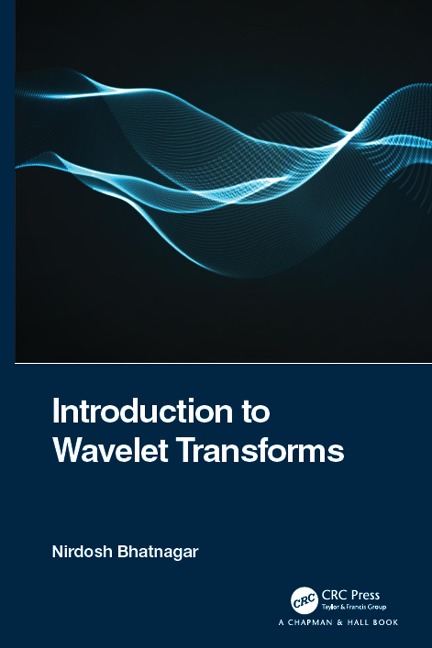
The textbook, Introduction to Wavelet Transforms provides basics of wavelet transforms in a self-contained manner. Applications of wavelet transform theory permeate our daily lives. Therefore it is imperative to have a strong foundation for this subject. Features - No prior knowledge of the subject is assumed. Sufficient mathematical background is provided to complete the discussion of different topics. - Different topics have been properly segmented for easy learning. This makes the textbook pedagogical and unique. - Notation is generally introduced in the definitions. Relatively easy consequences of the definitions are listed as observations, and important results are stated as theorems. - Examples are provided for clarity and to enhance reader's understanding of the subject. - Each chapter also has a problem section. A majority of the problems are provided with sufficient hints. The textbook can be used either in an upper-level undergraduate or first-year graduate class in electrical engineering, or computer science, or applied mathematics. It can also be used by professionals and researchers in the field who would like a quick review of the basics of the subject. About the Author Nirdosh Bhatnagar works in both academia and industry in Silicon Valley, California. He is also the author of a comprehensive two-volume work: Mathematical Principles of the Internet, published by the CRC Press in the year 2019. Nirdosh earned M.S. in Operations Research, and M.S. and Ph.D. in electrical engineering, all from Stanford University, Stanford, California.
Nirdosh Bhatnagar works, both in the academia and industry in Silicon Valley, California, USA. He is the author of several papers and reports. Nirdosh earned an MS in operations research, and MS and PhD in electrical engineering, all from Stanford University, Stanford, California.
Table of Contents Preface List of Symbols Greek Symbols Part I. Basics of Wavelet Transforms. Introduction to Wavelets Continuous Wavelet Transform Discrete Wavelet Transform Daubechies Wavelets Some Examples of Wavelets. Applications Part II. Intermediate Topics. Periodic Wavelet Transform Biorthogonal Wavelet Transform Coiflets The Lifting Technique Wavelet Packets Lapped Orthogonal Transform. Part III. Signal Processing. Discrete Fourier Transform The z-Transform and Discrete-Time Fourier Transform Elements of Continuous-Time Signal Processing Elements of Discrete-Time Signal Processing Part IV. Mathematical Concepts Set-Theoretic Concepts and Number Theory Matrices and Determinants Applied Analysis Fourier Theory Probability Theory and Stochastic Processes References Index
Dieses eBook wird im PDF-Format geliefert und ist mit einem Adobe Kopierschutz (DRM) versehen. Sie können dieses eBook mit allen Geräten lesen, die das PDF-Format und den Adobe Kopierschutz (DRM) unterstützen.
Zum Beispiel mit den folgenden Geräten:
• tolino Reader
Laden Sie das eBook direkt über den Reader-Shop auf dem tolino herunter oder übertragen Sie das eBook auf Ihren tolino mit einer kostenlosen Software wie beispielsweise Adobe Digital Editions.
• Sony Reader & andere eBook Reader
Laden Sie das eBook direkt über den Reader-Shop herunter oder übertragen Sie das eBook mit der kostenlosen Software Sony READER FOR PC/Mac oder Adobe Digital Editions auf ein Standard-Lesegeräte mit epub- und Adobe DRM-Unterstützung.
• Tablets & Smartphones
Möchten Sie dieses eBook auf Ihrem Smartphone oder Tablet lesen, finden Sie hier unsere kostenlose Lese-App für iPhone/iPad und Android Smartphone/Tablets.
• PC & Mac
Lesen Sie das eBook direkt nach dem Herunterladen mit einer kostenlosen Lesesoftware, beispielsweise Adobe Digital Editions, Sony READER FOR PC/Mac oder direkt über Ihre eBook-Bibliothek in Ihrem Konto unter „Meine eBooks“ - „online lesen“.
Schalten Sie das eBook mit Ihrer persönlichen Adobe ID auf bis zu sechs Geräten gleichzeitig frei.
Bitte beachten Sie, dass die Kindle-Geräte das Format nicht unterstützen und dieses eBook somit nicht auf Kindle-Geräten lesbar ist.