Und dann auf "Zum Home-Bildschirm [+]".

Stöbern
genialokal zum Startbildschirm hinzufügen
Installieren Sie die genialokal App auf Ihrem Startbildschirm für einen schnellen Zugriff und eine komfortable Nutzung.
Installieren Sie die genialokal App auf Ihrem Startbildschirm für einen schnellen Zugriff und eine komfortable Nutzung.
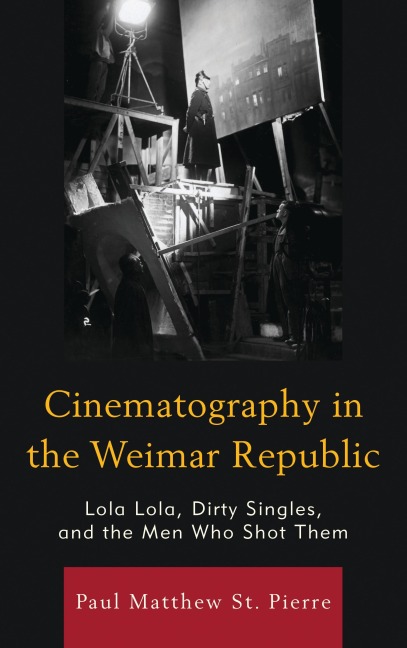
In film history, director-cinematographer collaborations were on a labor spectrum, with the model of the contracted camera operator in the silent era and that of the cinematographer in the sound era. But in Weimar era German filmmaking, 1919-33, a short period of intense artistic activity and political and economic instability, these models existed side by side due to the emergence of camera operators as independent visual artists and collaborators with directors.
Berlin in the 1920s was the chief site of the interdisciplinary avant-garde of the Modernist movement in the visual, literary, architectural, design, typographical, sartorial, and performance arts in Europe. The Weimar Revolution that arose in the aftermath of the November 1918 Armistice and that established the Weimar Republic informed and agitated all of the art movements, such as Expressionism, Dada, the Bauhaus, Minimalism, Objectivism, Verism, and Neue Sachlichkeit ("New Objectivity"). Among the avant-garde forms of these new stylistically and culturally negotiated arts, the cinema was foremost and since its inception had been a radical experimental practice in new visual technologies that proved instrumental in changing how human beings perceived movement, structure, perspective, light exposure, temporal duration, continuity, spatial orientation, human postural, facial, vocal, and gestural displays, and their own spectatorship, as well as conventions of storytelling like narrative, setting, theme, character, and structure. Whereas most of the arts mobilized into schools, movements, institutions, and other structures, cinema, a collaborative art, tended to organize around its ensembles of practitioners. Historically, the silent film era, 1895-1927, is associated with auteurs, the precursors of François Truffaut and other filmmakers in the 1960s: actuality filmmakers and pioneers like R. W. Paul and Fred and Joe Evans in England, Auguste and Luis Lumière and Georges Méliès in France, and Charles Chaplin and Buster Keaton in America, who, by managing all the compositional, executional, and editorial facets of film production-scripting, directing, acting, photographing, set, costume, and lighting design, editing, and marketing-imposed their personal vision or authorship on the film. The dichotomy of the auteur and the production ensemble established a production hierarchy in most filmmaking. In formative German silent film, however, this hierarchy was less rank or class driven, because collaborative partnerships took precedence over single authorship. Whereas in silent film production in most countries the terms filmmaker and director were synonymous, in German silent film the plural term filmemacherin connoted both directors and cinematographers, along with the rest of the filmmaking crew. Thus, German silent filmmakers' principle contribution to the new medium and art of film was less the representational iconographies of Expressionist, New Objective, and Naturalist styles than the executional practice of co-authorship and co-production, in distinctive cinematographer-director partnerships such as those of cinematographer Theodor Sparkuhl and director Ernst Lubitsch; Fritz Arno Wagner with F. W. Murnau, Fritz Lang, and G. W. Pabst; Rudolf Maté with Carl Theodor Dreyer; Guido Seeber with Lang and Pabst; and Carl Hoffmann with Lang and Murnau.
Paul Matthew St. Pierre is professor of English at Simon Fraser University, Vancouver.
List of Illustrations
Acknowledgments
1The Weimar Revolution and German Collaborative Filmmaking
2The Optical Convergence of Theodor Sparkuhl and Ernst Lubitsch
3Karl Freund's Signature Visual Designs in Manifold Collaborations
4Carl Hoffmann and the New Visual Discourse of German Silent Film
5Fritz Arno Wagner, with F. W. Murnau, Fritz Lang, and Arthur Robison
6Fritz Arno Wagner, G. W. Pabst, and the Weimar Zeitgeist
7Günther Rittau, Günther Krampf, Optical Language, and Autonomous Collaborative Agency
8Guido Seeber's Promotion from Special Effects Technician to Cinematographic Artist
9Rudolph Maté, Carl Theodor Dreyer, and the Framing Principle of Cinematography
10Cinematographers as Directors as Cinematographers and the Rebirth of Civilization
Filmography
Works Cited
Index
About the Author
Dieses eBook wird im PDF-Format geliefert und ist mit einem Adobe Kopierschutz (DRM) versehen. Sie können dieses eBook mit allen Geräten lesen, die das PDF-Format und den Adobe Kopierschutz (DRM) unterstützen.
Zum Beispiel mit den folgenden Geräten:
• tolino Reader
Laden Sie das eBook direkt über den Reader-Shop auf dem tolino herunter oder übertragen Sie das eBook auf Ihren tolino mit einer kostenlosen Software wie beispielsweise Adobe Digital Editions.
• Sony Reader & andere eBook Reader
Laden Sie das eBook direkt über den Reader-Shop herunter oder übertragen Sie das eBook mit der kostenlosen Software Sony READER FOR PC/Mac oder Adobe Digital Editions auf ein Standard-Lesegeräte mit epub- und Adobe DRM-Unterstützung.
• Tablets & Smartphones
Möchten Sie dieses eBook auf Ihrem Smartphone oder Tablet lesen, finden Sie hier unsere kostenlose Lese-App für iPhone/iPad und Android Smartphone/Tablets.
• PC & Mac
Lesen Sie das eBook direkt nach dem Herunterladen mit einer kostenlosen Lesesoftware, beispielsweise Adobe Digital Editions, Sony READER FOR PC/Mac oder direkt über Ihre eBook-Bibliothek in Ihrem Konto unter „Meine eBooks“ - „online lesen“.
Schalten Sie das eBook mit Ihrer persönlichen Adobe ID auf bis zu sechs Geräten gleichzeitig frei.
Bitte beachten Sie, dass die Kindle-Geräte das Format nicht unterstützen und dieses eBook somit nicht auf Kindle-Geräten lesbar ist.