Und dann auf "Zum Home-Bildschirm [+]".

Stöbern
genialokal zum Startbildschirm hinzufügen
Installieren Sie die genialokal App auf Ihrem Startbildschirm für einen schnellen Zugriff und eine komfortable Nutzung.
Installieren Sie die genialokal App auf Ihrem Startbildschirm für einen schnellen Zugriff und eine komfortable Nutzung.
Ihr gewünschter Artikel ist in 0 Buchhandlungen vorrätig - wählen Sie hier eine Buchhandlung in Ihrer Nähe aus:

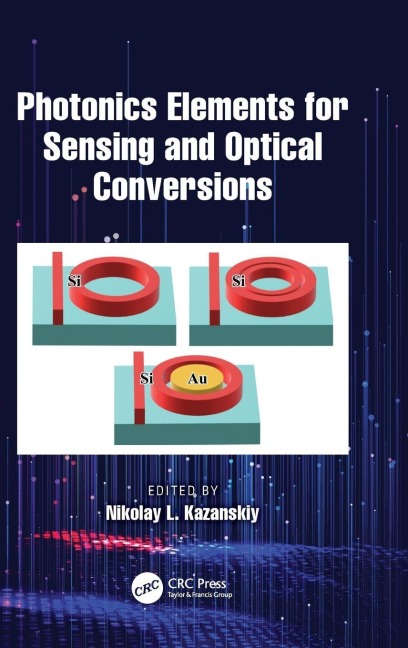
This book covers a number of a rapidly growing areas of knowledge that may be termed as diffractive nanophotonics. It also discusses in detail photonic components that may find uses in sensorics and optical transformations.
Nikolay Lvovich Kazanskiygraduated with honors (1981) from Kuibyshev Aviation Institute (presently, Samara NationalResearch University), majoring in Applied Mathematics. He received his Candidate inPhysics & Maths (1988) and Doctor in Physics &Mathematics (1996) degrees from SamaraNational Research University. He is the di-rector of Image Processing Systems Institute ofthe RAS-Branch of the Federal Scientific-Research Centre "Crystallography and Photonics"of the Russian Academy of Sciences, also holding a part-time position of a professor atTechnical Cybernetics department of Samara National Research University. He is a memberof OSA, SPIE and IAPR. He co-authored 290 scientific papers, 14 monographs, 57inventions and patents. His current research interests include diffractive optics, computervision, optical sensors, mathematical modeling, lighting devices design, and nanophotonics
Authors Preface Abbreviations Abstract Chapter 1 Silicon photonic waveguides: Comparison and utilization in sensing applications Chapter 2 Photonic crystal cavities in integrated on-chip optical signal processing components Chapter 3 Nanoplasmonic sensors: Recent advances Chapter 4 Plasmonic nanolasers Chapter 5 Metasurfaces and several well-studied applications Chapter 6 Optical fiber sensors based on diffractive and fiber periodic microstructures Chapter 7 Wavefront aberration sensors based on optical expansion by the Zernike basis Chapter 8 Optical computing: Key problems, achievements and perspectives General conclusion References Appendix A Listing for calculating the sensor matched with the Zernike basis functions Appendix B Listing for calculating a distorted image Index