Und dann auf "Zum Home-Bildschirm [+]".

Stöbern
genialokal zum Startbildschirm hinzufügen
Installieren Sie die genialokal App auf Ihrem Startbildschirm für einen schnellen Zugriff und eine komfortable Nutzung.
Installieren Sie die genialokal App auf Ihrem Startbildschirm für einen schnellen Zugriff und eine komfortable Nutzung.
Ihr gewünschter Artikel ist in 0 Buchhandlungen vorrätig - wählen Sie hier eine Buchhandlung in Ihrer Nähe aus:

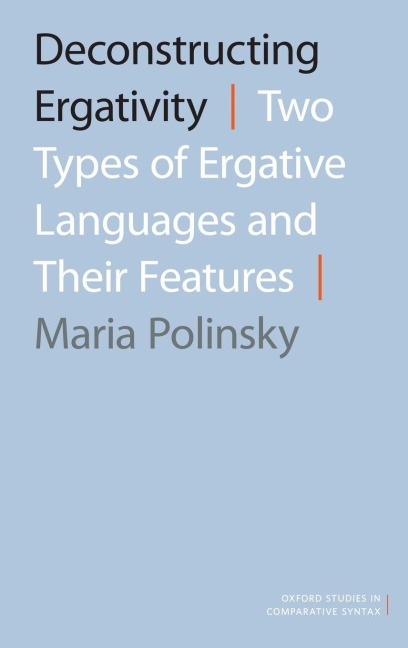
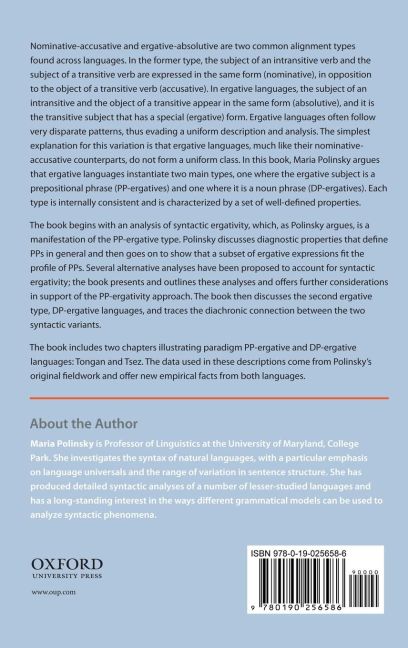
Nominative-accusative and ergative are two common alignment types found across languages. In the former type, the subject of an intransitive verb and the subject of a transitive verb are expressed the same way, and differently from the object of a transitive. In ergative languages, the subject of an intransitive and the object of a transitive appear in the same form, the absolutive, and the transitive subject has a special, ergative, form. Ergative languages often follow very different patterns, thus evading a uniform description and analysis. A simple explanation for that has to do with the idea that ergative languages, much as their nominative-accusative counterparts, do not form a uniform class. In this book, Maria Polinsky argues that ergative languages instantiate two main types, the one where the ergative subject is a prepositional phrase (PP-ergatives) and the one with a noun-phrase ergative. Each type is internally consistent and is characterized by a set of well-defined properties.
The book begins with an analysis of syntactic ergativity, which as Polinsky argues, is a manifestation of the PP-ergative type. Polinsky discusses diagnostic properties that define PPs in general and then goes to show that a subset of ergative expressions fit the profile of PPs. Several alternative analyses have been proposed to account for syntactic ergativity; the book presents and outlines these analyses and offers further considerations in support of the PP-ergativity approach. The book then discusses the second type, DP-ergative languages, and traces the diachronic connection between the two types.
The book includes two chapters illustrating paradigm PP-ergative and DP-ergative languages: Tongan and Tsez. The data used in these descriptions come from Polinsky's original fieldwork hence presenting new empirical facts from both languages.
Maria Polinsky is Professor of Linguistics at the University of Maryland, College Park. She investigates the syntax of natural languages, with a particular emphasis on language universals and the range of variation in sentence structure. She has produced detailed syntactic analyses of a number of lesser-studied languages and has a long-standing interest in the ways different grammatical models can be used to analyze syntactic phenomena.
- Preface
- Abbreviations
- Part I: Two types of ergatives
- 1 Introduction
- 1.1 Setting the stage
- 1.2 Syntactic ergativity
- 1.2.1 The phenomenon
- 1.2.2 The range of the phenomenon
- 1.2.3 The relevance of syntactic ergativity
- 1.3. The importance of starting small
- 1.3.1 Syntactic ergativity broadly defined
- 1.3.2 Not all A-bar movement phenomena are created equal
- 1.3.3 Some methodological odds and ends
- Appendix: Compensatory strategies under syntactic ergativity
- 2 Proposal
- 2.1 Crucial empirical observations
- 2.1.1 Diachronic pathways to ergativity
- 2.1.2 Oblique subjects
- 2.2 The proposal: Two classes of ergative languages
- 2.3 From PP specifier to syntactic ergativity
- 2.3.1 The relationship between the verbal functional head and ergative P
- 2.3.2 Ergative P and P-stranding
- 2.3.3 Ergative P and pied-piping
- 2.3.4 From a PP subject to syntactic ergativity
- 2.4 Basic clausal structures in the two types of ergative languages
- 2.4.1 PP-ergative and DP-ergative languages: transitive clauses
- 2.4.2 PP-ergative and DP-ergative languages: unergative clauses
- 2.4.3 PP specifiers everywhere? Preventing overgeneration
- 2.4.4 Compatibility between the ergative and the passive
- 2.5 Summary
- 3 Prepositional phrases: Establishing the diagnostics
- 3.1 PPs have distinct extraction and subextraction properties
- 3.2 Restrictions on PPs as pivots of clefts
- 3.3 PPs have resumptive proforms and may have special modifiers
- 3.4 PPs are less accessible to agreement probes than DPs are
- 3.5 PPs and binding
- 3.6 PPs and A-movement
- 3.7 PPs and control
- 3.8 Summary
- 4 Ergative as a PP: Take One
- 4.1 Ergative expressions can be PPs
- 4.2 Subextraction out of the ergative expression
- 4.3 Ergative cannot extract leaving a gap
- 4.4 Ergative and agreement
- 4.5 Ergative and depictives
- 4.6 Ergative and quantifier float
- 4.7 Taking stock
- 4.7.1 Silent P head
- 4.7.2 Overt P head
- 4.7.3 The nature of the operator
- 5 Ergative as a PP: Take Two
- 5.1 Binding: Reflexives and reciprocals
- 5.2 Raising
- 5.2.1 No true raising
- 5.2.2 Ergative is not preserved under raising-at least in Tongan
- 5.3 control
- 5.3 Summary
- 6 Cross-linguistic landscape: Correlates of PP-ergativity
- 6.1. Word order correlates
- 6.2 Expletive subjects
- 6.3 Non-canonical (quirky) subjects
- 7 The other ergative: A true DP
- 7.1 Extraction of the ergative with a gap
- 7.2 Subextraction from the ergative and the absolutive
- 7.3 Agreement
- 7.4 Binding
- 7.5 Control and raising
- 7.6 Word order
- 7.7 Summary
- 8 The relationship between the PP-ergative type and the DP-ergative type: Phylogeny and ontogeny
- 8.1 Diachronic relationship between the PP-ergative type and the DP-ergative type
- 8.2 Caught in transition: Niuean
- 8.3 Caught in transition: Adyghe
- 8.4 PP-ergatives and DP-ergatives in language acquisition
- 9 Alternative accounts of variation across ergative languages
- 9.1 Comp-trace vs. P-trace
- 9.2 Criterial freezing
- 9.3 Phase boundaries and high/low absolutive languages
- 9.4 Non-syntactic explanations for variation across ergative languages
- 9.5 Summary
- Part II: Paradigm languages
- 10 A paradigm PP-Ergative language: Tongan
- 10.1 Tongan basics
- 10.1.1 General remarks
- 10.1.2 Predicates
- 10.1.3 Case marking
- 10.1.4 Word order: Preliminary remarks
- 10.1.5 Questions
- 10.2 Subject and possessive marking: Clitics
- 10.2.1 Subject clitics
- 10.2.1.1 Basic facts about clitics
- 10.2.1.2 Accounting for Tongan clitics
- 10.2.1.3 Clitic doubling
- 10.2.2 Possessive clitics and possessive markers
- 10.3 Deriving Tongan clause structure
- 10.3.1 Word order: Deriving V1
- 10.3.2 Word order: The right periphery
- 10.3.2.1 The definitive accent
- 10.3.2.2 VOS is not due to scrambling
- 10.3.2.3 VOS as rightward topicalization
- 10.3.3 Basic clause structures
- 10.3.3.1 Intransitives: Unaccusatives
- 10.3.3.2 Intransitives: Unergatives
- 10.3.3.3 Transitive clauses
- 10.3.4 Tongan ergativity and split ergativity
- 10.4 A-bar movement
- 10.4.1 Relative clauses
- 10.4.2 Wh-questions
- 10.4.3 Focus: Exceptive constructions
- 10.4.4 Ko-Topicalization
- 10.4.5 Interim summary
- 10.5 Raising and control
- 10.5.1 The status of ke-clauses
- 10.5.2 "Raising "
- 10.5.2.1 Raising-like verbs and their structures
- 10.5.2.2 What moves in ke-clauses and where?
- 10.5.2.3 What is the nature of the operator in ke-clauses?
- 10.5.2.4 The transparency of finite ke-clauses
- 10.5.3 The verb lava
- 10.5.3.1 Monoclausal structure with lava: Restructuring
- 10.5.3.2 Biclausal structures with lava
- 10.5.4 Control
- 10.5.4.1 Basic facts
- 10.5.4.2 No obligatory control
- 10.5.4.3 The internal syntax of control ke-clauses
- 10.5.5 Interim summary
- 10.6 Binding
- 10.6.1 Anaphoric binding
- 10.6.2 Reciprocals? Just pluractionality
- 10.6.3 Other binding contexts
- 10.7 Summary
- 11 A paradigm DP-Ergative language: Tsez
- 11.1 Tsez basics
- 11.1.1 Preliminaries
- 11.1.2 Unergatives and unaccusatives
- 11.1.3 Clauses with two or more arguments
- 11.2 Discontinuous noun phrases
- 11.3 Non-finite forms
- 11.3.1 Infinitival and masdar clauses
- 11.3.2 Event nominalizations
- 11.4 A-bar movement
- 11.5 Raising and control
- 11.5.1 Raising
- 11.5.2 Complement control
- 11.5.2.1 Forward control
- 11.5.2.2 Backward control
- 11.5.3 Infinitival relative clauses
- 11.6 Binding
- 11.6.1 Anaphoric binding
- 11.6.2 Depictives
- 11.7 Interim summary
- 11.8 Deriving Tsez clauses
- 11.8.1 Two possible analyses
- 11.8.1.1 A single vP
- 11.8.1.2 Layered functional heads in the verb phrase
- 11.8.2 Single heads or layered structure: Which analysis is superior?
- 11.9 Summary
- 12 Taking stock
- References
- index