Und dann auf "Zum Home-Bildschirm [+]".

Stöbern
genialokal zum Startbildschirm hinzufügen
Installieren Sie die genialokal App auf Ihrem Startbildschirm für einen schnellen Zugriff und eine komfortable Nutzung.
Installieren Sie die genialokal App auf Ihrem Startbildschirm für einen schnellen Zugriff und eine komfortable Nutzung.
Ihr gewünschter Artikel ist in 0 Buchhandlungen vorrätig - wählen Sie hier eine Buchhandlung in Ihrer Nähe aus:

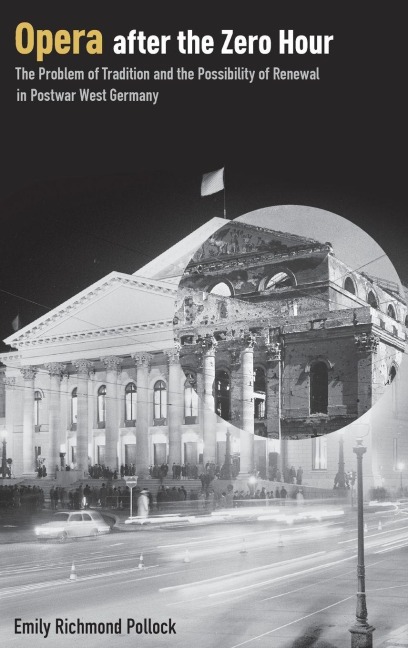
Opera After the Zero Hour: The Problem of Tradition and the Possibility of Renewal in Postwar West Germany presents opera as a site for the renegotiation of tradition in a politically fraught era of rebuilding. Though the "Zero Hour" put a rhetorical caesura between National Socialism and postwar West Germany, the postwar era was characterized by significant cultural continuity with the past. With nearly all of the major opera houses destroyed and a complex relationship to the competing ethics of modernism and restoration, opera was a richly contested art form, and the genre's reputed conservatism was remarkably multi-faceted. Author Emily Richmond Pollock explores how composers developed different strategies to make new opera "new" while still deferring to historical conventions, all of which carried cultural resonances of their own. Diverse approaches to operatic tradition are exemplified through five case studies in works by Boris Blacher, Hans Werner Henze, Carl Orff, Bernd Alois Zimmermann, and Werner Egk. Each opera alludes to a distinct cultural or musical past, from Greek tragedy to Dada, bel canto to Berg. Pollock's discussions of these pieces draw on source studies, close readings, unpublished correspondence, institutional history, and critical commentary to illuminate the politicized artistic environment that influenced these operas' creation and reception. The result is new insight into how the particular opposition between a conservative genre and the idea of the "Zero Hour" motivated the development of opera's social, aesthetic, and political value after World War II.
Emily Richmond Pollock is a member of the faculty in the Music and Theater Arts Section of the Massachusetts Institute of Technology. She earned her PhD in music history and literature from the University of California, Berkeley in 2012. Her articles and reviews have appeared in the Journal of Musicology, Journal of the American Musicological Society, Opera Quarterly, and Notes. Her research has been supported by the German Academic Exchange Service (DAAD), the Paul Sacher Stiftung, and the Class of 1947 at MIT.
- Introduction - Chapter One: Placement and Displacement - Rank and File: Opera's Everyday Biographies - The Situation of New Opera in the Post-War Repertoire - Chapter Two: The Significance of Nonsense: Boris Blacher's Abstrakte Oper Nr. 1 - Why Abstract an Opera? - Linguistic Abstraction in the Libretto - Making Music from Nonsense - Hearing Controversy and Politics in Abstraction - Chapter Three: Italy, Atonally: Hans Werner Henze's König Hirsch - The Bondage of bel canto - The Magic of König Hirsch - From Sketches to Songs - Melody, the "Renegade's Hara-kiri" - Chapter Four: The Opera Underneath: Carl Orff's Oedipus der Tyrann - Origin Stories I: Ancient Greece in Germany - Origin Stories II: Ancient Greece against the Opera - An Opera without Music? - Traces of the Opera Underneath - Chapter Five: Explosive Pluralisms: Bernd Alois Zimmermann's Die Soldaten - Wagner and Berg: Zimmermann's Operatic Pasts - A Spaceship of the Mind: Zimmermann's Operatic Futures - From Lenz to Literaturoper - The Structure of Pluralism - Serialism and Expression(ism) - In the End - Chapter Six: Rebuilding and Retrenchment: The Munich Nationaltheater and Werner Egk's Die Verlobung in San Domingo - Ideas of Reconstruction - The Reconstruction of the Munich Nationaltheater - November 1963: The Gala Reopening - Who Was Werner Egk? - Operaticism and Racial Stereotypes in Die Verlobung in San Domingo - Epilogue - Bibliography